
How Industrial IoT Connects Machine Signals to Manufacturing Workflows
How Industrial IoT Connects Machine Signals to Manufacturing Workflows. Use a worked manufacturing test, exception checks and direct Optiwise workflow evidence before rollout.
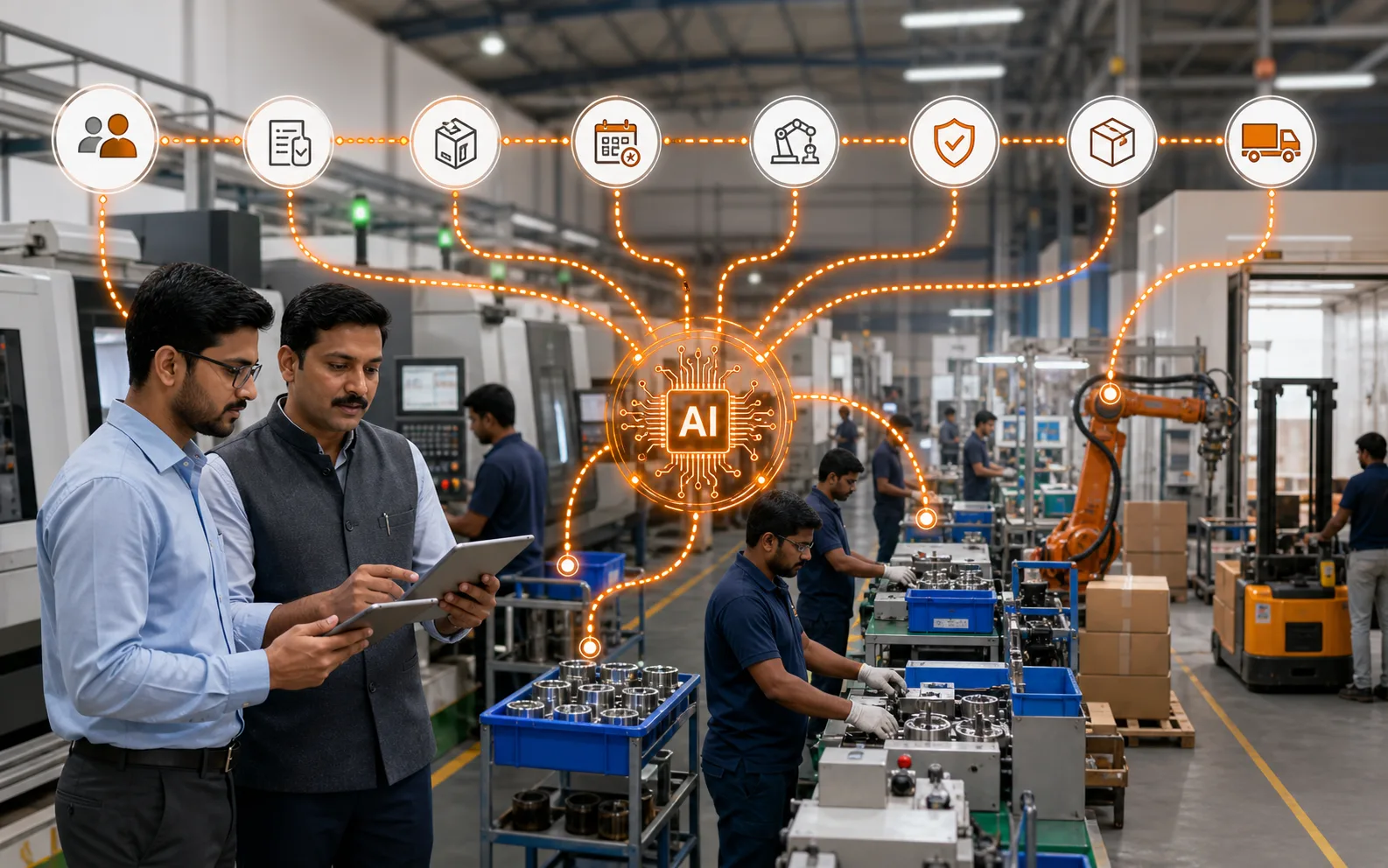
How Industrial IoT Connects Machine Signals to Manufacturing Workflows helps you attach machine data to the job, shift and decision it should change. Start with one order, one item and one exception. A screen tour cannot prove that records stay connected when the work changes.
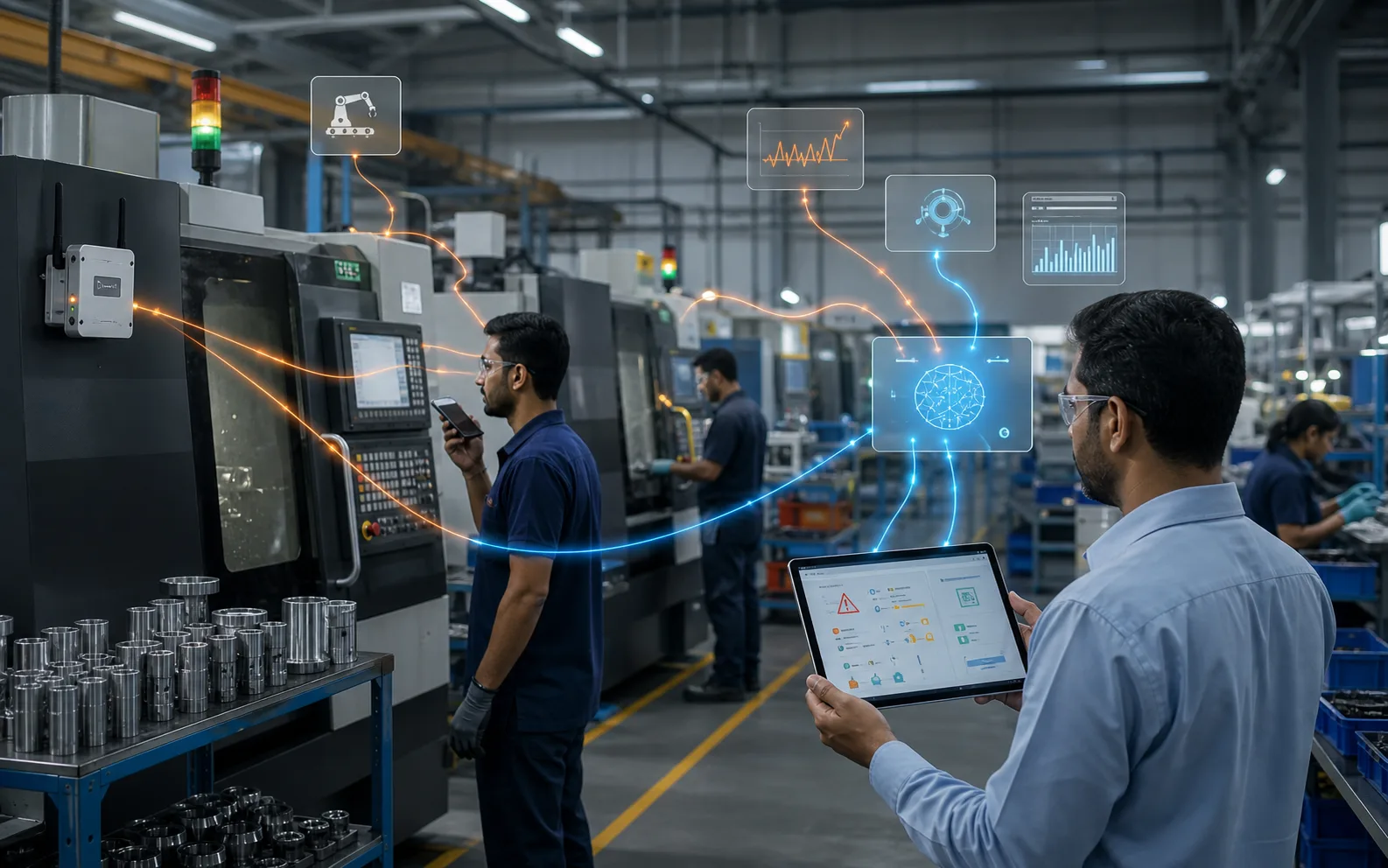
A runtime signal becomes useful when it is tied to Machine 12, Work Order 481, the current operation and shift. A stop event can then open the approved reason flow and update the order risk view.
Start with the decision the system must support
Map each signal to a machine and context before setting a threshold or alert.
OptiEdge supports Modbus and OPC-UA collection, local buffering and resynchronization. Optiwise adds runtime, downtime, cycle, load, energy, OEE and multi-plant views with machine context.
Use ISA-95 enterprise and control-system model as an external reference for the relevant data or process model. It does not prove an Optiwise feature or a business result; the product statements above come from our current feature record.
| # | Input to prepare | Evidence to retain |
|---|---|---|
| 1 | Device and machine mapping | Owner and last update |
| 2 | Signal definition and sampling rate | Definition and source |
| 3 | Job, operation and shift context | Acceptance rule |
| 4 | Threshold, recipient and response | Exception owner |
Run one controlled workflow before expanding scope
- 1. Device and machine mapping. Confirm who maintains it and which record is authoritative.
- 2. Signal definition and sampling rate. Use the current value in the chosen test order.
- 3. Job, operation and shift context. Record the pass condition before the demo begins.
- 4. Threshold, recipient and response. Assign the person who resolves a mismatch.
Keep the first test small enough to reconcile by hand. When the system result differs from the source documents, stop and identify whether the problem is master data, timing, transaction ownership or configuration.
Test exceptions alongside the normal flow
- Gateway loses connectivity
- Job changes without remapping
- Short stop should not trigger escalation
For each exception, record the expected status, permitted action, approver and audit trail. A useful manufacturing system should make the exception visible without allowing an unapproved shortcut to rewrite history.
Verify the connected Optiwise workflow
Review workflow details, product capability, supporting guide, implementation context, connected process, book a demo. In the demo, ask us to execute the scenario with your roles and sample records. Confirm the source transaction, resulting status, notification or action, correction method and report before accepting the workflow.
Questions to ask before rollout
What should we test first?
Choose one current order with a known complication. Prepare the four inputs above, run the transaction sequence and reconcile the result with the source documents.
What result should we accept?
Accept the workflow only when the normal path and named exceptions leave a complete, role-appropriate record. Keep feature validation separate from a promised business outcome.
A manufacturing process rarely fails in one dramatic moment. More often, it slows down through small gaps between departments.
A machine is ready, but material has not arrived. Material is available, but the operator is waiting for job instructions. Production is complete, but quality has not updated the status. Dispatch promises a delivery date, but nobody has seen the latest machine stoppage. Maintenance knows a problem is recurring, but production planning still assumes full capacity.
These are not only people problems. They are connection problems.
An IoT platform helps by linking events from machines, operators, inventory, quality, maintenance, and planning into one shared operating picture. Instead of each department working with delayed or partial information, the factory begins to work from the same version of reality.
For manufacturers exploring AICAN Optiwise, this connected view is often where IoT starts to feel less like a technology layer and more like a practical control system for daily operations.
The machine becomes a source of live production truth
The first connection usually starts at the machine.
Machines create signals all day: running, idle, stopped, cycle completed, job changed, energy consumed, alarm triggered, output counted, speed reduced, temperature rising, vibration changing. Without IoT, many of these signals remain trapped inside the machine or are captured manually after the fact.
Once machines are connected, those signals can flow into a platform where production teams can see what is happening in real time or near real time.
This changes the quality of decision-making. A supervisor no longer has to wait for the end of the shift to discover that output is low. A maintenance team does not need to rely only on complaints to identify repeated stoppages. Management does not have to ask five people for five different versions of the same production status.
Machine connectivity is not the whole system, but it is the anchor. It gives the factory a live pulse.
Production planning becomes more realistic
Planning often fails when it is based on assumed capacity instead of actual performance.
A planner may schedule work based on the idea that a machine can produce a certain number of parts per hour. But if the machine regularly loses time due to minor stoppages, tool changes, operator waiting, or material delays, the plan becomes unrealistic before the shift even starts.
IoT connects planning with actual shop-floor behavior. It can show whether a job is progressing as expected, whether a machine is available, whether a line is falling behind, and whether a promised delivery date is at risk.
This does not remove the planner's judgment. It improves it.
Instead of planning from static assumptions, the team can plan from actual capacity, recent downtime patterns, current WIP, and live production status. Over time, this helps manufacturers make more reliable commitments to customers.
Inventory stops being a separate conversation
In many factories, production and inventory are connected only through calls, messages, and manual updates. That creates delays.
A production team may not know that a critical material is short until the job reaches the machine. A store team may not know that consumption is higher than expected until stock has already fallen below comfort level. A purchase team may order late because the usage signal reached them too slowly.
IoT and connected manufacturing systems reduce this gap by linking production activity with material movement.
When a job starts, material consumption can be recorded more accurately. When output is completed, finished goods status can be updated sooner. When stock falls below a threshold, the right people can receive alerts. When material is not available, the production plan can reflect the constraint before the shift is wasted.
This is where manufacturers often see a quieter but important benefit: fewer surprises.
Quality becomes part of the flow, not an afterthought
Quality checks are often treated as a separate step after production. That creates a lag between making something and knowing whether it is acceptable.
A connected process can bring quality signals closer to production.
Inspection results, rejection reasons, rework counts, machine conditions, operator notes, and batch details can be linked together. If defects rise after a tool change or during a specific shift, the system can help the team identify the pattern faster.
This matters because quality problems are cheaper to fix when they are caught early. If a defect pattern is discovered after a full batch is complete, the cost is already high. If the same pattern is noticed after the first few signals, the team can intervene before waste grows.
IoT does not replace quality judgment. It gives quality teams better timing and better context.
Maintenance gets context instead of isolated complaints
Maintenance teams often operate under pressure. They hear about problems when production is already affected. The complaint may be vague: “Machine is giving trouble,” “speed is low,” “line is stopping,” or “same issue again.”
IoT gives maintenance teams a richer picture.
They can see when the stoppage happened, how often it repeats, which alarm appeared, whether the machine condition changed before the stoppage, and whether the issue is isolated or part of a pattern.
This helps maintenance move from reactive firefighting to more planned intervention. A machine that shows repeated short stops may need attention before a major breakdown. A motor that draws abnormal power may deserve inspection before it fails. A line that loses time after a specific product changeover may need a process correction rather than a repair.
The best maintenance decisions come from context, not guesswork.
Management sees the whole chain
Owners and senior managers do not need every sensor reading. They need to know whether the business is under control.
Are orders on track? Is production meeting plan? Are machines being used properly? Is inventory supporting demand? Are quality losses rising? Are maintenance issues recurring? Are delivery risks visible early enough?
A connected IoT platform turns scattered department updates into a single operating view. It gives leaders the ability to ask better questions and intervene earlier.
This is especially valuable for growing manufacturers. As the company adds more machines, products, shifts, and customers, informal coordination becomes harder. The owner cannot personally track every detail. The system has to carry more of the operating memory.
Integration does not need to happen all at once
A common fear is that connecting the factory means replacing everything immediately. That is rarely the best approach.
A practical rollout can start with the most important machines or the most painful process gap. For one manufacturer, that may be downtime visibility. For another, it may be production planning. For another, inventory and dispatch coordination may be the starting point.
The key is to build toward integration without overwhelming the team.
Start with the process where visibility will create immediate value. Connect the machines, users, and reports needed for that process. Once people trust the data and use it in daily routines, expand to the next link in the chain.
This phased approach keeps the system practical.
Where AICAN Optiwise fits
AICAN Optiwise is built for manufacturers who need their factory data to connect across operations, not sit in separate islands. The platform focuses on practical visibility across production, inventory, maintenance, and decision-making so teams can understand what is happening and act faster.
The larger idea behind AICAN is not just digitization for its own sake. It is to help factories become easier to manage, easier to measure, and easier to improve. You can learn more about the company through About AICAN.
Founder’s Note
A factory is already connected physically. Material moves, machines run, people coordinate, orders travel from one desk to another. The problem is that the information often does not move with the same discipline. IoT is useful when it respects this reality. It should not create a separate digital world. It should make the actual factory easier to see.
FAQs
Does IoT connect only machines?
No. Machine connectivity is often the starting point, but the real value comes when machine data connects with production planning, inventory, quality, maintenance, and management reporting.
Do I need to replace my ERP to use IoT?
Not always. Many manufacturers can begin by connecting critical machines and operational workflows first. The need for ERP integration depends on the existing systems, data quality, and business goals.
Can older machines be connected?
In many cases, yes. Older machines may need sensors, controllers, gateways, or custom integration methods. The feasibility depends on the machine type and the data required.
What is the biggest benefit of connecting the process?
The biggest benefit is earlier visibility. Teams can see delays, shortages, downtime, and quality issues sooner, which gives them more time to correct course.
Should we connect the whole factory at once?
Usually no. A phased approach is safer. Start with the highest-value process gap, prove the value, then expand.

Related Posts
Is AI Worth the Investment for My Factory?
Learn how to decide if AI is worth the investment for your factory by evaluating use cases, data readiness, costs, risks, ROI, and operational impact.
13 Jun 2026Read more →Manufacturing AI Mistakes to Avoid Before You Start
List manufacturing AI mistakes and controls for unclear use case, messy data, unsafe automation, no owner, weak security and unreviewed recommendations.
13 Jun 2026Read more →What's the Difference Between AI and Regular Automation?
Understand the difference between AI and regular automation in manufacturing, with practical examples for workflows, decisions, alerts, and predictive operations.
13 Jun 2026Read more →What Are the Risks of Using AI in Manufacturing?
Understand the risks of AI in manufacturing, including bad data, wrong recommendations, safety issues, security, job fear, over-automation, and implementation failure.
13 Jun 2026Read more →