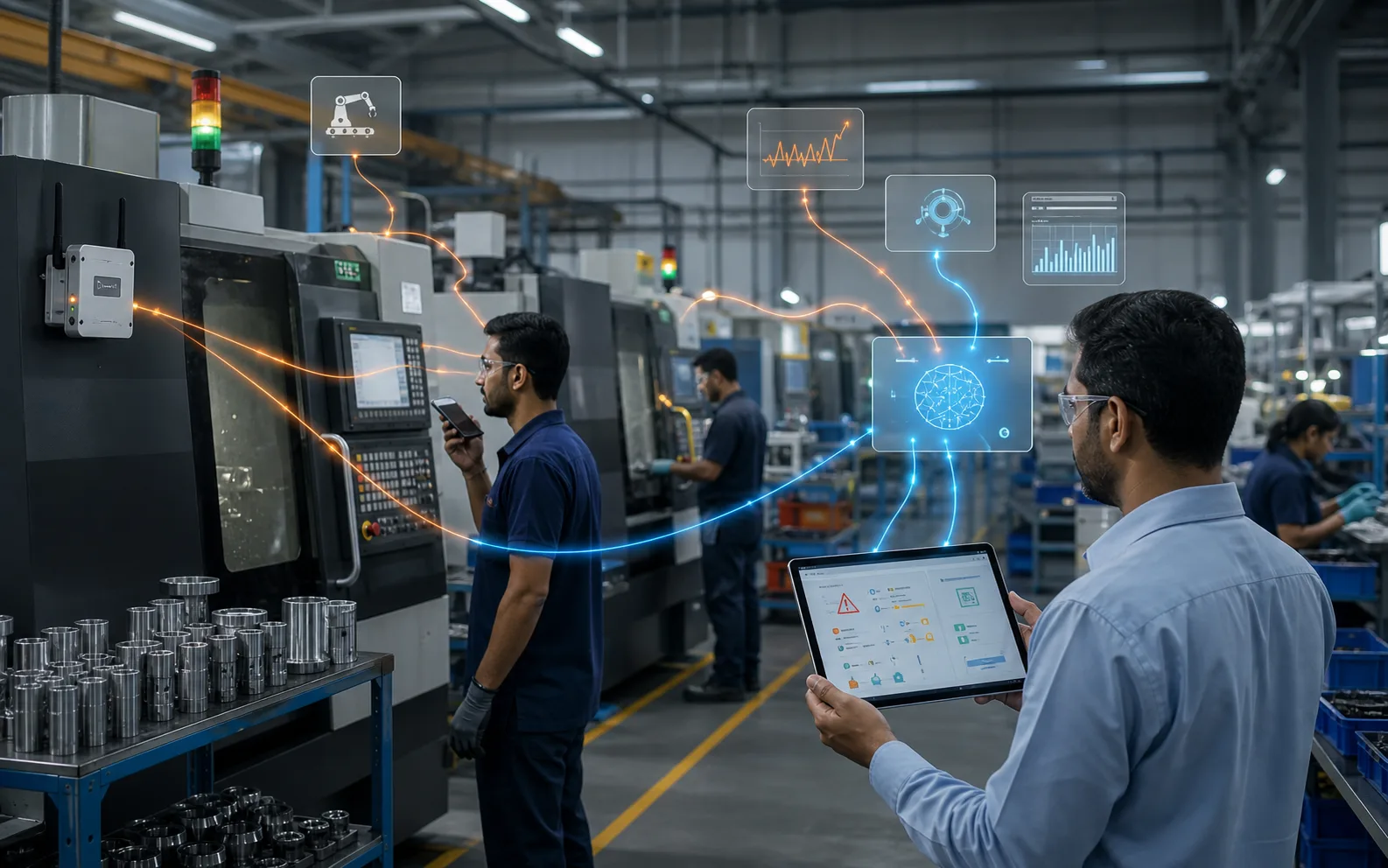
How Does IoT Connect to My Existing Machines?
Learn how IoT connects to existing manufacturing machines through PLCs, controllers, gateways, sensors, meters, operator inputs, and secure integration workflows.
How Does IoT Connect to My Existing Machines?
Most manufacturers do not begin an IoT project with a brand-new factory. They begin with the machines they already have.
Some machines may have modern PLCs. Some may have old control panels. Some may run well mechanically but offer almost no digital output. Some may be imported, custom-built, modified over the years, or maintained by a vendor who is no longer easily available. This is why the first practical question is not, “Can my factory use IoT?” The better question is, “What is the smartest way to connect IoT to the machines I already depend on every day?”
The good news is that IoT for manufacturing does not always require replacing machines. In many factories, existing equipment can be connected through a combination of controller integration, signal capture, external sensors, meters, gateways, barcode inputs, operator screens, and production software. The exact method depends on the machine, the process, the data required, and how much disruption the plant can tolerate.
A well-designed IoT implementation respects the factory as it exists today. It does not assume that every machine is new, perfectly documented, or ready for direct digital communication. It starts with observation, then connects the right data points in the least disruptive way.
Start With the Business Question, Not the Device
A common mistake is to begin an IoT project by asking, “Which sensor should we install?” That sounds logical, but it can quickly lead to unnecessary hardware and confusing dashboards.
A better starting point is the operational question the factory wants to answer. For example:
- Which machines are running, idle, stopped, or under maintenance?
- How much production did each machine complete during the shift?
- Why did production stop?
- Is cycle time increasing over the day?
- Which machine consumes more power than expected?
- Where are quality rejections happening?
- Are operators waiting for material, tools, approvals, or maintenance?
- Is the plan realistic compared with actual machine availability?
Once the question is clear, the IoT connection method becomes much easier to decide. A factory trying to measure machine running status may only need signal capture or sensor-based monitoring. A factory trying to calculate OEE may need machine status, production count, shift plan, downtime reason, and operator input. A factory trying to control energy cost may need energy meters and utility monitoring more than machine PLC data.
IoT succeeds when it collects useful operational truth, not when it collects the largest possible amount of data.
Method 1: Connecting Through PLCs and Machine Controllers
Many industrial machines already have a PLC, controller, CNC control unit, drive, HMI, or embedded control system. If that controller exposes data through a supported protocol, IoT can often connect directly to it.
This is usually the cleanest method because the controller may already know important machine states such as running, stopped, alarm, cycle complete, part count, speed, temperature, pressure, and program status. Instead of adding external sensors for everything, the IoT system reads selected values from the existing controller.
Common integration routes can include industrial communication protocols, vendor APIs, OPC-based connectivity, serial communication, Ethernet-based communication, or data pulled through an existing SCADA or HMI layer. The practical route depends heavily on the make and model of the machine, controller access, network availability, vendor permissions, and documentation quality.
Direct PLC or controller integration is powerful, but it should be handled carefully. Reading data is usually safer than writing commands. Many manufacturers start with read-only monitoring so the IoT layer does not interfere with machine control. This keeps the implementation focused on visibility while protecting production stability.
A good implementation team will ask questions such as:
- Which controller is installed on the machine?
- What communication options are available?
- Is machine documentation available?
- Are there spare communication ports?
- Can data be read without interrupting production?
- Which tags or registers actually matter?
- Is vendor approval required?
- Should the connection be isolated from the control network?
Direct integration can give high-quality machine data, but it should be planned with respect for machine safety, production continuity, and long-term maintainability.
Method 2: Capturing Machine Signals
Some machines may not allow full PLC integration, but they may still provide useful electrical signals. For example, a machine may have signals for run, stop, alarm, cycle complete, door open, emergency stop, or motor on.
These signals can be captured through an interface module or IoT input device. The IoT system then converts these signals into operational states. For example, if the run signal is high, the machine may be treated as running. If the alarm signal is active, the system may mark it as stopped due to fault. If the cycle complete pulse is detected, the system can count output.
This approach is common in mixed factories because it can work even when full controller access is difficult. It is also useful when the factory only needs a limited set of reliable data points.
However, signal capture must be mapped carefully. A signal does not always mean what people assume it means. A motor-on signal may not mean the machine is producing good parts. A cycle pulse may count attempted cycles, not accepted output. An alarm signal may show that something went wrong but not explain the reason.
That is why signal capture is often paired with operator input. The machine can tell the system that it stopped. The operator or supervisor can tell the system why it stopped.
Method 3: Adding External Sensors to Older Machines
Older machines may not have useful communication options. That does not make them impossible to connect. External sensors can often capture the behaviour of the machine without changing the machine control system.
Depending on the process, these sensors may detect vibration, current, proximity, temperature, pressure, flow, rotation, part movement, door activity, compressed air usage, or machine availability. For example, a current sensor may show whether a motor is drawing power. A proximity sensor may count parts passing a point. A vibration sensor may identify whether a machine is active or idle. A temperature sensor may monitor a critical zone in a heat-based process.
This method is especially useful for legacy equipment because it can be less invasive. The machine can continue operating as it always has, while the IoT layer observes selected signals around it.
But external sensors should be chosen with discipline. Installing sensors everywhere may create maintenance burden and data confusion. The goal should be to capture the smallest reliable set of signals that answers the operational question.
Before adding sensors, the factory should validate:
- What exact event the sensor is expected to detect
- Whether the signal is stable during real production conditions
- Whether dust, heat, vibration, oil, or operator movement will affect readings
- How the sensor will be mounted safely
- Who will maintain or replace it
- Whether false readings can create wrong decisions
External sensors are useful, but they are not magic. They need practical engineering and shop-floor validation.
Method 4: Connecting Energy Meters and Utility Devices
For many manufacturers, IoT is not only about production count. Energy, compressed air, water, steam, gas, and other utilities can have a major impact on cost and efficiency.
Energy meters and utility monitoring devices can be connected to an IoT system to track consumption by machine, line, department, shift, or process. This can help manufacturers identify idle energy use, abnormal consumption, peak load patterns, inefficient machines, leakage, and cost per production unit.
This is especially valuable when energy bills are rising but the factory cannot clearly explain where the consumption is happening. Instead of looking only at total monthly electricity cost, management can see energy behaviour closer to the production floor.
For example:
- A machine may consume significant power even when production is stopped.
- Compressed air may continue leaking after shifts.
- A particular line may use more energy per unit than expected.
- Peak demand may be driven by machine start-up patterns.
- Maintenance issues may show up as unusual power consumption.
Energy integration becomes more useful when connected with production data. Power consumption alone tells one story. Power consumption per good unit tells a much sharper story.
Method 5: Using Operator Inputs for Context
Machines can generate signals, but they do not always explain the full situation.
A machine may be stopped because of a tool issue, material shortage, quality hold, setup change, operator absence, maintenance delay, inspection wait, or planned break. From the machine’s point of view, many of these conditions may simply look like “not running.”
This is where operator input becomes important. Operators, supervisors, or line leaders can use tablets, kiosks, barcode scanners, or workstation screens to add context. They can select downtime reasons, confirm production quantities, scan work orders, record rejection reasons, mark setup time, or update job status.
Some factories worry that operator input will slow down production. That can happen if the system is badly designed. But when the input is simple, role-based, and limited to meaningful choices, it can improve trust in the data.
The goal is not to make operators do office work. The goal is to capture the missing context that machines cannot provide.
Good operator input design should be:
- Fast enough to use during real shifts
- Available in the right language if needed
- Limited to relevant reason codes
- Easy to use with gloves or shop-floor conditions
- Connected to actual work orders and machines
- Reviewed regularly so reason codes stay useful
Without human context, IoT data can become technically accurate but operationally incomplete.
What Does an IoT Gateway Do?
An IoT gateway sits between the machine layer and the software layer. It collects data from PLCs, sensors, meters, or devices, then sends selected data to the central platform.
In a manufacturing environment, the gateway may perform several useful functions:
- Collect data from machines using industrial protocols
- Convert raw signals into usable events
- Buffer data if internet connectivity is temporarily unavailable
- Filter unnecessary noise
- Send data securely to the software platform
- Keep machine networks separated from business networks
- Support local processing at the edge
Gateways are important because factories are not always perfect networking environments. Internet may be inconsistent. Machine networks may be old. Some areas may have electrical noise. Some machines may be sensitive. A gateway helps make the connection more stable and manageable.
For critical production environments, the architecture should be designed so temporary connectivity issues do not break factory operations. IoT visibility should support production, not create a new dependency that stops production.
How Existing ERP or Production Software Fits In
IoT data becomes more valuable when it connects with planning, inventory, maintenance, quality, and dispatch information.
For example, machine data can show that a press completed 1,000 strokes. But if that data is linked to the production order, item code, shift, operator, batch, and rejection entry, it becomes much more meaningful. Management can see whether the planned job is actually progressing, whether material is being consumed correctly, whether downtime is affecting delivery, and whether output matches dispatch commitments.
This is where a connected platform like AICAN Optiwise can help manufacturers move from isolated machine signals to usable operational visibility. IoT data should not live in a separate technical dashboard that only one engineer checks. It should connect to production, inventory, purchase, quality, maintenance, and management workflows.
When machine visibility is connected with business processes, the factory can answer practical questions:
- Are we behind today’s plan?
- Which job is causing the delay?
- Is the delay due to machine downtime, material shortage, or quality hold?
- Is the inventory record matching actual shop-floor usage?
- Should maintenance act now or can it wait until the planned window?
- What should the supervisor prioritize in the next two hours?
IoT should not become a separate island. It should become part of the factory’s daily decision-making system.
What Data Should You Capture First?
The best first IoT data points are usually the ones that create immediate clarity without making the project too complex.
For many manufacturers, a practical first phase may include:
- Machine running, idle, and stopped status
- Production count or cycle count
- Downtime duration
- Downtime reason
- Shift-wise production summary
- Work order or job reference
- Rejection quantity and reason
- Energy consumption for critical machines
- Alerts for long stoppages or abnormal conditions
This first layer can already improve visibility significantly. Once the factory trusts the data, it can add deeper monitoring such as condition monitoring, predictive maintenance signals, advanced energy analytics, process parameters, and quality correlations.
A phased approach usually works better than trying to connect everything at once. It gives operators time to adapt, supervisors time to trust the dashboard, and management time to act on the insights.
Why a Site Survey Matters
A site survey is one of the most important steps in connecting IoT to existing machines. It prevents assumptions from becoming expensive mistakes.
During a site survey, the implementation team should review machine types, controller models, signal availability, electrical panels, networking conditions, operator workflows, reporting needs, safety constraints, and existing software systems. They should also speak with people who run the machines daily because operators and maintenance teams often know details that are missing from documentation.
A good site survey should identify:
- Which machines are suitable for direct integration
- Which machines need signal capture or external sensors
- Which machines should be excluded from the first phase
- Where gateways and network equipment can be placed
- What data points are available versus what data points are desired
- What downtime reasons and production categories make sense
- What training operators will need
- What reports management expects after go-live
Skipping the survey can lead to poor sensor placement, wrong assumptions about machine signals, unrealistic timelines, and dashboards that do not match reality.
What Can Go Wrong in Legacy Machine Integration?
Legacy integration can work very well, but it needs care. The most common problems are not always technical; many are operational.
One problem is capturing data without defining decisions. If the factory collects machine status but no one acts on stoppage alerts, the dashboard becomes decoration. Another problem is counting output without tying it to the right job. This creates numbers that look impressive but are hard to use for planning.
Factories may also face issues such as noisy signals, inconsistent reason-code entry, missing machine documentation, poor network planning, unclear ownership, and resistance from operators who feel the system is being used only to monitor them.
The solution is to connect technology with process design. Decide what will be measured, who will review it, how often it will be reviewed, and what action should happen when the data shows a problem.
IoT should make the factory calmer and clearer, not more complicated.
Where AICAN Optiwise Fits
AICAN Optiwise is built for manufacturers who want better control over production, inventory, procurement, finance, reporting, and shop-floor visibility without losing sight of how factories actually work.
For IoT and legacy machine integration, Optiwise can help by connecting machine-level visibility with broader operational workflows. Instead of treating IoT as a separate technical experiment, manufacturers can use Optiwise to bring machine data closer to production planning, material movement, downtime tracking, quality records, maintenance priorities, and management reporting.
The larger value is not just seeing whether a machine is running. The value is understanding what that machine status means for today’s order, tomorrow’s dispatch, inventory availability, supervisor action, and business performance.
AICAN focuses on practical digital transformation for manufacturing businesses. That means the solution should respect the factory’s current machines, current team, current constraints, and growth plans. You can also learn more about the team and approach on the About AICAN page.
FAQ
Can IoT connect to old machines?
Yes, many old machines can be connected, but the method depends on what data is available. Some machines can be connected through controllers or signals, while others may need external sensors, meters, or operator input. A site survey is important before deciding the approach.
Do I need to replace my existing machines for IoT?
Usually, no. IoT often works by reading data from existing PLCs, capturing electrical signals, adding external sensors, or using gateways. Replacement is only considered when the machine cannot safely or practically provide the required data and the business case supports it.
Is PLC integration better than external sensors?
PLC integration can provide cleaner and richer data when it is available and safe to access. External sensors are useful when PLC access is limited or the machine is old. The best method depends on the machine, data requirement, budget, and risk level.
Will IoT interfere with production?
A properly planned IoT implementation should be designed to avoid production disruption. Many projects begin with read-only monitoring and non-invasive sensors. Any work inside panels or control systems should be planned with qualified electrical and automation professionals.
What is the first data point a factory should capture?
For many factories, the best starting point is machine status, production count, downtime duration, and downtime reason. These data points quickly improve visibility and help supervisors identify where production time is being lost.
Can IoT connect with ERP software?
Yes. IoT becomes more useful when connected with ERP or production software because machine data can be linked to work orders, inventory, quality, maintenance, and dispatch planning. This is where platforms like AICAN Optiwise can create stronger business value.
Founder’s Note
Many factories already have enough machines. What they often do not have is enough visibility.
When we speak with manufacturers, the concern is rarely only about technology. The real concern is practical: “Will this work with my existing machines? Will my team use it? Will it disturb production? Will the data help me make better decisions?” These are the right questions.
Our belief at AICAN is that digital transformation should begin with respect for the factory that already exists. The machines, people, habits, constraints, and informal knowledge inside a plant are all part of the system. IoT should strengthen that system, not ignore it.
A good IoT project does not start by forcing every machine into the same template. It starts by understanding what is already there, identifying the data that matters, and building a practical path from machine signals to business decisions.
Final Thought
IoT can connect to existing machines in many ways: PLC integration, signal capture, sensors, meters, gateways, and operator inputs. The right method depends on the machine and the business question.
The goal is not to make the factory look more digital. The goal is to make production clearer, downtime more visible, energy use more understandable, and decisions faster. When IoT is connected with a practical manufacturing platform like AICAN Optiwise, it can turn existing machines into a stronger source of operational intelligence.
Related Posts
Is AI Worth the Investment for My Factory?
Learn how to decide if AI is worth the investment for your factory by evaluating use cases, data readiness, costs, risks, ROI, and operational impact.
Manufacturing AI Mistakes to Avoid
Avoid common manufacturing AI mistakes such as unclear use cases, poor data, weak security, no human review, over-automation, and poor adoption planning.
What's the Difference Between AI and Regular Automation?
Understand the difference between AI and regular automation in manufacturing, with practical examples for workflows, decisions, alerts, and predictive operations.
What Are the Risks of Using AI in Manufacturing?
Understand the risks of AI in manufacturing, including bad data, wrong recommendations, safety issues, security, job fear, over-automation, and implementation failure.