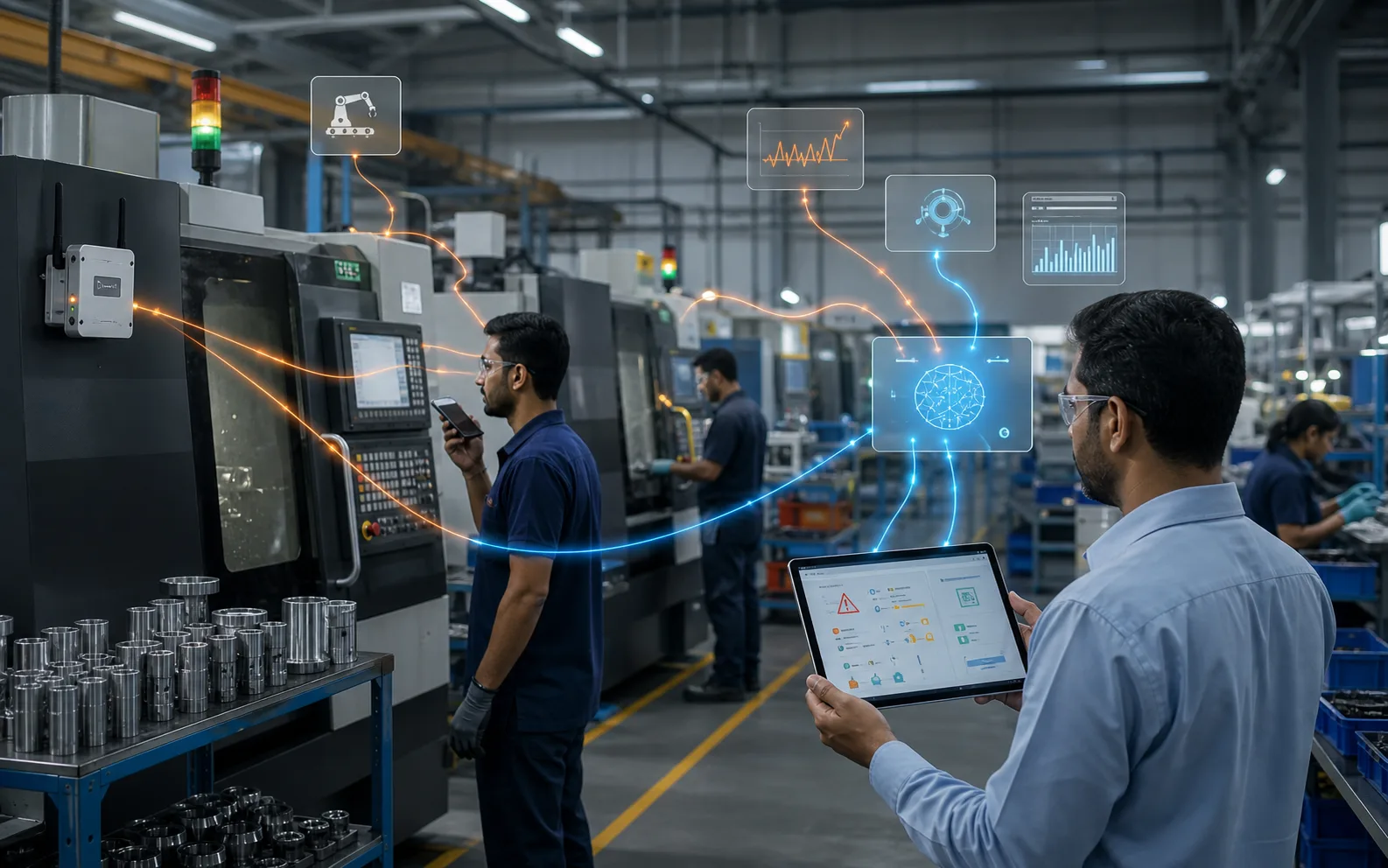
How Can IoT Data Improve My Production Planning?
Learn how IoT data improves production planning through real-time machine status, capacity visibility, plan-versus-actual tracking, downtime data, inventory connection, and better scheduling.
How Can IoT Data Improve My Production Planning?
IoT data improves production planning by replacing assumptions with actual shop-floor visibility.
Production planning often looks clean on paper. The schedule says which job should run, which machine should be used, how much output should be completed, and when dispatch should happen. But the factory floor may tell a different story: a machine is down, material is late, changeover took longer, rejection increased, operators are waiting, or the bottleneck line is overloaded.
IoT helps close the gap between plan and reality.
When production planners can see machine status, downtime, output, capacity, inventory movement, and shift progress more accurately, they can create plans that are realistic and adjust them faster when conditions change.
Planning Fails When Actual Data Is Late
Many planning problems come from delayed information.
If planners only see production results after the shift ends, they cannot respond during the shift. If machine downtime is recorded manually the next morning, the next day’s plan may already be wrong. If inventory consumption is updated late, jobs may be scheduled without material. If maintenance issues are not visible, urgent orders may be assigned to unreliable machines.
IoT reduces this delay by capturing data closer to the event.
This helps planners know:
- Which machines are available
- Which jobs are running
- Which orders are behind
- Which lines have capacity
- Which machines have recurring downtime
- Which material shortages are blocking production
- Which quality issues may delay dispatch
Better planning starts with better visibility.
Machine Availability Improves Scheduling
A production plan is only realistic if machine availability is understood.
IoT can show whether machines are running, idle, stopped, under maintenance, or experiencing repeated stoppages. This helps planners avoid scheduling critical jobs on machines that are not actually available.
Machine availability data can support:
- Daily scheduling
- Shift planning
- Bottleneck planning
- Alternate machine allocation
- Maintenance coordination
- Urgent order feasibility
- Capacity commitments
For example, if a machine has repeated breakdowns during the week, planners can avoid assigning a critical customer order to it without contingency.
Plan-Versus-Actual Tracking
IoT enables plan-versus-actual tracking during the shift, not only after the day ends.
This helps teams see whether production is on schedule. If output is falling behind, supervisors and planners can respond earlier.
Plan-versus-actual analytics may include:
- Planned quantity versus actual quantity
- Work order progress
- Machine-wise output
- Shift-wise achievement
- Delayed jobs
- Production rate versus expected rate
- Completion estimate
- Dispatch risk
This changes planning from static scheduling to active control.
Downtime Data Helps Improve Future Plans
Planning often assumes ideal machine availability. Reality includes downtime.
IoT downtime data helps planners understand true capacity. If a machine is available for eight hours but regularly loses two hours to setup, material wait, or breakdown, the schedule should reflect that.
Useful planning insights include:
- Average downtime by machine
- Setup time by product
- Changeover loss by line
- Repeated material wait
- Maintenance-related capacity loss
- Shift-wise stoppage patterns
- Micro-stoppage frequency
When downtime is measured honestly, plans become more realistic.
Inventory Connection Prevents Schedule Breaks
Production planning and inventory must work together.
A plan is useless if material is not available. IoT and connected manufacturing systems can link production activity with inventory movement, material issue, consumption, return, rejection, and WIP status.
This helps planners answer:
- Is material available for the scheduled job?
- Is material already reserved for another order?
- Has previous production consumed more than expected?
- Is WIP available for the next process?
- Is scrap affecting material availability?
- Which purchase item could delay the plan?
A platform like AICAN Optiwise helps because production planning needs visibility across production, inventory, purchase, and reporting.
Better Capacity Planning
IoT data helps planners understand actual capacity instead of theoretical capacity.
Theoretical capacity assumes machines run as planned. Actual capacity considers downtime, changeover, speed loss, quality loss, maintenance, operator availability, and material constraints.
With IoT data, planners can calculate more realistic capacity based on:
- Machine utilization
- Actual cycle time
- Downtime history
- Setup time
- Rejection rate
- Shift performance
- Maintenance availability
- Bottleneck constraints
This improves commitments to customers and reduces unrealistic schedules.
Faster Replanning When Things Change
Factories rarely run exactly as planned.
Material may arrive late. A machine may stop. A customer may request an urgent order. Quality may hold a batch. Maintenance may need unexpected downtime.
IoT helps replanning because the current factory state is visible. Planners can see what is running, what is blocked, and what capacity is available.
This supports faster decisions:
- Move job to alternate machine
- Change sequence
- Shift manpower
- Split production across lines
- Delay lower-priority work
- Escalate material shortages
- Update customer commitment
Replanning becomes less dependent on guesswork.
Forecasting Becomes More Realistic
Forecasting is stronger when it uses actual production behaviour.
IoT data can show real cycle times, true downtime patterns, quality losses, and output trends. Over time, this helps improve planning assumptions.
For example, if one product always takes longer than standard time, the planning master data should be updated. If a machine consistently underperforms during certain shifts, capacity assumptions should be reviewed. If material-related stoppages repeat, purchase planning needs correction.
Better history creates better forecasts.
Where AICAN Optiwise Fits
AICAN Optiwise connects production, inventory, purchase, finance, reporting, and operational visibility. This makes production planning more practical because planners can work with connected information instead of separate spreadsheets and delayed updates.
Optiwise helps manufacturers connect machine visibility, work orders, material availability, downtime, quality, and management reporting into a clearer planning system.
AICAN focuses on practical manufacturing digitization for better control and decision-making. You can learn more on the About AICAN page.
FAQ
Can IoT automatically create production plans?
IoT can provide data that supports planning, but human planners still need to decide priorities, constraints, and customer commitments. Automation can assist, but planning judgement remains important.
What IoT data is most useful for planning?
Machine availability, downtime reasons, production count, cycle time, work order progress, material availability, quality status, and capacity utilization are especially useful.
How does IoT improve plan-versus-actual tracking?
IoT captures production progress during the shift, helping planners and supervisors see whether jobs are on schedule before the day ends.
Can IoT reduce dispatch delays?
It can help by detecting production delays, material shortages, downtime, and quality holds earlier, allowing faster replanning and customer updates.
How does AICAN Optiwise support production planning?
AICAN Optiwise connects production, inventory, purchase, finance, reporting, and operations so planners can work with more accurate and timely information.
Does IoT replace ERP planning?
No. IoT can strengthen ERP or manufacturing planning by feeding real shop-floor data into planning decisions and operational workflows.
Founder’s Note
Planning is where factory ambition meets factory reality.
At AICAN, we believe good planning needs honest data. A plan built on assumptions can look perfect and still fail on the floor. When planners can see machine status, material availability, and production progress clearly, the factory can commit with more confidence.
Better planning starts with better truth.
Final Thought
IoT data improves production planning by making machine availability, downtime, output, inventory, quality, and capacity more visible.
With AICAN Optiwise, that data can connect to the workflows planners use every day, helping manufacturers create realistic schedules, respond faster to disruptions, and improve delivery performance.
Related Posts
Is AI Worth the Investment for My Factory?
Learn how to decide if AI is worth the investment for your factory by evaluating use cases, data readiness, costs, risks, ROI, and operational impact.
Manufacturing AI Mistakes to Avoid
Avoid common manufacturing AI mistakes such as unclear use cases, poor data, weak security, no human review, over-automation, and poor adoption planning.
What's the Difference Between AI and Regular Automation?
Understand the difference between AI and regular automation in manufacturing, with practical examples for workflows, decisions, alerts, and predictive operations.
What Are the Risks of Using AI in Manufacturing?
Understand the risks of AI in manufacturing, including bad data, wrong recommendations, safety issues, security, job fear, over-automation, and implementation failure.