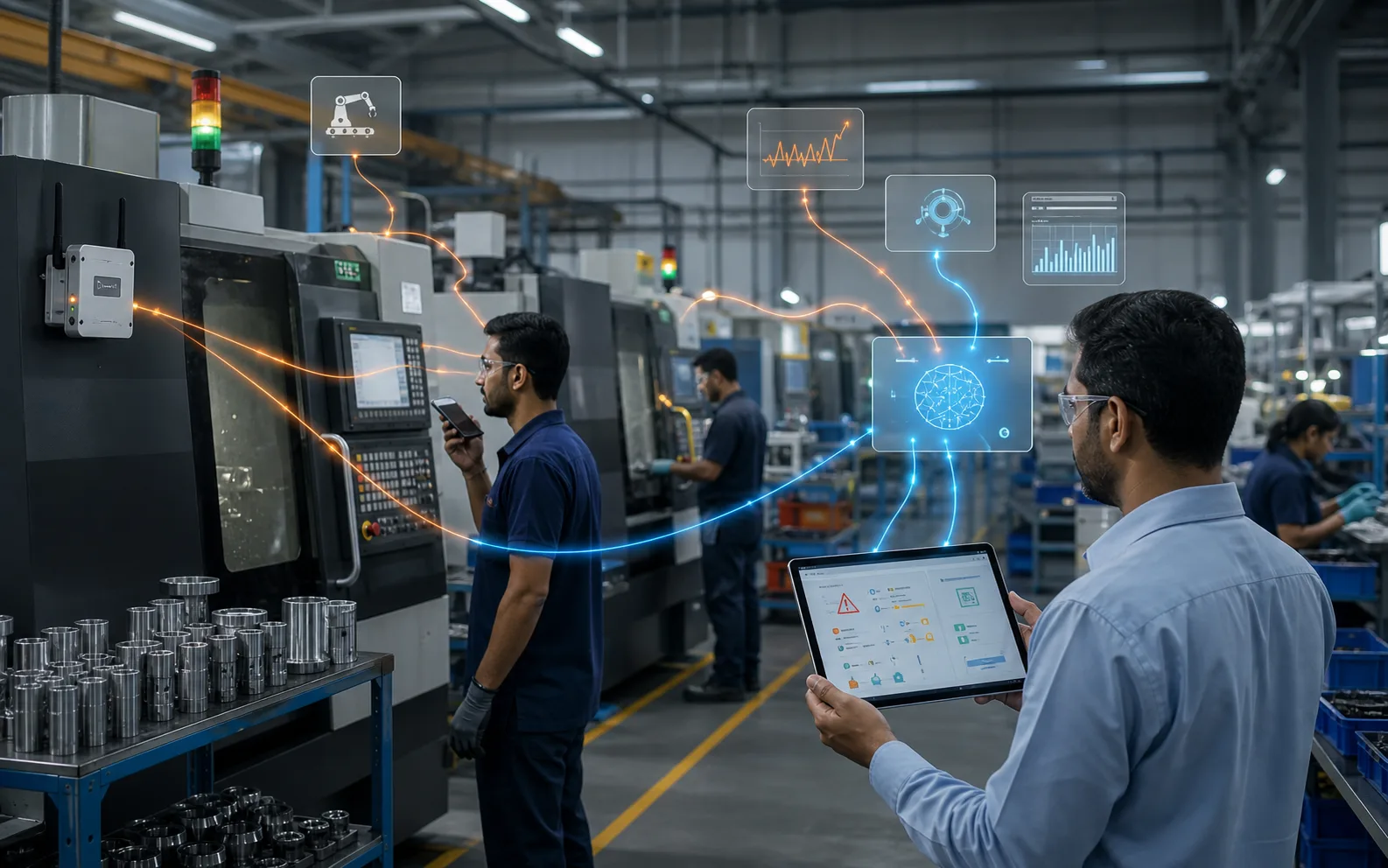
How Does IoT Handle Network Connectivity Issues?
Learn how manufacturing IoT systems handle poor internet, network drops, offline machines, edge gateways, buffering, redundancy, alerts, and reliable factory data flow.
How Does IoT Handle Network Connectivity Issues?
Factories are not perfect network environments.
Internet can drop. Wi-Fi may be weak in some areas. Electrical noise can affect communication. Machines may be located far from office routers. Old buildings may have thick walls, metal structures, heat, dust, and vibration. Some areas may have poor mobile signal. Network cables may be damaged during maintenance or machine movement.
So it is completely reasonable for a manufacturer to ask: if IoT depends on connectivity, what happens when the network is not reliable?
A well-designed manufacturing IoT system should expect connectivity problems. It should not assume the factory always has perfect internet. Instead, it should use practical architecture such as local gateways, edge buffering, offline storage, retry mechanisms, status alerts, network segmentation, and fallback workflows.
The goal is simple: temporary network issues should not destroy data, confuse reports, or stop production.
Factory IoT Should Not Depend Only on Live Internet
A common fear is that if internet goes down, the factory will stop.
That should not be the design.
In most manufacturing IoT setups, the machine should continue running locally even if the internet connection drops. The IoT layer is usually monitoring, collecting, and reporting data. It should support operations, not become a fragile dependency for machine control.
For many factories, the correct first principle is read-only monitoring. The system collects production status, downtime, cycle count, energy readings, or operator inputs, but it does not control critical machine functions remotely. This reduces operational risk.
If internet is temporarily unavailable, the machine continues operating. The IoT system may store data locally and send it later when connectivity returns.
Edge Gateways Help Keep Data Flow Stable
An IoT gateway is one of the most important components for handling connectivity issues.
The gateway sits close to the machines. It collects data from PLCs, sensors, meters, or devices, then sends that data to the software platform. In a reliable design, the gateway can also buffer data locally if it cannot immediately send data to the cloud or central server.
This means the system can continue collecting machine events even during a temporary outage. When the network returns, the gateway can sync the stored data.
A good gateway strategy can help with:
- Temporary internet outages
- Cloud connection delays
- Local network instability
- Device communication retries
- Data filtering before upload
- Time-stamped event storage
- Reduced dependency on constant connectivity
The gateway is not just a cable box. It is the bridge between real factory conditions and usable digital visibility.
Buffering Prevents Data Loss
Buffering means storing data temporarily when the system cannot send it immediately.
For example, if a machine completes cycles during a network outage, the gateway or local system may store those events with timestamps. Once connectivity returns, the events are uploaded and processed.
Without buffering, the dashboard may miss production data or downtime events. This can damage trust because reports will not match reality.
Buffering should be designed with clear rules:
- How much data can be stored locally?
- How long can the system remain offline before data risk increases?
- What happens if local storage fills up?
- Are timestamps preserved correctly?
- Does the dashboard show that data was delayed?
- Are duplicate uploads prevented after reconnection?
For manufacturing decisions, timestamp accuracy matters. If data arrives late but keeps its correct time, reports can still be useful.
Offline Indicators Are Important
A dashboard should not pretend everything is normal when a device is offline.
If a gateway, sensor, meter, or machine connection stops updating, the system should show an offline or stale-data status. Otherwise, users may assume the machine is idle or running when the real issue is connectivity.
Good dashboards distinguish between:
- Machine stopped
- Machine running
- Machine idle
- Device offline
- Gateway disconnected
- Data delayed
- Last updated time
This distinction is critical. A disconnected sensor is not the same as a stopped machine. If the system does not show the difference, supervisors may make wrong decisions.
Alerts Should Cover Connectivity Health
Most people think IoT alerts are only for production problems. But connectivity health also needs alerts.
The system should notify the right person if:
- A gateway goes offline
- A machine stops sending data
- A sensor battery is low
- A network connection is unstable
- Data has not synced for too long
- A device repeatedly disconnects
- Internet outage affects dashboard updates
These alerts should usually go to maintenance, IT, admin, or system owners, not necessarily every manager. Owners and plant heads should receive only important escalation alerts, such as a critical production line losing visibility for a long period.
Connectivity alerts help the team fix the monitoring system before data gaps become serious.
Wired Connections Are Often More Reliable Than Wi-Fi
In factory environments, wired Ethernet is often more stable than Wi-Fi for fixed machines and gateways. Wi-Fi can work, but it may be affected by distance, metal structures, interference, and layout changes.
For critical machines, manufacturers should consider wired connectivity where practical. For mobile devices, tablets, scanners, or temporary stations, Wi-Fi may still be suitable.
The network design should match the use case:
- Fixed critical machines: wired network where possible
- Mobile operator devices: strong Wi-Fi coverage
- Remote areas: industrial access points or alternate connectivity
- Utility meters: wired or protocol-based integration where suitable
- Backup needs: secondary internet or mobile data where justified
The lowest-cost network option is not always the most affordable in the long run. If weak connectivity creates missing data, repeated support calls, and dashboard mistrust, it becomes expensive.
Redundancy Depends on Criticality
Not every factory needs full network redundancy everywhere.
A small manufacturer monitoring a few non-critical machines may only need basic buffering and device alerts. A plant with critical production lines, high-value downtime, or multi-location monitoring may need stronger redundancy.
Redundancy options can include:
- Backup internet connection
- Dual SIM or mobile data fallback
- Redundant gateways for critical areas
- Local server or edge storage
- Separate network paths for key lines
- UPS backup for gateways and network devices
- Automatic reconnection and retry logic
The right level depends on the cost of losing visibility. If one hour of missing data on a bottleneck line creates major planning issues, stronger redundancy may be justified.
Local Dashboards Can Help During Internet Outages
Some factories benefit from local dashboards or local access even when cloud connectivity is down.
For example, a supervisor inside the plant may still need to see machine status on the local network. If the system supports local visibility, shop-floor operations can continue with reduced disruption even during external internet outages.
This is especially useful where internet reliability is poor or where production must continue regardless of cloud availability.
However, local dashboards still need proper access control, maintenance, and sync rules. They should not become a separate source of truth that conflicts with central reports.
Data Sync After Reconnection
Reconnection is not just about sending delayed data. The system must sync cleanly.
A good sync process should handle:
- Correct event order
- Duplicate prevention
- Missing timestamp checks
- Delayed data flags
- Conflict handling between operator input and machine data
- Dashboard refresh after data upload
- Audit trail of offline period
For example, if an operator entered downtime reason during an outage and machine data syncs later, the system should connect those records correctly. If data arrives out of order, reports should still reflect the real sequence of events.
This is where manufacturing software design matters. Data reliability is not only a hardware issue.
What Should Manufacturers Ask Vendors?
Before choosing an IoT system, manufacturers should ask direct questions about connectivity handling.
Useful questions include:
- What happens if internet goes down?
- Does the gateway store data locally?
- How long can data be buffered?
- Does the dashboard show device offline status?
- Are timestamps preserved during outages?
- How are duplicate records prevented?
- Can alerts be sent when devices go offline?
- Is wired connectivity recommended for critical machines?
- Can the system work with backup internet?
- What support is available for network troubleshooting?
A vendor who cannot clearly explain offline behaviour may not be ready for real factory conditions.
Where AICAN Optiwise Fits
AICAN Optiwise is built around practical manufacturing visibility, not ideal-world assumptions. In real factories, connectivity issues can happen, so production workflows need clear data status, reliable reporting discipline, and escalation when information is delayed or incomplete.
Optiwise can help manufacturers connect shop-floor visibility with production, inventory, purchase, finance, and reporting workflows, so teams do not depend only on scattered manual updates. When IoT data is designed and integrated properly, it becomes part of a stronger operating system for the factory.
AICAN focuses on manufacturing digitization that works with real factory constraints. You can learn more about the team and approach on the About AICAN page.
FAQ
Will my factory stop if internet goes down?
A properly designed IoT monitoring system should not stop machines when internet goes down. Machines should continue operating locally. The IoT system may buffer data and sync later when connectivity returns.
Can IoT work with poor internet?
Yes, but the system must be designed for it. Edge gateways, local buffering, offline indicators, retry logic, and backup connectivity can help manage poor internet conditions.
What happens to data during a network outage?
In a good design, data is stored locally with timestamps and uploaded when the network returns. The dashboard should also show that data was delayed or devices were offline.
Is Wi-Fi good enough for factory IoT?
Wi-Fi can work for some use cases, especially mobile devices, but wired connectivity is often more reliable for fixed critical machines and gateways. The choice depends on factory layout, interference, criticality, and budget.
How do I know if a sensor is offline?
The dashboard should show device health, last updated time, and offline status. Alerts can notify maintenance or IT when a device stops sending data.
Can AICAN Optiwise help with reliable factory visibility?
AICAN Optiwise helps connect manufacturing workflows and reporting so factory teams can work with clearer operational visibility. For IoT-connected setups, reliable data flow and clear status indicators are important parts of the overall solution design.
Founder’s Note
Factories are real environments, not clean diagrams. Networks fail, cables get disturbed, routers restart, and devices sometimes stop talking. A good manufacturing system should be designed with that reality in mind.
At AICAN, we believe reliability is not about pretending problems will never happen. It is about making sure the system handles problems clearly, safely, and without creating confusion for the team.
Good IoT should help the factory trust its data, even when conditions are imperfect.
Final Thought
IoT handles network connectivity issues through practical design: edge gateways, buffering, offline indicators, alerts, redundancy, and clean data sync.
Manufacturers should not accept a system that only works when everything is perfect. The right IoT architecture should support real factory conditions and keep production visibility dependable. Connected with AICAN Optiwise, that visibility can support better daily decisions even when the network is not flawless.
Related Posts
Is AI Worth the Investment for My Factory?
Learn how to decide if AI is worth the investment for your factory by evaluating use cases, data readiness, costs, risks, ROI, and operational impact.
Manufacturing AI Mistakes to Avoid
Avoid common manufacturing AI mistakes such as unclear use cases, poor data, weak security, no human review, over-automation, and poor adoption planning.
What's the Difference Between AI and Regular Automation?
Understand the difference between AI and regular automation in manufacturing, with practical examples for workflows, decisions, alerts, and predictive operations.
What Are the Risks of Using AI in Manufacturing?
Understand the risks of AI in manufacturing, including bad data, wrong recommendations, safety issues, security, job fear, over-automation, and implementation failure.