
How Does IoT Help Automobile Manufacturing?
Learn how IoT helps automobile manufacturing with machine monitoring, downtime tracking, energy visibility, quality control, predictive maintenance, WIP tracking, and ERP-connected decisions.

How Does IoT Help Automobile Manufacturing?
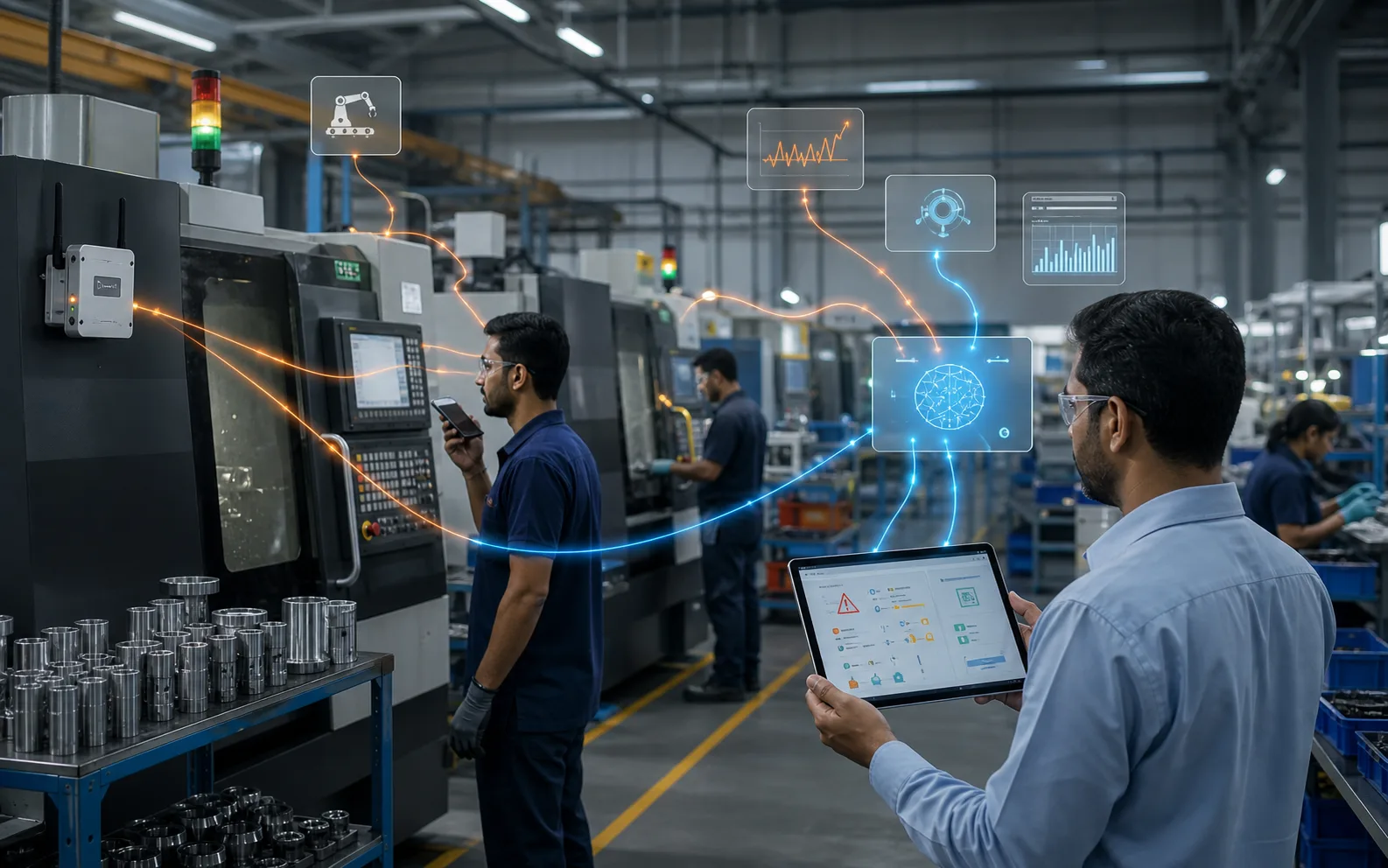
IoT helps automobile manufacturing by turning machines, processes, and shopfloor events into usable data. But the value is not in collecting data alone. The value comes when that data helps teams reduce downtime, improve quality, track production, control energy, plan maintenance, and protect dispatch commitments.
A sensor by itself does not improve a factory. A connected workflow does.
In an automobile plant, IoT can capture machine status, cycle counts, temperature, vibration, energy use, alarms, and process conditions. When connected to ERP and production context, this data can tell the factory which job is affected, which machine is losing time, which quality issue is repeating, and which dispatch may be at risk.
AICAN Optiwise is relevant because it helps manufacturers connect operational data with planning, inventory, production, quality, and reporting workflows.
What IoT Means in a Factory
IoT, or Internet of Things, means physical equipment and devices are connected so they can send data to software systems.
In automobile manufacturing, IoT may involve:
- Machine sensors.
- PLC data.
- CNC or VMC controller signals.
- Energy meters.
- Temperature or humidity sensors.
- Vibration sensors.
- Barcode or RFID systems.
- Edge devices.
- Operator terminals.
- Industrial gateways.
The data may be used for monitoring, alerts, dashboards, analysis, or automated workflows.
IoT Improves Machine Visibility
One of the most common IoT use cases is machine monitoring.
IoT can show:
- Machine running status.
- Idle time.
- Breakdown time.
- Alarm events.
- Cycle counts.
- Cycle time.
- Utilization.
- Shift-wise output.
This helps supervisors understand which machines are producing and which are losing time.
However, machine visibility is most useful when connected to production orders. Knowing that a machine was idle is useful. Knowing that it delayed a customer-critical order is much more useful.
IoT Helps Track Downtime Reasons
IoT can automatically capture when a machine stops, but the reason may still need human input. A machine may be idle because of no material, no operator, inspection hold, tool change, setup, or breakdown.
A strong downtime workflow combines automatic machine status with operator or supervisor reason codes.
This helps the factory identify repeat causes:
- Material waiting.
- Tooling issues.
- Setup delays.
- Maintenance problems.
- Quality holds.
- Program issues.
- Operator availability.
Once downtime reasons are visible, improvement becomes targeted.
IoT Supports Predictive and Preventive Maintenance
IoT can help maintenance teams move from reactive repair to better planned maintenance.
Depending on the machine and sensor setup, IoT may track:
- Vibration.
- Temperature.
- Runtime hours.
- Motor load.
- Alarm frequency.
- Lubrication status.
- Energy spikes.
- Repeated stops.
These signals can help identify machines that need attention before a major breakdown. Even simple runtime-based preventive maintenance becomes easier when machine hours are tracked automatically.
Predictive maintenance should be implemented carefully. It needs good data, clear thresholds, and maintenance discipline. But even basic IoT visibility can improve maintenance planning.
IoT Helps Improve Quality
IoT can support quality by monitoring process conditions that affect output.
Examples include:
- Temperature during a process.
- Pressure or force in a press.
- Vibration during machining.
- Cycle consistency.
- Machine alarms during production.
- Environmental conditions for sensitive processes.
When this data is connected to quality results, the factory can identify patterns. For example, defects may increase when a machine runs outside a certain condition or after a tool has been used too long.
IoT does not replace inspection, but it can provide earlier warning signals.
IoT Improves WIP and Material Movement
IoT is not limited to machines. Barcode, RFID, and scanning workflows can improve material and WIP movement visibility.
Factories can track:
- Material receipt.
- Material issue.
- WIP transfer.
- Bin movement.
- Job work movement.
- Packing and dispatch.
- Location status.
This reduces manual searching and improves traceability.
For auto component factories with many SKUs and process stages, movement visibility can reduce delays significantly.
IoT Helps Energy Monitoring
Energy cost matters in manufacturing. IoT-enabled energy meters can show consumption by machine, line, department, or shift.
This can help identify:
- High energy-consuming machines.
- Idle energy waste.
- Compressed air leaks or utility losses.
- Peak demand patterns.
- Energy use per production quantity.
Energy monitoring becomes more useful when connected to production output. A machine with high consumption may be acceptable if output is high, but inefficient if energy use is high during idle time.
IoT Data Must Connect to ERP
IoT data becomes much more useful when connected to ERP context.
ERP provides:
- Production order.
- Part number.
- BOM and routing.
- Customer order.
- Shift.
- Operator.
- Material issue.
- Quality status.
- Dispatch commitment.
IoT provides shopfloor signals.
Together, they answer stronger questions: which customer order was affected by downtime, which part family has repeated cycle loss, which machine causes dispatch risk, and which quality issue links to machine conditions?
How to Start with IoT
Factories should avoid connecting everything at once. Start with a clear use case.
Good starting points include:
- Bottleneck machine downtime.
- CNC or VMC utilization.
- Energy monitoring for high-load equipment.
- WIP movement tracking.
- Quality-critical process parameter monitoring.
- Maintenance runtime tracking.
Define the baseline, the data to capture, who will review it, and what action will follow.
Common IoT Mistakes
Common mistakes include:
- Collecting data without a business problem.
- Building dashboards without action owners.
- Ignoring operator input.
- Not connecting IoT data to production orders.
- Starting with too many machines.
- Overcomplicating the first phase.
- Treating IoT as separate from ERP.
IoT succeeds when it helps people act, not when it simply creates more data.
How AICAN Optiwise Helps
AICAN Optiwise helps manufacturers connect IoT and shopfloor signals with production, inventory, quality, and reporting workflows. This makes IoT data more useful because it becomes part of the operating decision flow.
AICAN focuses on practical manufacturing visibility. You can learn more about the company at About AICAN.
Founder’s Note
IoT is powerful, but it should stay grounded. A factory does not need a flood of data. It needs the right signals at the right time, connected to the right action.
When IoT helps a supervisor see downtime early, helps maintenance prevent repeat failure, or helps management understand bottlenecks, it becomes valuable. That is the kind of useful intelligence we care about.
FAQs
How does IoT help automobile manufacturing?
IoT helps by capturing machine, process, energy, and movement data that can improve downtime tracking, utilization, quality, maintenance, WIP visibility, and production decisions.
Does IoT replace ERP?
No. IoT provides shopfloor signals, while ERP provides business and production context. The best results come when IoT data connects with ERP workflows.
What is a good first IoT project for a factory?
A good first project targets a clear bottleneck such as machine downtime, CNC utilization, energy consumption, quality-critical process monitoring, or WIP movement.
Is IoT only for large factories?
No. Smaller factories can start with focused IoT projects on important machines or workflows, especially where downtime or visibility problems are costly.
How does AICAN Optiwise support IoT use cases?
AICAN Optiwise helps connect IoT data with production, quality, inventory, and reporting so the data supports real factory decisions.

Related Posts
Is AI Worth the Investment for My Factory?
Learn how to decide if AI is worth the investment for your factory by evaluating use cases, data readiness, costs, risks, ROI, and operational impact.
13 Jun 2026Read more →Manufacturing AI Mistakes to Avoid Before You Start
List manufacturing AI mistakes and controls for unclear use case, messy data, unsafe automation, no owner, weak security and unreviewed recommendations.
13 Jun 2026Read more →What's the Difference Between AI and Regular Automation?
Understand the difference between AI and regular automation in manufacturing, with practical examples for workflows, decisions, alerts, and predictive operations.
13 Jun 2026Read more →What Are the Risks of Using AI in Manufacturing?
Understand the risks of AI in manufacturing, including bad data, wrong recommendations, safety issues, security, job fear, over-automation, and implementation failure.
13 Jun 2026Read more →