
How Do IoT Sensors Work in Manufacturing?
Learn how IoT sensors work in manufacturing by collecting machine data, sending it through gateways, and turning it into dashboards, alerts, and insights.

How Do IoT Sensors Work in Manufacturing?
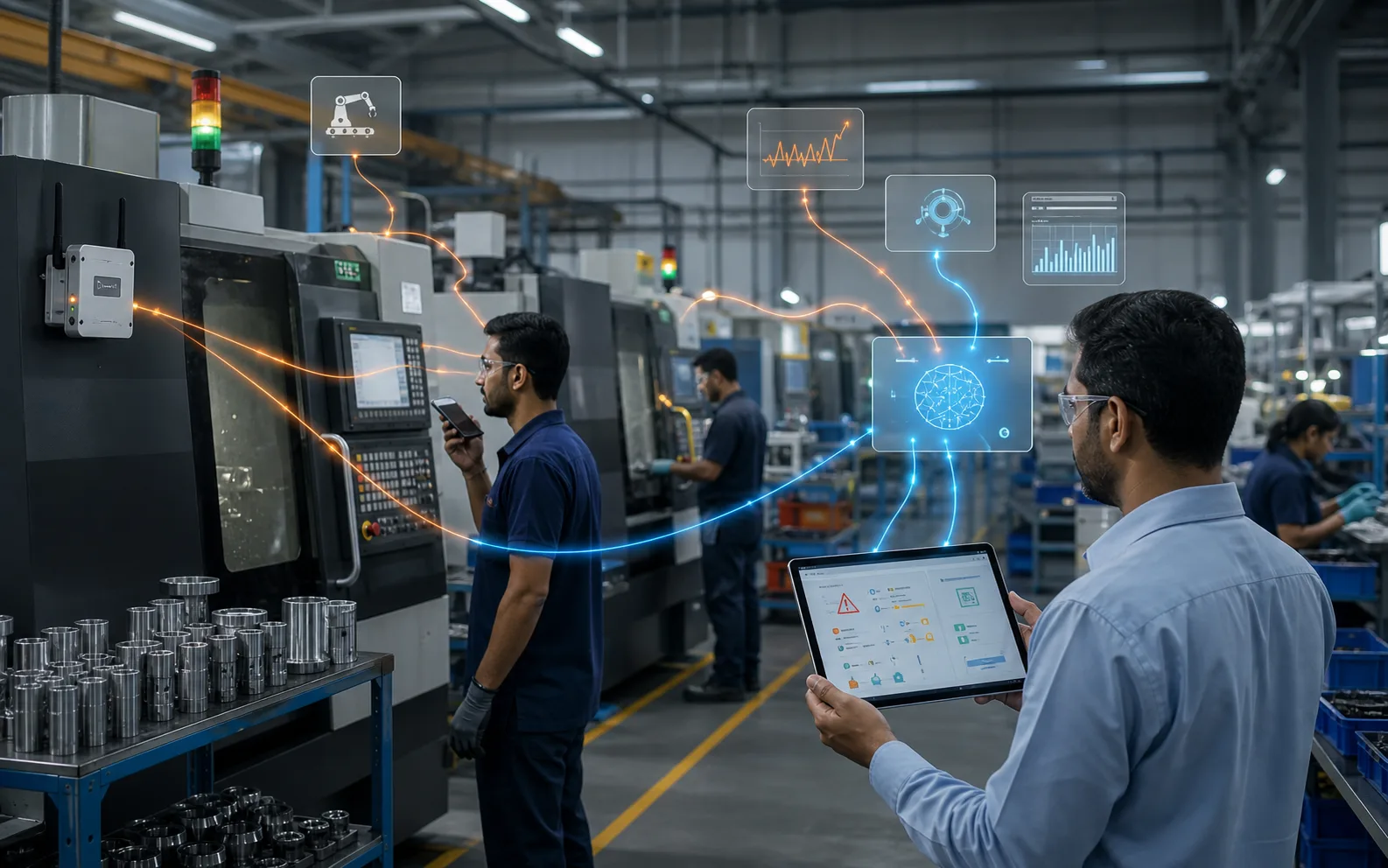
IoT sensors work by turning physical factory conditions into digital information the team can use.
A sensor detects something happening in the real world: a machine running, a motor heating, a part passing, a vibration increasing, pressure dropping, current rising, or a tank level falling. That signal is collected by a controller, gateway, PLC, or connected device. The data then moves into a platform where it becomes a dashboard, alert, trend, report, or decision.
That is the simple version.
For manufacturers evaluating AICAN Optiwise, the important part is not only how the sensor works technically. It is how the signal helps the factory act sooner.
Sensors measure physical conditions
Every IoT sensor begins with a physical measurement.
Different sensors measure different conditions: proximity, vibration, temperature, pressure, flow, current, speed, level, humidity, position, or visual features. The sensor converts that condition into an electrical or digital signal.
For example, a current sensor may show whether a machine is running. A vibration sensor may show mechanical change. A proximity sensor may detect parts moving through a station. A temperature sensor may show overheating.
The sensor is the starting point of visibility.
The signal needs a path into the system
Sensor data must travel somewhere.
It may go into a PLC, IoT gateway, industrial PC, data logger, controller, or wireless device depending on the setup. In many factories, gateways are useful because they collect data from different machines and sensors, then send it to a platform.
The connection method depends on the machine age, available ports, wiring, signal type, and network design.
Older machines may need external sensors. Newer machines may expose data directly.
Data is timestamped and interpreted
Raw sensor data is not enough.
The system needs to know what the signal means. Is this value a machine running state? A part count? A pressure warning? A quality condition? A maintenance signal? A communication failure?
Timestamping is also important. The platform should know when the event happened, not just when someone viewed it. Accurate timestamps help shift analysis, downtime review, maintenance investigation, and quality traceability.
Dashboards make the data useful
A sensor signal becomes useful when it appears in a form people can understand.
Dashboards may show live machine status, downtime, production count, trend lines, alerts, energy use, quality conditions, or maintenance signals. Different users need different views.
Operators may need simple prompts. Supervisors may need exceptions. Maintenance teams may need history. Owners may need performance and risk visibility.
A good IoT system turns sensor data into role-based action.
Alerts turn signals into response
Some sensor readings should trigger attention.
A machine stopped. Pressure dropped. Temperature crossed a limit. Vibration increased. A sensor stopped communicating. Production count fell behind plan.
Alerts help the right person respond sooner. But alerts need rules: who receives them, when escalation happens, and how closure is recorded.
Without response ownership, alerts become noise.
Analytics turns events into patterns
IoT sensors do more than show live status.
Over time, sensor data helps reveal patterns: repeated short stops, abnormal machine behavior, energy waste, quality drift, maintenance recurrence, or production bottlenecks.
This historical view helps the factory improve. A single alert solves one event. A pattern solves a recurring problem.
Where AICAN Optiwise fits
AICAN Optiwise helps manufacturers connect IoT sensor data into dashboards, alerts, reports, and operational insights. The platform is built to make machine and sensor signals useful for production, maintenance, quality, and management decisions.
AICAN works with manufacturers that want connected systems grounded in real factory workflows. More about the company is available at About AICAN.
Founder’s Note
An IoT sensor is useful only when its signal reaches the moment of decision. A reading sitting alone in a device does not change the factory. A reading that helps someone act earlier can change the day.
FAQs
What does an IoT sensor do?
It measures a physical condition and sends that data to a connected system for monitoring, alerts, reports, or analysis.
Do IoT sensors need internet?
They need a data path. Some systems use local gateways and later sync to cloud platforms, depending on design.
Can old machines use IoT sensors?
Yes. External sensors can often monitor older machines without full controller integration.
What is an IoT gateway?
A gateway collects sensor or machine data and sends it to a dashboard or platform.
What makes IoT sensor data useful?
Clear context, accurate timestamps, reliable connectivity, dashboards, alerts, and people who act on the information.

Related Posts
Is AI Worth the Investment for My Factory?
Learn how to decide if AI is worth the investment for your factory by evaluating use cases, data readiness, costs, risks, ROI, and operational impact.
13 Jun 2026Read more →Manufacturing AI Mistakes to Avoid Before You Start
List manufacturing AI mistakes and controls for unclear use case, messy data, unsafe automation, no owner, weak security and unreviewed recommendations.
13 Jun 2026Read more →What's the Difference Between AI and Regular Automation?
Understand the difference between AI and regular automation in manufacturing, with practical examples for workflows, decisions, alerts, and predictive operations.
13 Jun 2026Read more →What Are the Risks of Using AI in Manufacturing?
Understand the risks of AI in manufacturing, including bad data, wrong recommendations, safety issues, security, job fear, over-automation, and implementation failure.
13 Jun 2026Read more →