
How Do I Know If My Factory Needs Automation?
Learn the practical signs that a factory is ready for automation, including downtime, manual reporting, quality issues, labor pressure, and production visibility gaps.

How Do I Know If My Factory Needs Automation?
A factory usually needs automation before the owner feels fully ready for it.
The signs appear quietly: supervisors spend too much time chasing updates, operators wait for instructions, machines stop without clear reasons, quality issues are discovered late, and production plans depend on memory more than data. The factory may still be running, but it is running with too much invisible effort.
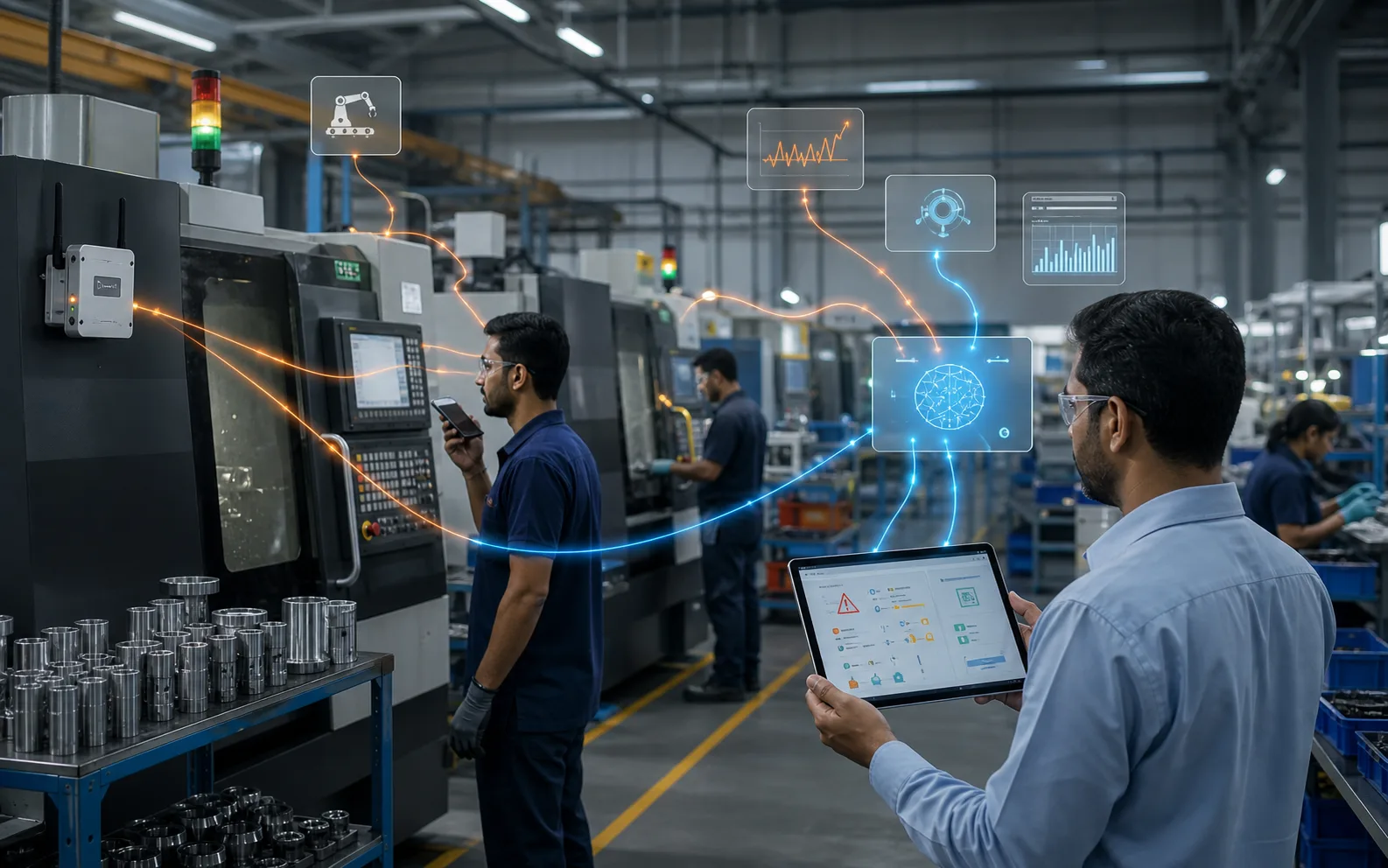
Automation does not always mean robots or a complete plant overhaul. Often, the first step is simpler: sensors, dashboards, alerts, machine monitoring, digital reporting, or connected production visibility.
For manufacturers evaluating AICAN Optiwise, the right question is not “Are we advanced enough for automation?” It is “Which part of our factory is costing us because it depends too much on manual visibility?”
You do not know machine status in time
If the owner or plant head has to call someone to know whether machines are running, the factory has a visibility gap.
Manual checking may work in a small setup, but it becomes unreliable as machines, shifts, and orders increase. A stoppage that is discovered late can affect production, dispatch, overtime, and customer commitments.
Automation through sensors and monitoring can show machine status sooner. The team can see running, idle, stopped, abnormal, or underperforming machines without waiting for end-of-shift reports.
This is often the first sign that automation is needed.
Manual reporting is slowing the team down
If operators write production numbers in registers, supervisors collect them, admin teams enter them into spreadsheets, and managers still ask for updates separately, the factory is paying for duplicate effort.
Manual reporting also creates delays and errors. By the time the report reaches management, the decision window may already be closed.
Automation can reduce manual reporting by capturing machine signals, production counts, downtime, and status updates closer to the source. Human input may still be needed for reasons and exceptions, but the basic data becomes easier to trust.
Downtime reasons are unclear
Every factory has downtime. The problem is not only downtime itself. The problem is not knowing why it happened often enough to fix it.
If downtime is described vaguely as “machine problem,” “operator issue,” “material delay,” or “setting problem,” the team cannot identify patterns clearly. The same issue keeps returning because nobody has enough evidence.
Sensors and automation can help capture stoppage timing, machine state, abnormal conditions, and downtime reason workflows. This helps the factory move from complaint to analysis.
Quality problems are found too late
If defects are discovered after a full batch is complete, the cost is already high.
Automation may help when quality depends on process conditions such as temperature, pressure, speed, humidity, positioning, vibration, or flow. Sensors can detect drift earlier and help teams connect process behavior with quality outcomes.
Automation does not replace quality judgment. It gives quality teams better timing and better context.
Production planning depends too much on assumptions
If planning is based on expected capacity rather than actual machine performance, schedules may look good on paper but fail on the floor.
Automation can show actual cycle time, machine availability, downtime, output, and bottlenecks. This gives planners a more realistic view of what the factory can deliver.
When customers ask for delivery commitments, the team can answer with more confidence.
Labor is being wasted on waiting and follow-up
A factory may not need fewer people, but it may need to reduce wasted human effort.
Operators waiting for material, supervisors chasing status, maintenance teams diagnosing without history, and managers reconciling reports are all signs of manual overload.
Automation helps when it removes avoidable waiting, repeated checking, and delayed information flow.
Maintenance is mostly reactive
If maintenance teams mostly respond after breakdowns, automation may help create earlier visibility.
Sensors can track vibration, temperature, current, pressure, flow, or other conditions that show machine stress. Over time, the team can identify patterns and plan interventions before failures become severe.
The factory does not need to become fully predictive on day one. Even better machine history can improve maintenance decisions.
Start with one painful process
A factory does not need to automate everything at once.
Start with the area where visibility will create the biggest benefit: critical machine downtime, production counting, energy monitoring, maintenance alerts, material level monitoring, or quality-sensitive process conditions.
Define the problem, connect the right signals, train the right users, and measure the result. Automation should begin where it can prove value.
Where AICAN Optiwise fits
AICAN Optiwise helps manufacturers begin automation through practical visibility: sensor data, machine status, production dashboards, alerts, and operational reporting. The platform can support phased adoption so factories can start where the pain is strongest.
AICAN works with manufacturers who want automation to improve daily operations, not just look advanced. More about the company is available at About AICAN.
Founder’s Note
Automation should not begin with fear of being left behind. It should begin with honesty about where the factory is losing time, trust, or control. Start there, and automation becomes a tool for discipline rather than a symbol of modernity.
FAQs
Does automation always mean robots?
No. Automation can begin with sensors, machine monitoring, alerts, dashboards, and digital reporting.
What is the first sign my factory needs automation?
A common sign is late visibility: you do not know machine status, downtime, output, or production risk until too late.
Can small factories automate gradually?
Yes. A phased approach is usually best. Start with one painful process and expand after value is proven.
Will automation reduce jobs?
Not necessarily. Many factories use automation to reduce wasted effort, improve visibility, and help existing teams work better.
How do I choose the first automation project?
Choose the problem with the clearest cost and fastest practical value, such as downtime, manual reporting, maintenance surprises, or energy waste.

Related Posts
Is AI Worth the Investment for My Factory?
Learn how to decide if AI is worth the investment for your factory by evaluating use cases, data readiness, costs, risks, ROI, and operational impact.
13 Jun 2026Read more →Manufacturing AI Mistakes to Avoid Before You Start
List manufacturing AI mistakes and controls for unclear use case, messy data, unsafe automation, no owner, weak security and unreviewed recommendations.
13 Jun 2026Read more →What's the Difference Between AI and Regular Automation?
Understand the difference between AI and regular automation in manufacturing, with practical examples for workflows, decisions, alerts, and predictive operations.
13 Jun 2026Read more →What Are the Risks of Using AI in Manufacturing?
Understand the risks of AI in manufacturing, including bad data, wrong recommendations, safety issues, security, job fear, over-automation, and implementation failure.
13 Jun 2026Read more →