
How Do I Start Implementing AI in My Manufacturing Business?
A step-by-step guide for manufacturers who want to start using AI without disrupting operations, overspending, or overwhelming teams.
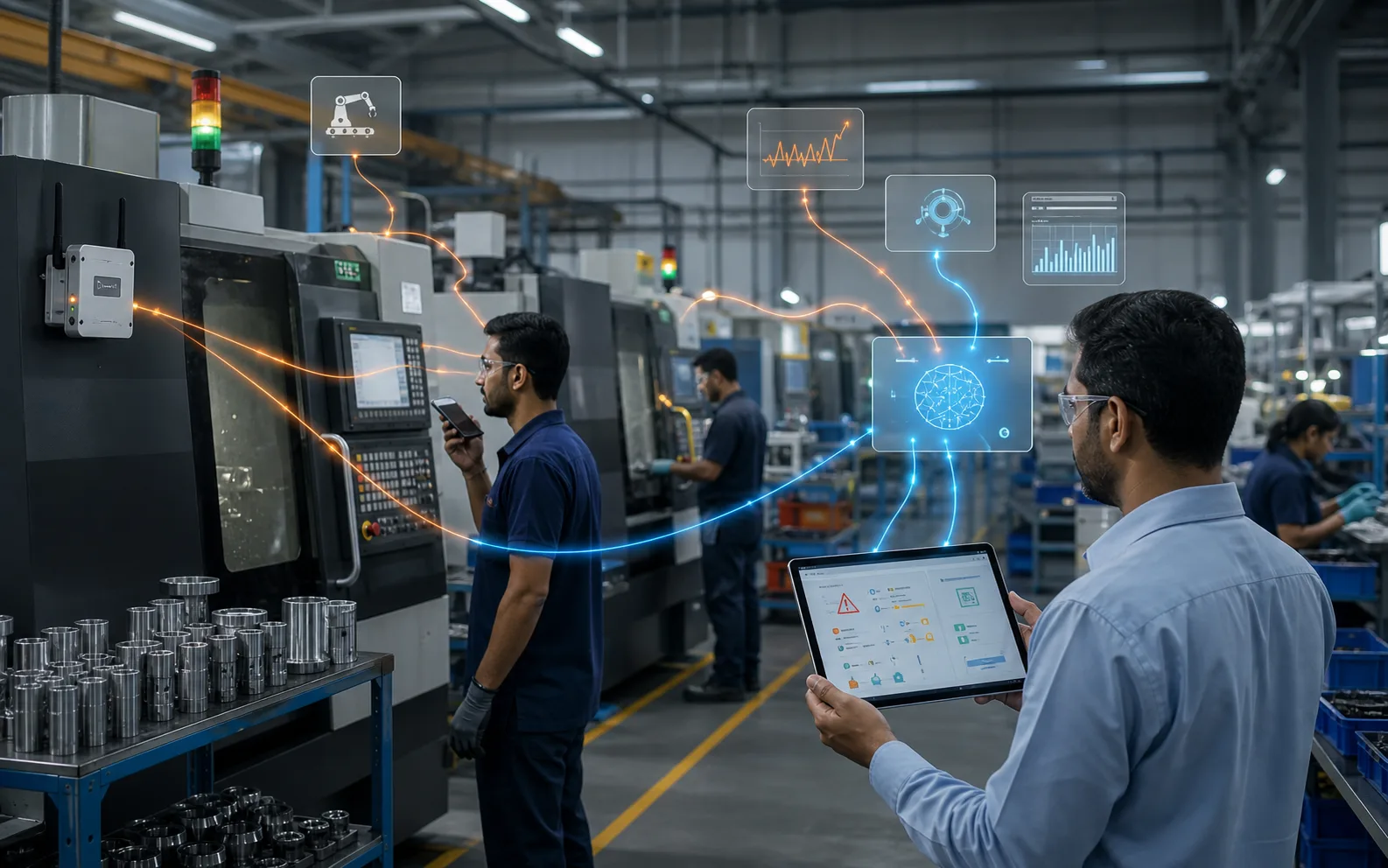
How Do I Start Implementing AI in My Manufacturing Business?
Starting AI in a manufacturing business should not begin with buying the most advanced tool in the market. It should begin with a clear look at where the factory is losing time, money, accuracy, or control today. In many factories, the first useful AI opportunity is not a robot. It is better visibility into production delays, inventory risk, purchase follow-ups, quality issues, or customer commitments.
The factories that get AI right usually start small and practical. They do not try to transform everything in one month. They choose a business problem, clean the data around it, connect the workflow, train the team, and then expand. This is slower than hype, but faster than failed implementation.
Artificial intelligence in manufacturing works best when it sits on top of disciplined operations. If production entries are delayed, stock data is wrong, and departments work in separate spreadsheets, AI will only expose the confusion faster. The first step is to make the factory readable.
Step 1: Identify the Business Problem, Not the Technology
Start with the problem you can describe in plain language. For example: material shortages are delaying production, finished goods dispatch is unpredictable, quality defects are discovered too late, machine downtime is not tracked properly, or management receives reports after the problem has already happened.
This matters because AI should be measured against business outcomes. A project called "AI adoption" is too vague. A project called "reduce purchase-related production delays by improving material visibility" is specific enough to act on.
Make a list of your top five operational pain points. Then rank them by financial impact, frequency, and ease of measurement. The best first use case is usually painful, repeated, and visible across departments.
Step 2: Check Your Data Readiness
AI needs reliable data, but reliable does not mean perfect. It means the basic records are consistent enough to support decisions. Before starting, check whether item masters, BOMs, stock records, purchase orders, production orders, quality checks, and dispatch records are updated in a disciplined way.
If the same item has three names in different files, if closing stock is adjusted only at month-end, or if production status is updated verbally, the AI system will struggle. The fix is not to delay forever. The fix is to clean the critical data required for the first use case.
For example, if the first use case is inventory risk, focus on item codes, stock levels, consumption patterns, purchase lead times, and open production requirements.
Step 3: Start With Connected Workflows
AI should not sit outside the factory workflow as a separate dashboard that only management checks once a week. It should connect with the daily flow of work. If a material shortage is predicted, someone must receive the alert, verify it, take action, and close the loop.
This is where many AI projects fail. The insight is generated, but no process owns the response. A practical implementation defines who receives each alert, what action is expected, and how the result is tracked.
A connected workflow may include sales orders feeding production planning, production planning checking material availability, purchase teams seeing shortages, stores updating receipts, and management reviewing exceptions in real time.
Step 4: Train Teams on Decisions, Not Just Screens
Training should not only explain where to click. It should explain how the system changes decisions. If a dashboard shows delayed production, what should the supervisor do? If AI flags unusual consumption, who verifies it? If purchase lead time risk increases, when should the team escalate?
Workers adopt systems faster when training is tied to their daily pressure. Instead of saying "this is an AI feature," say "this is how you will know before production stops." That makes the value practical.
Step 5: Measure One Clear Outcome
For the first 60 to 90 days, measure a small number of outcomes. Examples include fewer stockouts, faster production reporting, reduced manual follow-ups, fewer urgent purchases, lower defect repetition, or improved dispatch reliability.
Avoid measuring vanity metrics like number of dashboards viewed. The real question is whether decisions improved. Did the factory catch issues earlier? Did teams coordinate faster? Did owners get cleaner visibility?
Where AICAN Optiwise Fits
AICAN Optiwise helps manufacturers start with connected operations before layering AI into decision-making. It brings production, inventory, purchase, sales, finance, reporting, IoT readiness, and AI workflows into one operating system, so the factory has a reliable base for intelligent alerts and automation.
For a business starting its AI journey, this is important because the system supports daily work instead of becoming an isolated experiment. You can explore AICAN’s manufacturing-first approach at aican.co.in and read more about the team’s shopfloor roots at About AICAN.
Founder’s Note
AICAN’s belief is that manufacturers do not need to jump blindly into AI. They need a practical path from scattered operations to connected intelligence. The most valuable AI project is often the one that helps the team solve a real factory problem with less confusion and more confidence.
That founder-led view keeps the focus on usefulness. AI should earn trust by improving daily decisions, not by sounding advanced in a presentation.
FAQ
What is the first step to using AI in manufacturing?
Identify one repeated operational problem and check whether the data around it is reliable enough to support decisions. Do not begin with technology selection alone.
Do I need IoT devices before starting AI?
Not always. Many AI use cases can begin with ERP, inventory, production, purchase, and quality data. IoT can be added later where machine-level data is required.
How long does a first AI implementation take?
A focused first phase can often begin showing useful visibility within weeks, but meaningful adoption usually needs 60 to 90 days of process discipline and team training.
Should small manufacturers wait until AI becomes cheaper?
Waiting is not always the best strategy. Small manufacturers can start with practical, affordable use cases that improve visibility and reduce manual firefighting.
Final Thought
AI implementation is not a race to install the newest technology. It is a disciplined move toward a factory that can see problems earlier, respond faster, and learn from its own data.
Next step: Explore AICAN Optiwise to understand how a connected manufacturing operating system can help your factory start AI implementation in a practical way.

Related Posts
Is AI Worth the Investment for My Factory?
Learn how to decide if AI is worth the investment for your factory by evaluating use cases, data readiness, costs, risks, ROI, and operational impact.
13 Jun 2026Read more →Manufacturing AI Mistakes to Avoid Before You Start
List manufacturing AI mistakes and controls for unclear use case, messy data, unsafe automation, no owner, weak security and unreviewed recommendations.
13 Jun 2026Read more →What's the Difference Between AI and Regular Automation?
Understand the difference between AI and regular automation in manufacturing, with practical examples for workflows, decisions, alerts, and predictive operations.
13 Jun 2026Read more →What Are the Risks of Using AI in Manufacturing?
Understand the risks of AI in manufacturing, including bad data, wrong recommendations, safety issues, security, job fear, over-automation, and implementation failure.
13 Jun 2026Read more →