
Industrial IoT in Manufacturing: From Signal to Controlled Action
Industrial IoT in Manufacturing. Use a worked manufacturing test, explicit inputs and exception checks before rollout.
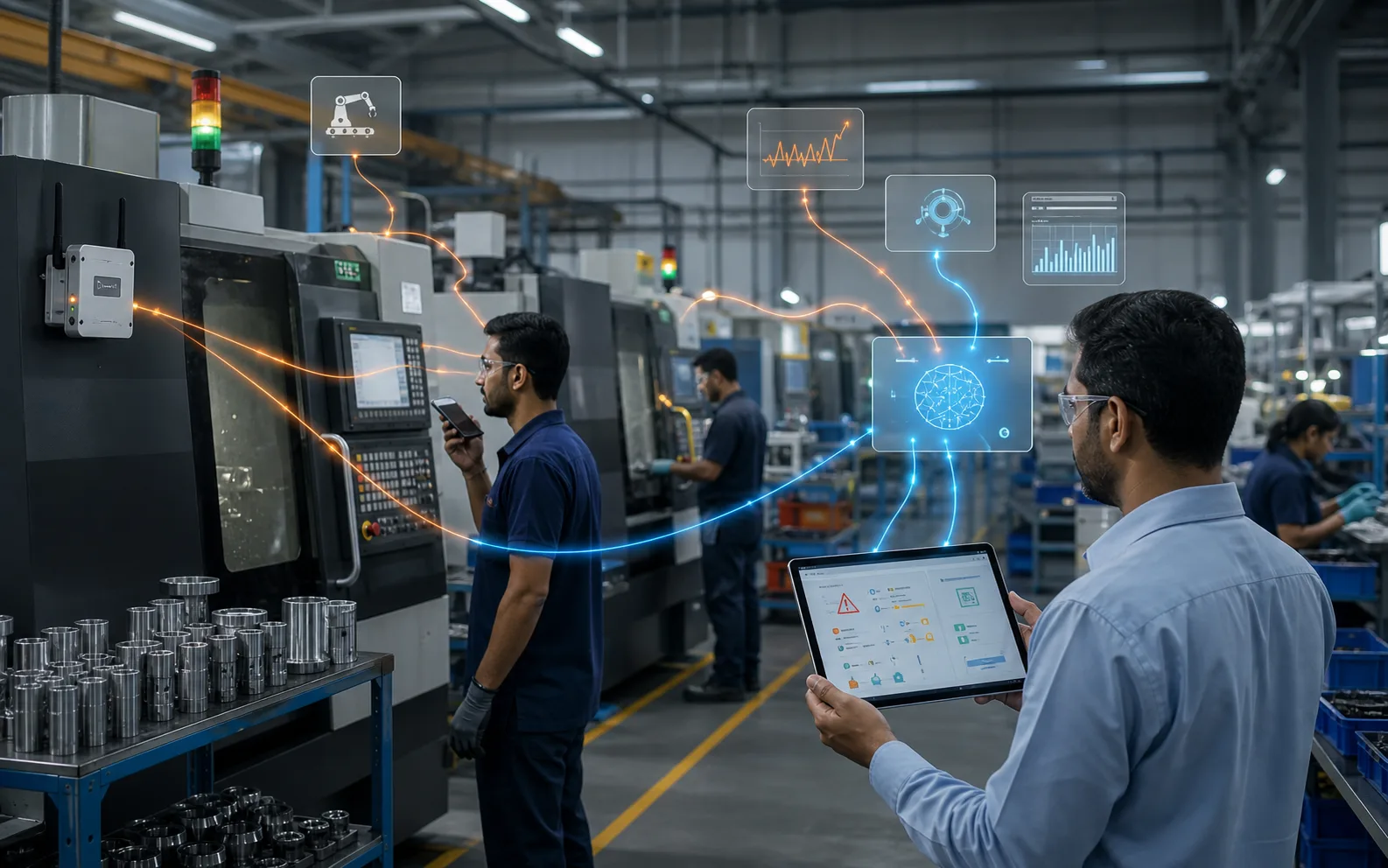
Industrial IoT in Manufacturing: From Signal to Controlled Action helps you design an IIoT flow that gives machine data a manufacturing context. Test one real order and one exception before expanding scope.
A stop bit becomes actionable only after the gateway associates it with Machine 8, Operation 30, the current work order and a timestamp. The supervisor can then record the reason and see which commitment is at risk.
Start with the decision the system must support
Map every signal to a machine, operation, shift and work order before using it in an alert or KPI.
OptiEdge supports Modbus and OPC-UA collection, local buffering and resynchronization. Optiwise adds runtime, downtime, cycle, load, energy and OEE views with machine context.
Use ISA-95 enterprise and control-system model as an external reference for the relevant process or control model. It does not prove an Optiwise feature or business result; our product statements come from the current feature record.
| # | Input to prepare | Evidence to retain |
|---|---|---|
| 1 | Device and machine identity | Owner and last update |
| 2 | Signal meaning and sampling rule | Definition and source |
| 3 | Order, operation and shift context | Acceptance rule |
| 4 | Alert owner and response rule | Exception owner |
Run one controlled workflow
- 1. Device and machine identity. Name the owner and authoritative record.
- 2. Signal meaning and sampling rule. Use the current value from the test order.
- 3. Order, operation and shift context. Write the pass condition before the demo.
- 4. Alert owner and response rule. Assign the person who resolves a mismatch.
Keep the first test small enough to reconcile by hand. When the result differs from the source documents, identify whether the problem is master data, timing, transaction ownership or configuration.
Test exceptions with the normal flow
- Gateway buffers during an outage
- Job changes without remapping
- Noise creates a false stop
For every exception, record the expected status, permitted action, approver and audit trail. The workflow should expose a problem without allowing an unapproved shortcut to rewrite history.
Verify the connected Optiwise workflow
Review workflow details, product capability, supporting guide, implementation context, connected process, book a demo. In the demo, ask us to run the scenario with your roles and sample records. Confirm the source transaction, resulting status, action, correction method and report.
Questions to ask before rollout
What should we test first?
Choose one current order with a known complication. Prepare the four inputs above, run the sequence and reconcile the result with the source documents.
What result should we accept?
Accept the workflow only when the normal path and named exceptions leave a complete, role-appropriate record. Keep feature validation separate from a promised outcome.
Industrial Internet of Things, or IIoT, means using connected sensors, machines, devices, and software to collect industrial data and make manufacturing operations more visible. In simple terms, machines and processes start sending signals that people can use for better decisions.
For small and mid-sized manufacturers, IIoT can sound like a large-factory concept. But its practical idea is simple: capture what is happening on the shop floor faster and more accurately. Machine status, downtime, energy use, production count, temperature, pressure, vibration, and process conditions can all become useful signals.
AICAN Optiwise helps manufacturers connect operational workflows with digital visibility, making IIoT data more meaningful when paired with production, inventory, and planning records.
What Is IIoT?
IIoT is the industrial use of connected devices and sensors. These devices collect data from machines, equipment, production lines, utilities, and environments.
IIoT may track:
- Machine run time
- Downtime
- Production count
- Cycle time
- Temperature
- Pressure
- Vibration
- Energy consumption
- Process parameters
- Maintenance alerts
- Quality conditions
The goal is to move from delayed reporting to real-time or near-real-time visibility.
Why IIoT Matters In Manufacturing
Manufacturers lose time and money when problems are discovered late. A machine may be idle for two hours before management knows. A process parameter may drift before quality detects defects. Energy use may increase without explanation.
IIoT helps by providing earlier signals.
Benefits include:
- Better downtime visibility
- Predictive maintenance possibility
- Improved production tracking
- Faster quality alerts
- Energy monitoring
- Better equipment utilization
- Reduced manual data entry
- Stronger process control
IIoT does not replace operators. It gives operators and managers better information.
IIoT And Production Monitoring
Production counts are often entered manually. IIoT can capture output directly from machines or connected devices, depending on setup.
This helps compare:
- Planned output
- Actual output
- Machine run time
- Idle time
- Cycle time
- Rejection events
When connected with work orders, the data becomes more useful.
IIoT And Maintenance
Maintenance teams can use IIoT data to detect abnormal patterns. Vibration, temperature, current, or run-hour data may indicate when equipment needs attention.
Maintenance can move from purely breakdown-based to more planned activity.
Useful signals include:
- Machine hours
- Abnormal vibration
- Temperature rise
- Repeated stoppages
- Energy spikes
- Alarm frequency
IIoT And Quality
Some quality issues are connected to process conditions. If temperature, pressure, humidity, speed, or machine setting changes, output quality may suffer.
IIoT can help record process conditions and support root-cause analysis.
For example, if rejection increases during a particular shift or machine condition, data helps investigate.
Start Small
Manufacturers do not need to connect every machine at once. Start with one valuable use case:
- Critical machine downtime
- Energy monitoring
- Production count tracking
- Temperature-sensitive process
- Maintenance alerting
- Quality parameter logging
A focused pilot is better than a large project nobody uses.
ERP Context Makes IIoT Useful
Machine data alone is not enough. It becomes more useful when connected with production orders, item codes, operators, shifts, BOMs, and dispatch commitments.
That is where systems like Optiwise by AICAN matter. Operational context turns raw machine signals into business decisions.
Founder’s Note
At AICAN, we believe IIoT should solve real factory problems, not become a technology showcase. Start with the question: what do we need to know earlier?
Optiwise helps manufacturers build the operating foundation that makes advanced data more useful.
FAQs
What is IIoT?
IIoT means Industrial Internet of Things, where connected devices and sensors collect industrial data from machines and processes.
How does IIoT help manufacturers?
It improves visibility into downtime, production output, maintenance needs, quality conditions, and energy usage.
Is IIoT only for large factories?
No. Small manufacturers can start with focused use cases such as downtime tracking or energy monitoring.
Does IIoT replace ERP?
No. IIoT captures machine and process data. ERP provides business context such as orders, inventory, production plans, and dispatch.
How does Optiwise support IIoT readiness?
AICAN Optiwise helps structure manufacturing workflows so machine data can be connected with real business operations.

Related Posts
Is AI Worth the Investment for My Factory?
Learn how to decide if AI is worth the investment for your factory by evaluating use cases, data readiness, costs, risks, ROI, and operational impact.
13 Jun 2026Read more →Manufacturing AI Mistakes to Avoid Before You Start
List manufacturing AI mistakes and controls for unclear use case, messy data, unsafe automation, no owner, weak security and unreviewed recommendations.
13 Jun 2026Read more →What's the Difference Between AI and Regular Automation?
Understand the difference between AI and regular automation in manufacturing, with practical examples for workflows, decisions, alerts, and predictive operations.
13 Jun 2026Read more →What Are the Risks of Using AI in Manufacturing?
Understand the risks of AI in manufacturing, including bad data, wrong recommendations, safety issues, security, job fear, over-automation, and implementation failure.
13 Jun 2026Read more →