
IoT Data Analytics for Production Insights
Learn how IoT data analytics turns machine, downtime, production, quality, and maintenance data into practical manufacturing insights for better decisions.

IoT Data Analytics for Production Insights
Production insight begins when the factory stops treating data as a report and starts using it as evidence.
Most manufacturers already generate data all day. Machines run and stop. Operators change jobs. Material moves. Quality checks pass or fail. Maintenance teams respond to issues. Orders move closer to dispatch or fall behind. The problem is that much of this information is late, scattered, manual, or invisible.
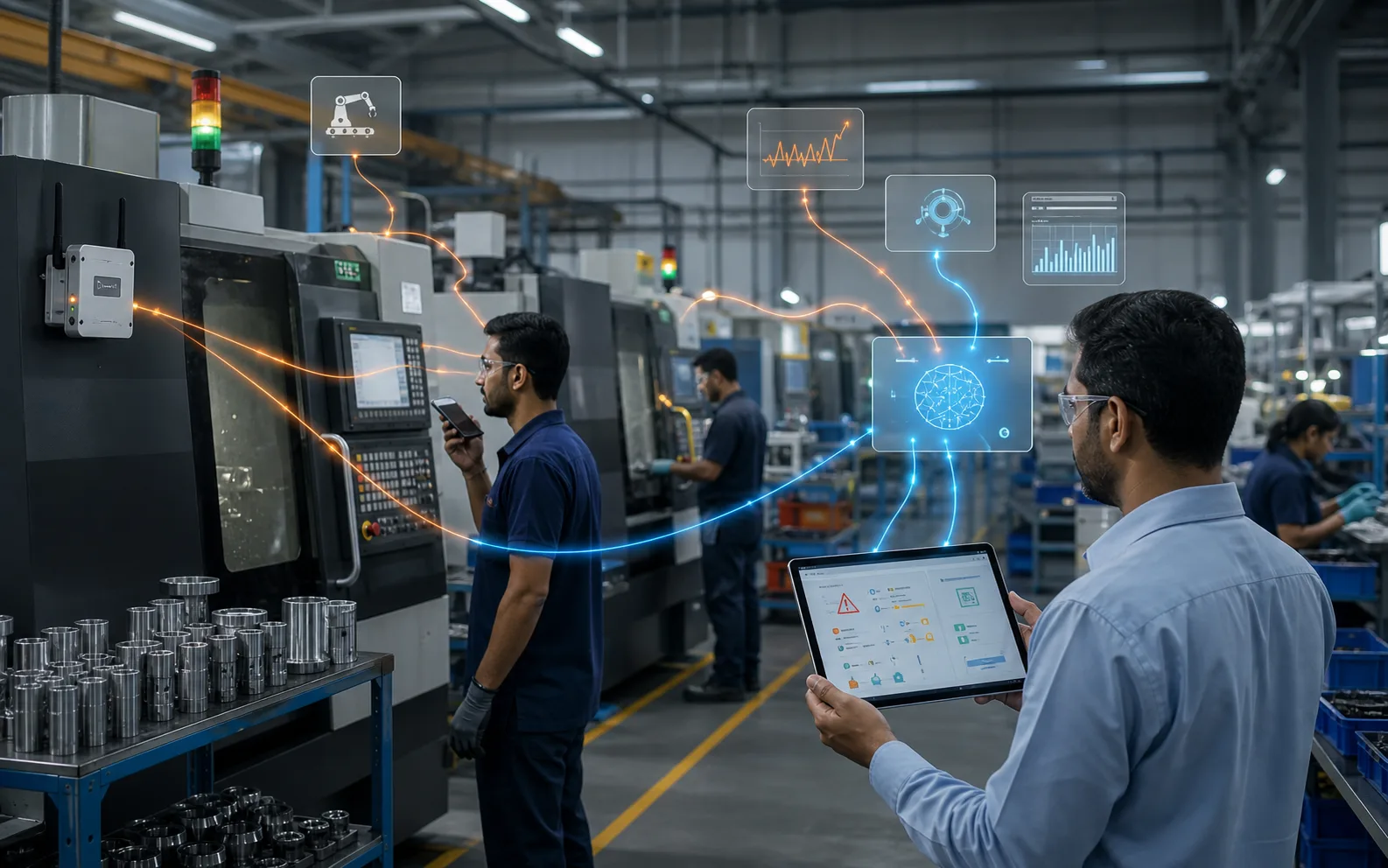
IoT data analytics turns those factory signals into patterns the team can act on.
For manufacturers evaluating AICAN Optiwise, analytics should not mean complicated charts that only specialists understand. It should mean practical answers: where are we losing time, which machine is underperforming, why is output below plan, which issue keeps repeating, and what should we fix first?
Analytics starts with clean operational questions
Before building dashboards, a manufacturer should define the questions it wants answered.
Good production analytics begins with questions like:
- Which machines lose the most time?
- Which downtime reasons repeat across shifts?
- Which jobs take longer than expected?
- Which lines are consistently below plan?
- Where does output vary without a clear reason?
- Which maintenance issues return after repair?
- Which production delays affect delivery commitments?
These questions keep analytics grounded in factory reality.
Without clear questions, analytics becomes a collection of graphs. With clear questions, it becomes a decision tool.
Machine utilization reveals hidden capacity
Many manufacturers buy new machines before fully understanding existing capacity.
IoT analytics can show how machines are actually being used: running time, idle time, stoppage time, changeover time, and production speed. This helps the team see whether capacity is limited by machine availability, planning, material readiness, maintenance, operator allocation, or process discipline.
A machine may appear fully loaded on paper but spend hours waiting during the week. Another machine may be blamed for low output when the real issue is material delay or frequent changeover.
Utilization analytics helps separate assumption from fact.
Downtime analytics turns complaints into patterns
Downtime is often discussed emotionally because it creates immediate pressure.
A machine stops, production falls behind, people rush, and the team moves on after the issue is fixed. Without analytics, the same problem may return again and again.
IoT downtime analytics helps by grouping stoppages by machine, shift, reason, duration, product, operator input, or time of day. The team can identify recurring short stops, long breakdowns, planned stoppages, and avoidable delays.
This changes the maintenance conversation. Instead of saying, “This machine always gives trouble,” the team can say, “This machine lost the most time due to tool setting in the last two weeks.” That is a more useful starting point.
Production against plan shows risk early
A production plan is only useful if the team can see when reality is drifting away from it.
IoT analytics can compare planned output with actual output during the shift. If a job is falling behind, the supervisor can act earlier: check the machine, move resources, adjust sequencing, escalate maintenance, or warn dispatch.
This early visibility is especially valuable for customer commitments. A late production update often leaves only two choices: overtime or missed delivery. A live or near-live production insight gives the team more room to recover.
Quality and process signals become easier to connect
Quality issues rarely happen in isolation.
A defect may rise after a tool change, during a specific shift, on a certain machine, or after an abnormal machine condition. If quality data is separated from production and machine data, the pattern may be missed.
IoT analytics can help connect process signals with quality outcomes. It can show whether rejection patterns align with downtime, speed variation, temperature changes, operator notes, or maintenance events.
This does not replace quality expertise. It gives quality teams better context for investigation.
Maintenance analytics supports prevention
Maintenance analytics is useful when it helps the team move from reacting to planning.
Repeated alarms, abnormal energy draw, temperature change, vibration trend, frequent stoppages, and recurring repair notes can point toward machines that need attention before they create a bigger failure.
A maintenance engineer does not need every possible data point. They need the right history: what happened, how often, under what conditions, and what changed before the issue became serious.
IoT analytics can help prioritize maintenance effort where it protects production most.
Analytics should lead to action
The test of analytics is not whether the chart is interesting. It is whether the factory changes something.
A useful insight should lead to one of these actions:
- adjust a production plan
- investigate a recurring downtime reason
- schedule preventive maintenance
- reduce manual reporting
- improve material readiness
- train operators on a repeated issue
- change review meeting priorities
- update dispatch communication
If analytics does not lead to action, it becomes decoration.
Where AICAN Optiwise fits
AICAN Optiwise helps manufacturers turn shop-floor data into practical production insights. The platform is designed to connect machine status, production progress, downtime, maintenance context, and management visibility so teams can move from delayed reporting to faster decisions.
AICAN supports manufacturers that want analytics to serve operations, not overwhelm them. More about the company is available at About AICAN.
Founder’s Note
Analytics should feel like a sharper production meeting, not a separate technical exercise. The best insights are the ones that help a supervisor, maintenance engineer, planner, or owner make a better decision before the day is lost.
FAQs
What is IoT data analytics in manufacturing?
It is the use of connected machine and operational data to find patterns in production, downtime, maintenance, quality, and delivery performance.
Do manufacturers need data scientists for IoT analytics?
Not for the first level of value. Practical dashboards and reports can answer many operational questions without advanced data science.
Which analytics should we start with?
Start with the biggest pain point: downtime, output against plan, machine utilization, maintenance history, or quality patterns.
How does IoT analytics improve production planning?
It shows actual capacity, delays, and performance patterns so planners can make more realistic schedules.
What makes analytics useful?
It must lead to action. If the insight does not change a decision, follow-up, or operating habit, it is not useful enough.

Related Posts
Is AI Worth the Investment for My Factory?
Learn how to decide if AI is worth the investment for your factory by evaluating use cases, data readiness, costs, risks, ROI, and operational impact.
13 Jun 2026Read more →Manufacturing AI Mistakes to Avoid Before You Start
List manufacturing AI mistakes and controls for unclear use case, messy data, unsafe automation, no owner, weak security and unreviewed recommendations.
13 Jun 2026Read more →What's the Difference Between AI and Regular Automation?
Understand the difference between AI and regular automation in manufacturing, with practical examples for workflows, decisions, alerts, and predictive operations.
13 Jun 2026Read more →What Are the Risks of Using AI in Manufacturing?
Understand the risks of AI in manufacturing, including bad data, wrong recommendations, safety issues, security, job fear, over-automation, and implementation failure.
13 Jun 2026Read more →