
Can IoT Improve Food Safety?
Learn how IoT can improve food safety visibility through temperature monitoring, equipment alerts, storage tracking, traceability, ERP integration, and faster response.

Can IoT Improve Food Safety?
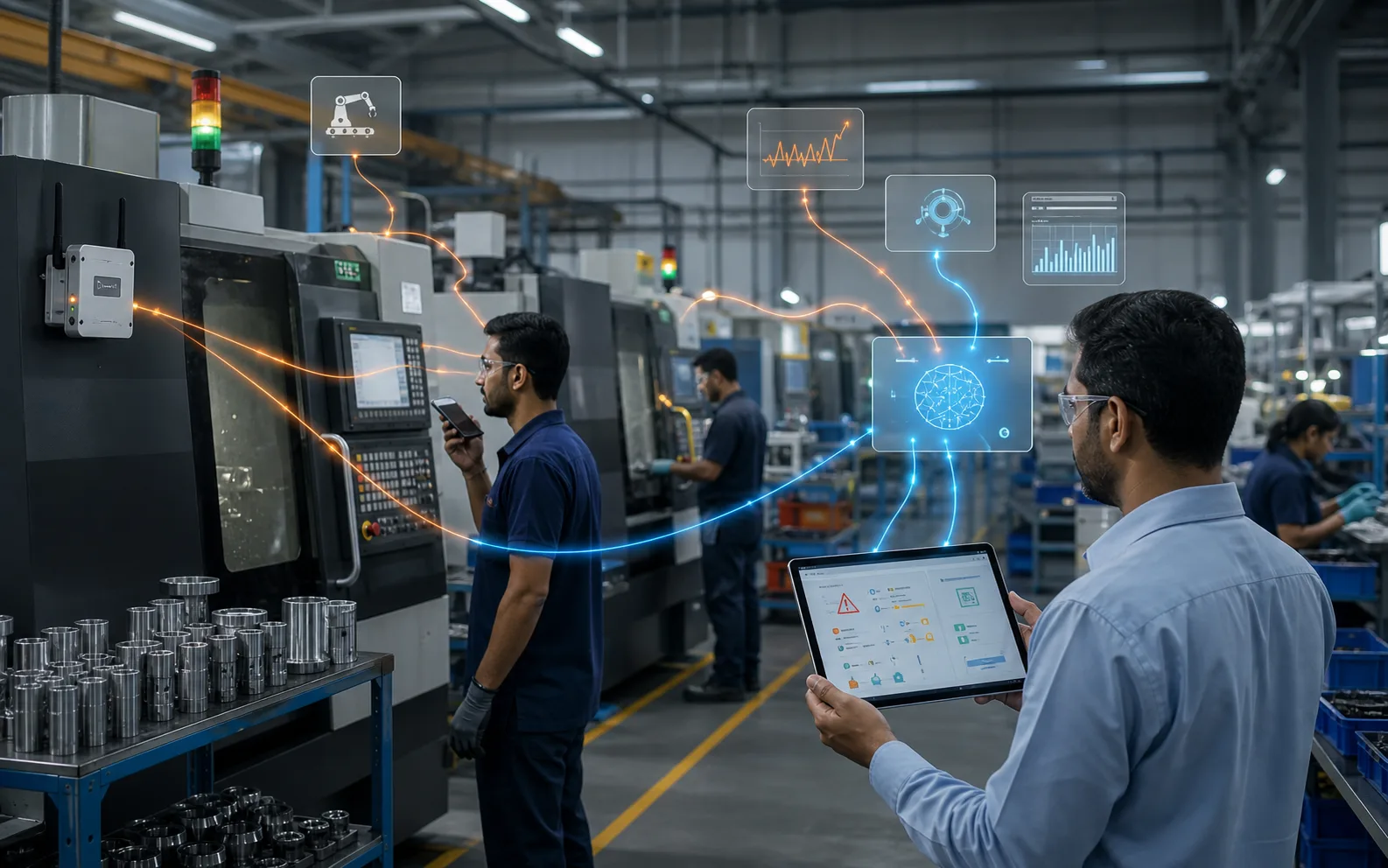
IoT can improve food safety by making important conditions easier to monitor, alert, record, and review. It can help teams see temperature excursions, equipment problems, storage risks, and process deviations earlier than manual checks alone.
But IoT does not make food safe by itself. Food safety still depends on good processes, hygiene, quality checks, trained people, SOPs, supplier control, traceability, and management discipline. IoT is valuable when it supports these controls and triggers action.
AICAN Optiwise helps manufacturers connect inventory, production, quality checkpoints, maintenance, dispatch, and reporting. IoT becomes more useful when its signals connect to these ERP workflows.
What IoT can monitor in food operations
IoT devices can monitor many signals depending on the product and plant.
Common use cases include:
- Cold room temperature
- Freezer temperature
- Storage humidity
- Refrigerated vehicle temperature
- Door-open events
- Equipment runtime
- Machine stoppage
- Energy consumption
- Water or utility conditions where relevant
- Process temperature
- Cleaning or sanitation checkpoints where configured
The best IoT use case is the one tied to a real safety or quality risk.
IoT helps detect problems earlier
Manual checks happen at intervals. IoT can provide more frequent visibility and alerts.
For example:
- A freezer temperature rises overnight.
- A cold room door stays open too long.
- A pasteurization-related process parameter drifts.
- A packaging line stops repeatedly.
- A refrigerated vehicle crosses its temperature limit.
Early detection gives the team more time to act before product quality or safety is affected.
Alerts need clear ownership
Food safety does not improve just because alerts exist. Someone must respond.
Each alert should define:
- Trigger condition
- Responsible person
- Escalation rule
- Response time
- Documentation requirement
- Quality review requirement
- Product hold or release logic
Without ownership, IoT becomes a dashboard that people stop trusting.
Connect IoT with traceability
IoT data is strongest when connected to batch traceability.
If a temperature excursion happens, the company should know:
- Which products were affected?
- Which batches were in that location?
- What quantity was present?
- Was any stock dispatched?
- Which customers received it?
- What quality decision was made?
ERP provides this context. IoT shows the event; ERP shows the business impact.
Use IoT for preventive action
IoT can help identify repeated patterns before they become major failures.
Useful trend analysis includes:
- Repeated cold room excursions
- Equipment stoppage patterns
- Temperature drift by time of day
- Door-open frequency
- High-risk storage zones
- Maintenance triggers
- Energy abnormalities
This helps teams prevent issues instead of only reacting.
Do not overcomplicate the first project
Many companies try to monitor everything at once and then struggle with alerts, data volume, and ownership.
Better starting points include:
- Cold room temperature monitoring
- Freezer monitoring
- Refrigerated vehicle monitoring
- Critical equipment runtime
- Storage humidity where product-sensitive
- Door-open alerts
Start with one problem, define the response workflow, and then expand.
Where Optiwise fits
Optiwise can help connect IoT alerts and readings with ERP workflows such as inventory, batch tracking, quality review, maintenance, dispatch, and reporting.
For food manufacturers, this supports:
- Faster exception visibility
- Batch impact assessment
- Cold storage monitoring
- Equipment maintenance triggers
- Quality hold and release workflows
- Management dashboards
AICAN focuses on technology that helps teams act, not technology that only adds more screens.
Founder’s Note
IoT improves food safety only when it changes response. A sensor that notices a problem but does not trigger ownership is not enough. At AICAN, we believe signals should connect to people, batches, actions, and records. That is how digital monitoring becomes useful on the factory floor. Learn more at About AICAN.
FAQs
Can IoT improve food safety?
Yes. IoT can improve food safety visibility by monitoring temperature, storage conditions, equipment status, transport conditions, and process signals. It supports faster response but does not replace food safety systems.
What is the best IoT use case for food companies?
Cold room, freezer, refrigerated transport, and critical equipment monitoring are strong starting points because they address clear operational risks.
Should IoT connect with ERP?
Yes. ERP adds context such as batch inventory, quality status, dispatch, maintenance, and customer movement, making IoT data actionable.
Can IoT prevent food spoilage?
IoT can reduce spoilage risk by alerting teams earlier, but teams must act on alerts and follow defined SOPs.
What is the biggest IoT mistake in food safety?
The biggest mistake is collecting data without defining who responds, how fast they respond, and how the action is documented.

Related Posts
Is AI Worth the Investment for My Factory?
Learn how to decide if AI is worth the investment for your factory by evaluating use cases, data readiness, costs, risks, ROI, and operational impact.
13 Jun 2026Read more →Manufacturing AI Mistakes to Avoid Before You Start
List manufacturing AI mistakes and controls for unclear use case, messy data, unsafe automation, no owner, weak security and unreviewed recommendations.
13 Jun 2026Read more →What's the Difference Between AI and Regular Automation?
Understand the difference between AI and regular automation in manufacturing, with practical examples for workflows, decisions, alerts, and predictive operations.
13 Jun 2026Read more →What Are the Risks of Using AI in Manufacturing?
Understand the risks of AI in manufacturing, including bad data, wrong recommendations, safety issues, security, job fear, over-automation, and implementation failure.
13 Jun 2026Read more →