
How Can IoT Improve Injection Molding Operations?
Learn how IoT improves injection molding operations through live machine visibility, cycle time tracking, downtime alerts, mold monitoring, rejection analysis, and ERP integration.

How Can IoT Improve Injection Molding Operations?
IoT can improve injection molding operations by making machine performance, cycle time, downtime, mold issues, rejection, and production progress visible in near real time. It helps the plant see problems earlier and understand patterns that are easy to miss in manual reports.
Injection molding is a process where small changes can create large effects. A cycle time drift of a few seconds, a mold cooling issue, a resin drying problem, a machine stoppage, or a cavity problem can affect output, quality, and delivery. If the team only discovers these issues at the end of the shift, recovery becomes harder.
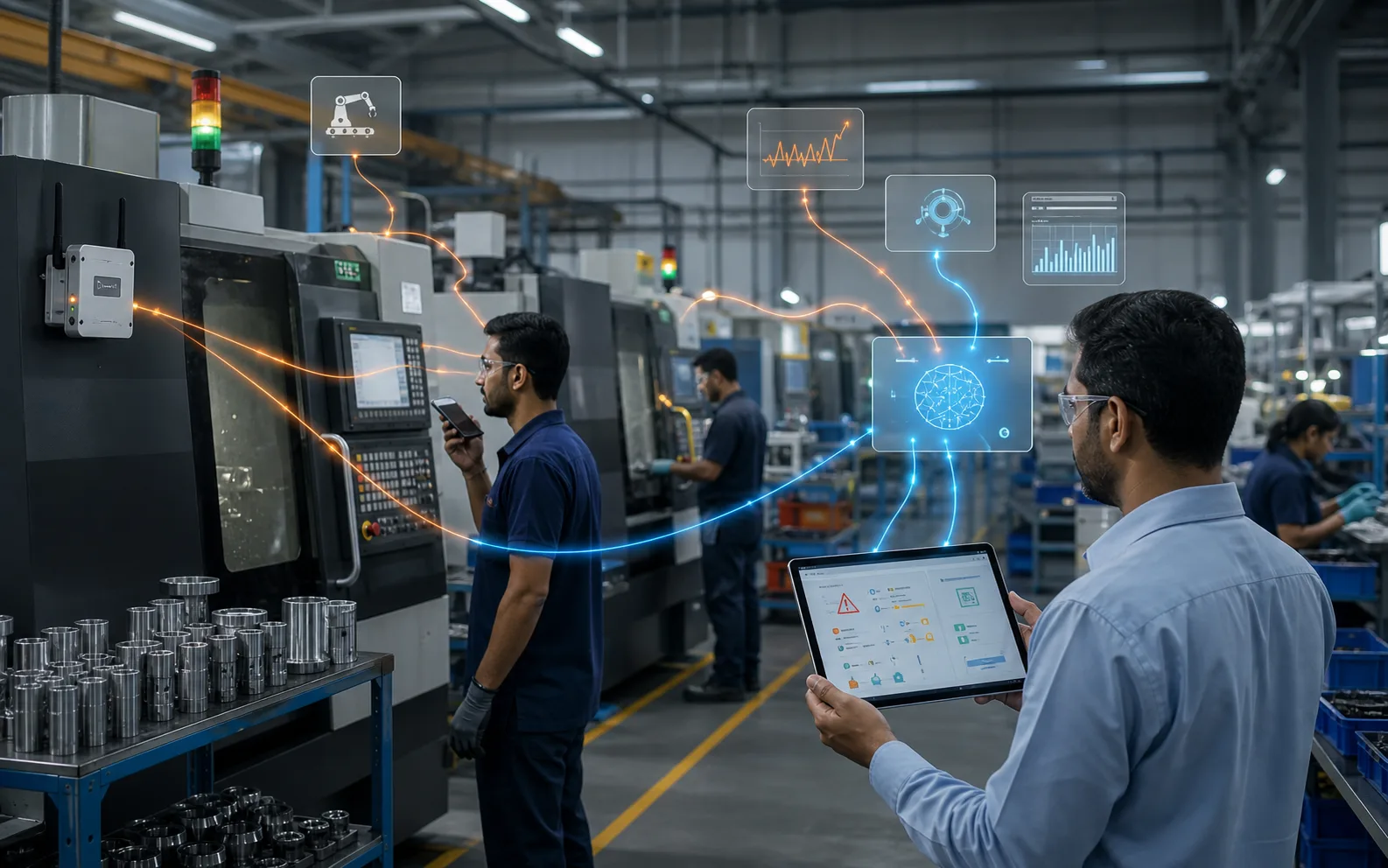
Connect machine data with the work happening on your floor in Optiwise. Use operator, supervisor and IoT inputs alongside production orders, material movements and quality results to track execution in its operating context.
What IoT Can Track In Injection Molding
Depending on the machine and setup, IoT can help track:
- Machine running, idle, stopped, or breakdown status
- Cycle time
- Shot count
- Production quantity
- Downtime duration
- Downtime reason
- Mold change time
- Machine alarms
- Utility or energy signals
- Process conditions where available
- Maintenance alerts
- Operator or shift updates
The factory does not need every signal from day one. It needs the signals that help improve delivery, quality, and machine use.
Cycle Time Visibility
Cycle time is one of the strongest use cases for IoT in injection molding. Manual records often show total output, but they do not show cycle time drift clearly.
IoT can help compare planned cycle time with actual cycle time. If actual time increases, the team can investigate cooling, machine setting, mold condition, material behaviour, or operator handling.
This matters because cycle time directly affects output and costing.
Downtime Alerts
IoT can detect when a machine stops or remains idle beyond a defined threshold. Alerts can be sent to supervisors or maintenance teams.
The alert should include context when possible:
- Machine number
- Current job
- Mold running
- Downtime start time
- Reason if available
- Maintenance status
- Production impact
Without context, alerts create noise. With context, alerts support action.
Mold And Machine Performance
IoT can help compare performance across machine-mold combinations. A mold may run better on one machine than another. A machine may create more stoppages with certain jobs.
When IoT data connects with ERP, the plant can review performance by mold, machine, shift, product, and material batch.
Quality And Rejection Analysis
IoT does not replace quality inspection, but it can support quality investigation. If rejection increases, machine and process data can help identify what changed.
For example, defects may correlate with cycle time drift, repeated stoppage, mold condition, or material batch. Connecting production data with rejection reasons gives the team a better starting point for corrective action.
Maintenance Improvement
IoT can support maintenance by showing repeat stoppages, abnormal runtime patterns, alarms, and machine health indicators where available.
This helps maintenance move from firefighting toward preventive planning.
ERP Integration Matters
IoT data becomes more powerful when connected with ERP. Machine data alone tells what happened. ERP context tells which order, mold, batch, quality status, and dispatch commitment were affected.
AICAN Optiwise helps bring these layers together so IoT visibility becomes part of production control.
Implementation Roadmap
A practical IoT rollout can start with:
- Select critical molding machines.
- Track running, idle, and stopped status.
- Add cycle time and downtime alerts.
- Link machines to production orders and molds.
- Capture downtime reasons.
- Connect rejection and quality data.
- Review weekly improvement actions.
- Expand after data is trusted.
The goal is usable visibility, not excessive data collection.
Founder’s Note
At AICAN, we believe IoT should help teams see the few things that matter while there is still time to act. In injection molding, that usually means cycle time, downtime, mold condition, rejection, and job progress.
AICAN Optiwise is built to connect these signals with ERP workflows. Learn more on About AICAN.
FAQs
What is IoT in injection molding?
It is the use of connected machines, sensors, gateways, and dashboards to monitor molding machine status, cycle time, downtime, production output, maintenance, and quality signals.
Can IoT reduce rejection?
IoT can help identify patterns related to rejection, but reduction happens when teams use the data to correct material, mold, machine, or process issues.
Does every molding machine support IoT?
Many machines can be monitored in some form, but the method depends on controller, machine age, available signals, and plant infrastructure.
Why connect IoT with ERP?
ERP connects machine data to orders, molds, materials, quality, dispatch, and costing, making the data actionable.
Where should a factory start?
Start with critical machines, cycle time, downtime alerts, and job-mold linkage before expanding to deeper process data.
How can AICAN Optiwise help?
AICAN Optiwise helps connect IoT machine data with ERP workflows for production, quality, maintenance, and dispatch.

Related Posts
Is AI Worth the Investment for My Factory?
Learn how to decide if AI is worth the investment for your factory by evaluating use cases, data readiness, costs, risks, ROI, and operational impact.
13 Jun 2026Read more →Manufacturing AI Mistakes to Avoid Before You Start
List manufacturing AI mistakes and controls for unclear use case, messy data, unsafe automation, no owner, weak security and unreviewed recommendations.
13 Jun 2026Read more →What's the Difference Between AI and Regular Automation?
Understand the difference between AI and regular automation in manufacturing, with practical examples for workflows, decisions, alerts, and predictive operations.
13 Jun 2026Read more →What Are the Risks of Using AI in Manufacturing?
Understand the risks of AI in manufacturing, including bad data, wrong recommendations, safety issues, security, job fear, over-automation, and implementation failure.
13 Jun 2026Read more →