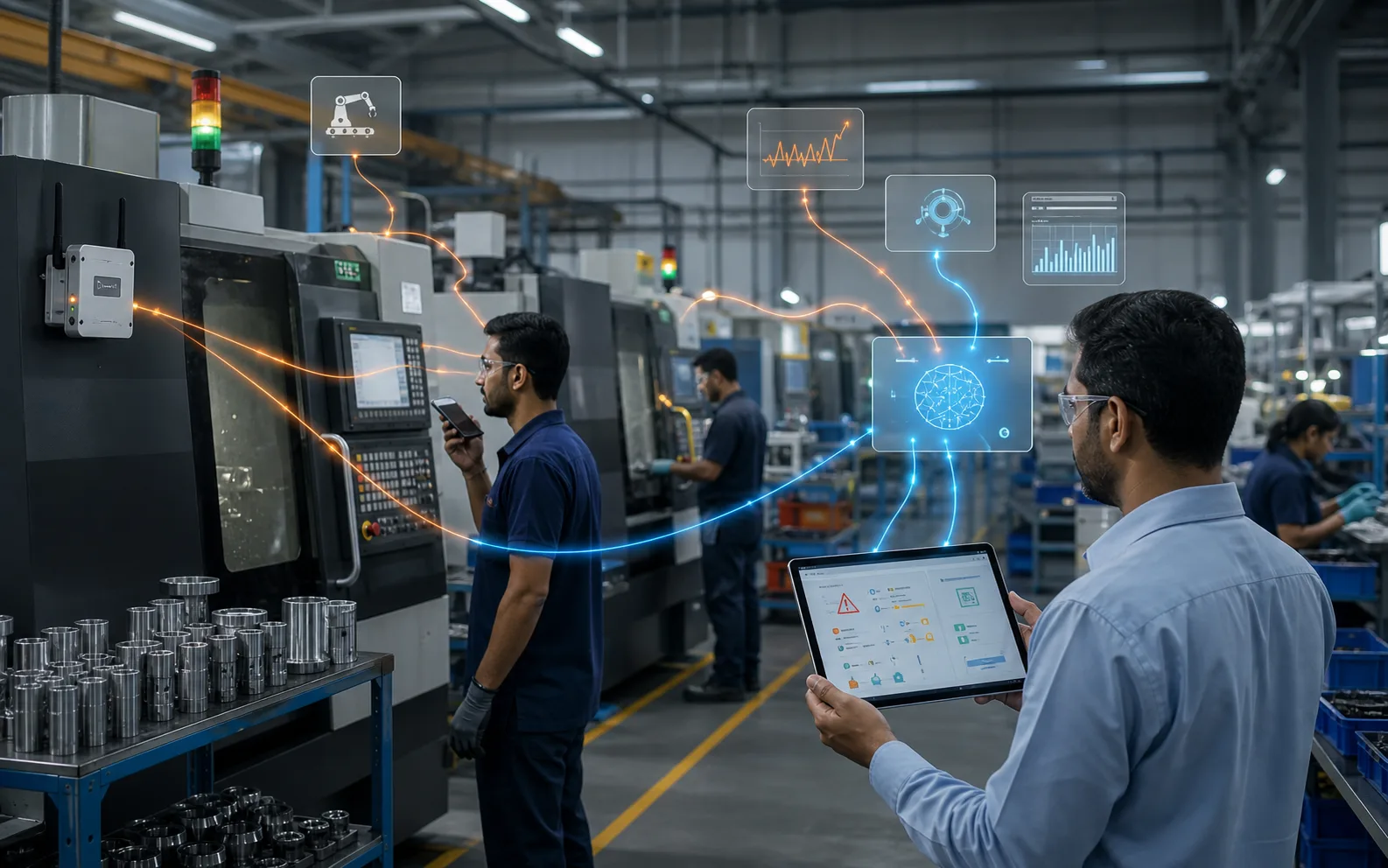
IoT Pilot Projects: Starting Small in Manufacturing
Learn how to plan a practical IoT pilot project for manufacturing without overspending, overbuilding, or overwhelming your factory team.
IoT Pilot Projects: Starting Small in Manufacturing
The safest way to begin IoT in manufacturing is not to connect the whole factory on day one. It is to pick one painful problem, connect only what is needed, prove that the data changes decisions, and then expand.
A good IoT pilot is not a demo. It is a controlled business experiment inside the factory. It should answer a practical question such as: can we reduce unplanned downtime on this machine, understand why this line misses target output, monitor energy waste in this process, or improve traceability for this product family?
If the pilot answers a real question, it builds confidence. If it only shows a shiny dashboard, people may admire it for a week and then return to old habits.
Start With the Pain, Not the Sensor
Many IoT projects begin with the wrong question: "Which sensors should we install?" A better starting point is: "Which decision is currently weak because we do not have timely data?"
For example, a plant may struggle with:
- a bottleneck machine that stops without clear reason
- production reports that arrive only at the end of the shift
- high power consumption with no machine-level visibility
- repeated quality issues without batch-level evidence
- maintenance teams responding too late to early warning signs
- supervisors spending too much time collecting manual updates
Each of these problems may require different data. Some need machine status. Some need cycle counts. Some need temperature, pressure, vibration, current, or energy readings. Some need operator reason codes. Some need ERP integration.
When the pain is clear, the technology becomes easier to choose.
Choose a Pilot Area Where Results Will Be Visible
Do not select a pilot area only because it is easy to instrument. Select an area where improvement matters.
A strong pilot candidate usually has three qualities:
- It affects money, delivery, quality, or customer confidence.
- The current process has poor visibility or slow reporting.
- The team responsible for that area is willing to use the data.
A bottleneck machine is often a good starting point because everyone understands the impact of lost time. A high-energy process can also work because the cost is measurable. A quality-critical line may be ideal if traceability is becoming important for customers.
Avoid starting with a department where nobody owns the result. IoT needs ownership. If no one is responsible for acting on the data, the pilot will not teach much.
Define the Question the Pilot Must Answer
Before buying hardware or configuring dashboards, write the pilot question in plain language.
Examples:
- Can we identify the top three reasons this machine loses production time?
- Can we reduce manual production reporting for this line?
- Can we detect abnormal machine behavior before breakdowns?
- Can we compare energy consumption against actual output?
- Can we create a reliable batch history for customer complaints?
This question becomes the anchor for the whole pilot. It prevents scope creep. It also helps decide what data is required and what can wait.
A pilot that tries to answer ten questions usually answers none properly.
Decide What Data Is Actually Needed
A useful IoT pilot should collect enough data to support the decision, but not so much that the team drowns in signals.
For a downtime pilot, you may need machine status, stop duration, stop frequency, operator reason, shift, product, and production target.
For an energy pilot, you may need machine-level consumption, production count, shift timing, idle time, compressor usage, or batch details.
For a predictive maintenance pilot, you may need readings such as vibration, temperature, current, pressure, cycle count, and maintenance history.
For a quality pilot, you may need inspection results, batch number, operator, machine, setting changes, material lot, and rejection reason.
The key is context. Raw sensor data alone can be misleading. A machine consuming more energy may be producing more output. A longer cycle time may be caused by a product variant. A stoppage may be planned cleaning, not a breakdown.
Involve Operators Early
Operators often know more about machine behavior than any dashboard does. If they are brought in late, they may see the pilot as surveillance. If they are involved early, they can help make the data useful.
Ask operators:
- What problems happen repeatedly?
- Which stoppage reasons are currently unclear?
- Which manual entries are frustrating?
- Which alerts would be useful and which would be noise?
- When should the system ask for input?
Good IoT design respects factory reality. A button placed in the wrong location will not be used. A screen with too many fields will be ignored. An alert that triggers too often will become background noise.
The pilot should make the operator's work clearer, not heavier.
Keep the Dashboard Small and Action-Oriented
The first dashboard should not try to impress management with twenty charts. It should help the team act.
For a production pilot, the dashboard may show:
- target vs actual output
- machine running, idle, or stopped status
- downtime by reason
- top stoppages by duration
- shift-wise performance
- current order or batch context
For an energy pilot, it may show:
- energy per unit produced
- idle energy loss
- peak consumption events
- line-wise energy trend
- abnormal consumption alerts
Every chart should answer a question someone actually asks. If a chart does not lead to a decision, remove it from the pilot view.
Set Success Metrics Before the Pilot Starts
A pilot cannot be judged by excitement. It needs metrics.
Examples of useful success metrics include:
- reduction in unplanned downtime
- improvement in production reporting accuracy
- reduction in manual reporting time
- faster response to stoppages
- clearer top downtime reasons
- lower idle energy consumption
- improved traceability for batches
- fewer disputes between production and maintenance teams
Not every metric must improve immediately. Sometimes the first win is simply discovering the truth. If the pilot shows that stoppages are mostly due to material waiting, not machine failure, that is valuable. The business now knows where to act.
Plan a Realistic Pilot Timeline
A practical IoT pilot can often be structured in stages.
Week one is for problem definition, site assessment, machine selection, team alignment, and success metrics.
Weeks two and three are for installing the necessary sensors, gateways, meters, or data capture points. This stage should include safety checks and minimal production disruption.
Weeks four and five are for dashboard setup, data validation, operator feedback, and correcting wrong assumptions.
Weeks six to eight are for live usage, review meetings, action tracking, and measuring whether the data improves decisions.
The timeline can vary, but the principle remains: do not call the pilot successful just because data is flowing. It is successful when the data is trusted and used.
Avoid Common Pilot Traps
One trap is overbuilding. Teams add too many machines, too many sensors, too many reports, and too many stakeholders. The pilot becomes heavy before it becomes useful.
Another trap is treating IoT as an IT-only project. IT matters, but production, maintenance, quality, and management must own the use case.
A third trap is ignoring data quality. If machine status is wrong, downtime reasons are unclear, or operators do not trust the readings, the dashboard will lose credibility.
A fourth trap is failing to connect the pilot to business systems. IoT data becomes far stronger when it relates to orders, inventory, planning, maintenance, and costing.
Where AICAN Optiwise Fits
AICAN Optiwise helps manufacturers turn factory visibility into operating discipline. A pilot should not remain isolated from the rest of the business. When production data connects with inventory, purchase, sales, finance, and reporting, the value becomes much clearer.
Optiwise is designed for manufacturers who want practical control over daily operations, not just another tool to maintain. You can learn more about AICAN and the company’s manufacturing focus on the About AICAN page.
FAQ
How small can an IoT pilot be?
It can be as small as one machine, one line, one energy meter, or one quality checkpoint. The pilot should be small enough to manage but important enough to matter.
Should we start with production, maintenance, quality, or energy?
Start where the pain is clearest and the owner is ready to act. If downtime is hurting dispatch, start with maintenance and production visibility. If power cost is rising, start with energy monitoring. If complaints are increasing, start with quality traceability.
Do old machines support IoT pilots?
Yes, many old machines can be included through retrofit sensors, counters, gateways, meters, and operator input. Full machine replacement is not required for most first pilots.
How do we know if the pilot worked?
The pilot worked if the team trusts the data and uses it to improve decisions. Metrics may include downtime reduction, reporting accuracy, faster response, better traceability, or clearer cost visibility.
Should the pilot connect with ERP from the beginning?
If possible, yes. Even a limited connection to production orders, item codes, batches, inventory, or maintenance records can make IoT data much more useful.
Founder’s Note
At AICAN, we believe manufacturers should not be forced into large, risky technology projects just to get better control. The best transformation often starts with one honest question on the shop floor.
What is happening? Why is it happening? What should we do now?
A good pilot answers those questions for one important area. Once the team sees the value, expansion becomes a business decision, not a technology gamble.
Final Thought
Start small, but do not start vaguely.
Pick one problem. Define one decision. Capture the right data. Review it with the people who run the factory. Then expand only after the pilot proves that the factory is making better decisions than before.
Related Posts
Is AI Worth the Investment for My Factory?
Learn how to decide if AI is worth the investment for your factory by evaluating use cases, data readiness, costs, risks, ROI, and operational impact.
Manufacturing AI Mistakes to Avoid
Avoid common manufacturing AI mistakes such as unclear use cases, poor data, weak security, no human review, over-automation, and poor adoption planning.
What's the Difference Between AI and Regular Automation?
Understand the difference between AI and regular automation in manufacturing, with practical examples for workflows, decisions, alerts, and predictive operations.
What Are the Risks of Using AI in Manufacturing?
Understand the risks of AI in manufacturing, including bad data, wrong recommendations, safety issues, security, job fear, over-automation, and implementation failure.