
How Do IoT Platforms Handle Data From Multiple Equipment Types?
Learn how IoT platforms collect, normalize, and use data from different manufacturing equipment types, including PLC machines, legacy machines, utilities, sensors, and manual processes.

How Do IoT Platforms Handle Data From Multiple Equipment Types?
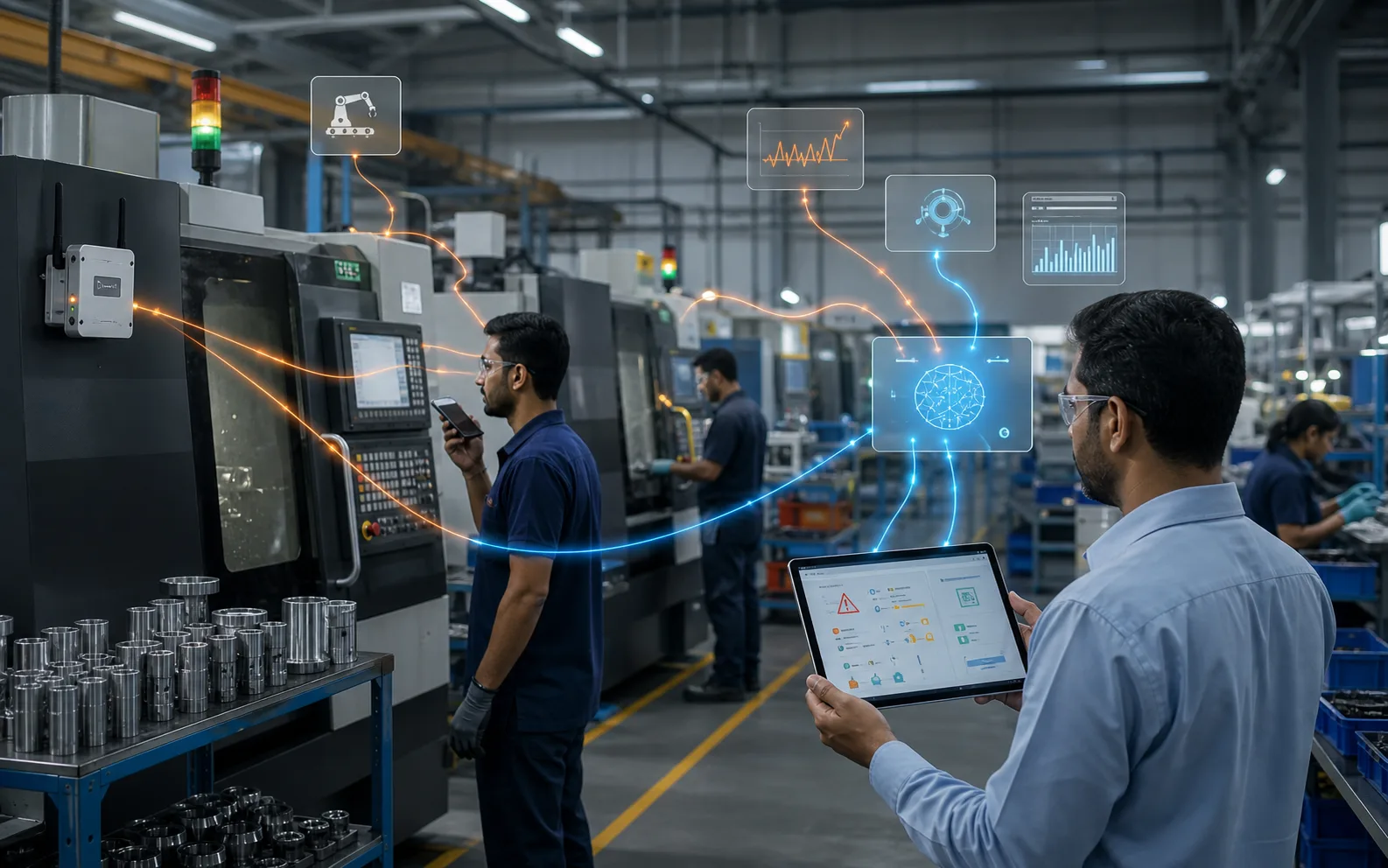
A real factory rarely has one type of equipment. It has newer machines, older machines, utility systems, manual workstations, inspection stations, energy meters, and sometimes equipment from multiple vendors across different years. That mixed environment is normal.
A good IoT platform handles this by collecting data through different methods, converting it into a common structure, and showing it in a way that people can actually use.
The goal is not to make every machine identical. The goal is to make different equipment speak a common operational language.
Different Machines Produce Different Kinds of Data
One machine may provide detailed PLC data. Another may only allow a current sensor to detect running status. A compressor may need pressure and energy readings. A manual station may need operator input. A quality bench may need inspection results and batch information.
Common equipment data sources include:
- PLCs and controllers
- retrofit sensors
- energy meters
- production counters
- gateways
- barcode or QR scanners
- operator terminals
- quality inspection devices
- utility monitoring devices
- ERP or production software
An IoT platform must support this variety without making the factory rebuild everything.
Data Collection Starts at the Equipment Level
For each equipment type, the implementation team decides what data is useful and how to capture it.
For a CNC or automated machine, the system may capture machine state, alarms, cycle count, speed, and operating parameters.
For an older press, it may capture current draw, cycle count, vibration, temperature, and operator reason codes.
For a compressor, it may capture running hours, pressure, energy consumption, load pattern, and abnormal behavior.
For a quality station, it may capture inspection result, defect reason, batch number, operator, and process context.
The data capture method should match the use case.
Normalization Turns Raw Signals Into Useful Meaning
Different equipment may describe the same event differently. One machine may call a state "alarm." Another may show "fault." A current sensor may only show load variation. An operator may select "breakdown" from a reason list.
The IoT platform must normalize these signals into common meanings such as:
- running
- idle
- stopped
- under maintenance
- under setup
- waiting for material
- quality hold
- production count
- downtime duration
- abnormal condition
This normalization is important because management needs comparable information across the factory.
Context Makes the Data Valuable
Raw equipment data becomes much more useful when connected with business context.
For example:
- machine status plus production order shows order impact
- energy meter plus output shows energy per unit
- sensor reading plus maintenance history shows asset risk
- quality result plus batch record improves traceability
- downtime plus inventory status shows whether material caused delay
Without context, equipment data is only a technical reading. With context, it supports decisions.
Dashboards Should Respect Equipment Differences
A single dashboard should not flatten every machine into the same view if the machines do different jobs.
Good dashboards may show common metrics across all equipment, such as status, downtime, output, and alerts. They may also show equipment-specific views, such as compressor pressure, furnace temperature, vibration trends, or inspection defects.
The platform should allow both standardization and flexibility.
Integration With ERP and Operations
Multiple equipment types are easier to manage when the IoT platform connects with ERP or manufacturing workflows.
This helps connect equipment data with:
- production orders
- items and BOMs
- batch records
- inventory movement
- maintenance tickets
- quality inspection
- purchase planning
- sales and dispatch
- costing and finance
The factory then gets a connected view instead of separate equipment dashboards.
Data Quality Must Be Checked for Each Equipment Type
Different equipment creates different data-quality risks.
A retrofit sensor may be mounted incorrectly. A PLC tag may be mapped wrong. An energy meter may need calibration. An operator reason list may be unclear. A gateway may disconnect in one area of the plant.
Validation should be done equipment by equipment:
- does the status match reality?
- are counts accurate?
- are alerts meaningful?
- are readings stable?
- is the mapping correct?
- do users understand the labels?
This protects trust.
Where AICAN Optiwise Fits
AICAN Optiwise helps manufacturers bring operational visibility into connected workflows across production, inventory, purchase, sales, finance, and reporting. Different equipment types matter because every factory has mixed assets and mixed processes.
Optiwise supports the bigger operating goal: turning diverse factory signals into clearer decisions. You can explore AICAN and learn more on About AICAN.
FAQ
Can one IoT platform handle old and new machines together?
Yes, if it supports PLC integration, retrofit sensors, gateways, meters, and operator inputs.
What does data normalization mean?
It means converting different raw signals into common operational meanings such as running, stopped, idle, downtime, output, or alert.
Do all machines need the same sensors?
No. Sensors should match the machine, environment, and business question.
Is ERP integration important for mixed equipment?
Yes. ERP context helps equipment data connect with orders, inventory, maintenance, quality, cost, and dispatch.
What is the biggest risk with multiple equipment types?
The biggest risk is inconsistent data quality. Each equipment connection must be validated before reports are trusted.
Founder’s Note
At AICAN, we know factories are rarely uniform. Modernization has to work with mixed equipment, old machines, manual inputs, and practical constraints.
A good system should bring that variety into one useful operating view, not force the factory into an artificial model.
Final Thought
IoT platforms handle multiple equipment types by collecting data in different ways and turning it into common operational meaning.
The value comes when that meaning connects to production, quality, maintenance, inventory, cost, and delivery decisions.

Related Posts
Is AI Worth the Investment for My Factory?
Learn how to decide if AI is worth the investment for your factory by evaluating use cases, data readiness, costs, risks, ROI, and operational impact.
13 Jun 2026Read more →Manufacturing AI Mistakes to Avoid Before You Start
List manufacturing AI mistakes and controls for unclear use case, messy data, unsafe automation, no owner, weak security and unreviewed recommendations.
13 Jun 2026Read more →What's the Difference Between AI and Regular Automation?
Understand the difference between AI and regular automation in manufacturing, with practical examples for workflows, decisions, alerts, and predictive operations.
13 Jun 2026Read more →What Are the Risks of Using AI in Manufacturing?
Understand the risks of AI in manufacturing, including bad data, wrong recommendations, safety issues, security, job fear, over-automation, and implementation failure.
13 Jun 2026Read more →