
Can IoT Help Me Reduce Downtime and Lost Production?
Learn how IoT helps manufacturers reduce downtime through real-time machine visibility, downtime reason capture, alerts, maintenance planning, and production context.

Can IoT Help Me Reduce Downtime and Lost Production?
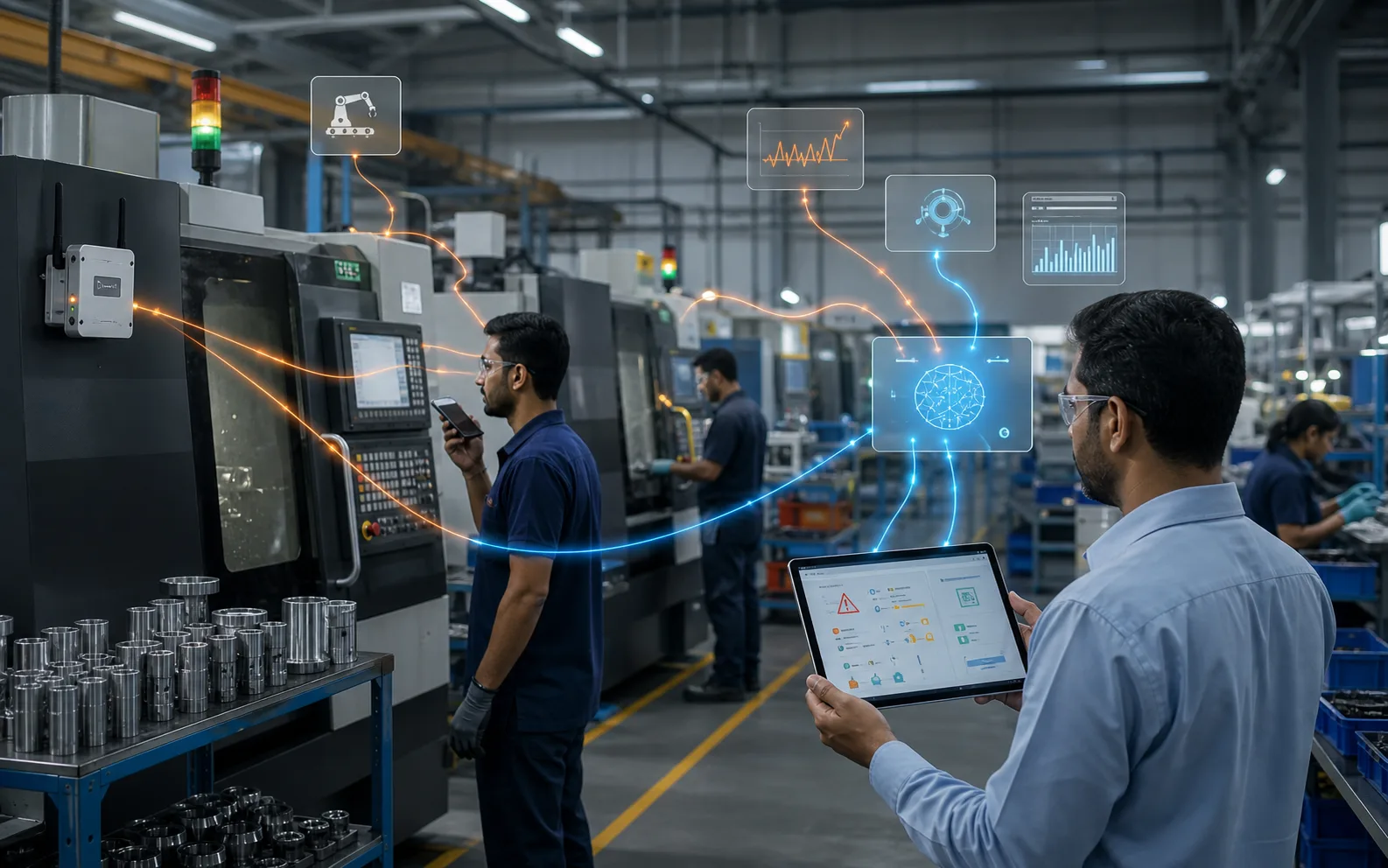
Yes, IoT can help reduce downtime and lost production, but not by itself. It helps by showing when machines stop, how long they stop, why they stop, how often the same problem repeats, and which production orders are affected.
Downtime is expensive because it hides inside daily work. A ten-minute stoppage may not look serious. But if it happens repeatedly, across machines and shifts, it can quietly destroy capacity. Many factories lose more output through small repeated delays than through one major breakdown.
IoT helps turn those hidden delays into visible, measurable, fixable problems.
The First Step Is Measuring Downtime Honestly
Manual downtime records are often incomplete. Operators may be busy. Supervisors may write summaries later. Reasons may be vague. Short stoppages may never be recorded.
IoT can automatically detect when a machine is running, idle, or stopped. This creates a more accurate record of downtime duration and frequency.
But automatic detection is only half the story. The system also needs reason context. A stoppage could be caused by material shortage, tool change, maintenance, quality check, no manpower, setup, cleaning, power issue, or waiting for approval.
When duration and reason come together, downtime becomes actionable.
Downtime Reason Codes Reveal the Real Problem
Factories often assume downtime is mainly a machine problem. Data may show something different.
For example, the top downtime reasons may be:
- material not available
- changeover taking too long
- quality hold
- tool waiting
- maintenance response delay
- operator not assigned
- planning change
- machine breakdown
If the top reason is material waiting, buying better sensors will not solve the issue. The factory needs inventory and planning improvement. If the top reason is changeover, the team may need setup standardization. If the top reason is maintenance response, the maintenance workflow needs attention.
IoT helps by replacing assumptions with evidence.
Real-Time Alerts Reduce Delay
A stoppage that is noticed after 30 minutes is more expensive than one noticed after 3 minutes.
IoT alerts can notify supervisors, maintenance, quality, or planning teams when a machine stops for longer than an acceptable threshold. Alerts can be routed based on reason, machine, shift, or severity.
This reduces response time. It also creates accountability. The team can see not only that downtime happened, but how quickly it was acknowledged and resolved.
Repeated Micro-Stoppages Matter
Some machines do not fail dramatically. They stop briefly again and again. These micro-stoppages are easy to ignore because each one looks small.
IoT can reveal repeated short stops that manual reports miss. This is useful because micro-stoppages often point to deeper problems such as material feeding issues, sensor misalignment, operator intervention, tool wear, lubrication problems, or unstable settings.
Reducing micro-stoppages can improve output without major capital investment.
Link Downtime With Production Orders
Downtime data becomes more powerful when connected with production orders and dispatch commitments.
If a non-critical job is delayed, the response may be different from a priority customer order. If a machine is down but another machine can handle the work, planning can shift. If downtime affects a dispatch date, sales and management need early visibility.
This is why IoT should connect with ERP and production planning. Lost production is not only a machine metric. It is a business impact.
Maintenance Planning Improves With Trend Data
IoT downtime history helps maintenance teams see which assets need attention.
Useful questions include:
- which machine stops most often?
- which machine creates the longest downtime?
- which breakdown reasons repeat?
- which spare parts are used frequently?
- which assets show rising vibration, temperature, or energy use?
- which machines need planned downtime before failure?
This supports preventive and predictive maintenance. The factory can move from reacting to every breakdown toward planning maintenance around real asset behavior.
Reduce Downtime With Weekly Review Discipline
Data does not reduce downtime unless someone reviews it and acts.
A practical weekly downtime review should cover:
- top machines by downtime
- top reasons by duration
- repeated short stoppages
- maintenance response time
- material waiting issues
- quality-related holds
- action owners and due dates
- impact on output and dispatch
This meeting should be short, factual, and action-focused. The goal is not to admire charts. The goal is to remove repeat losses.
Where AICAN Optiwise Fits
AICAN Optiwise helps manufacturers connect downtime visibility with production, inventory, purchase, sales, finance, and reporting. This matters because downtime often begins in one department but affects the whole business.
Optiwise is designed to help teams move from scattered updates to connected operating control. You can explore AICAN and learn more on About AICAN.
FAQ
Can IoT reduce downtime immediately?
It can reveal downtime immediately, but reduction depends on action. The factory must use the data to fix repeated causes.
What downtime data should we collect first?
Start with machine status, downtime duration, downtime reason, shift, product or order, and maintenance response time.
Are short stoppages worth tracking?
Yes. Repeated micro-stoppages can create major lost production over time.
Should downtime alerts go to everyone?
No. Alerts should be routed to the right role based on machine, reason, and severity. Too many alerts create noise.
Is downtime only a maintenance problem?
No. Downtime can come from material, planning, quality, manpower, tooling, setup, utilities, or maintenance. Data helps identify the real cause.
Founder’s Note
At AICAN, we believe downtime should not remain a vague frustration. If a factory is losing production, the team deserves to know where, why, and what action will prevent the repeat.
Good systems make loss visible without turning the workplace into a blame game. That is the balance manufacturers need.
Final Thought
IoT helps reduce downtime by turning lost time into evidence. Measure it accurately, capture the reason, connect it with production impact, and review it until repeated losses disappear.

Related Posts
Is AI Worth the Investment for My Factory?
Learn how to decide if AI is worth the investment for your factory by evaluating use cases, data readiness, costs, risks, ROI, and operational impact.
13 Jun 2026Read more →Manufacturing AI Mistakes to Avoid Before You Start
List manufacturing AI mistakes and controls for unclear use case, messy data, unsafe automation, no owner, weak security and unreviewed recommendations.
13 Jun 2026Read more →What's the Difference Between AI and Regular Automation?
Understand the difference between AI and regular automation in manufacturing, with practical examples for workflows, decisions, alerts, and predictive operations.
13 Jun 2026Read more →What Are the Risks of Using AI in Manufacturing?
Understand the risks of AI in manufacturing, including bad data, wrong recommendations, safety issues, security, job fear, over-automation, and implementation failure.
13 Jun 2026Read more →