
IoT vs. Industry 4.0 Terminology
Understand the difference between IoT and Industry 4.0 in manufacturing, how they overlap, and how factories can use both concepts practically without getting lost in terminology.
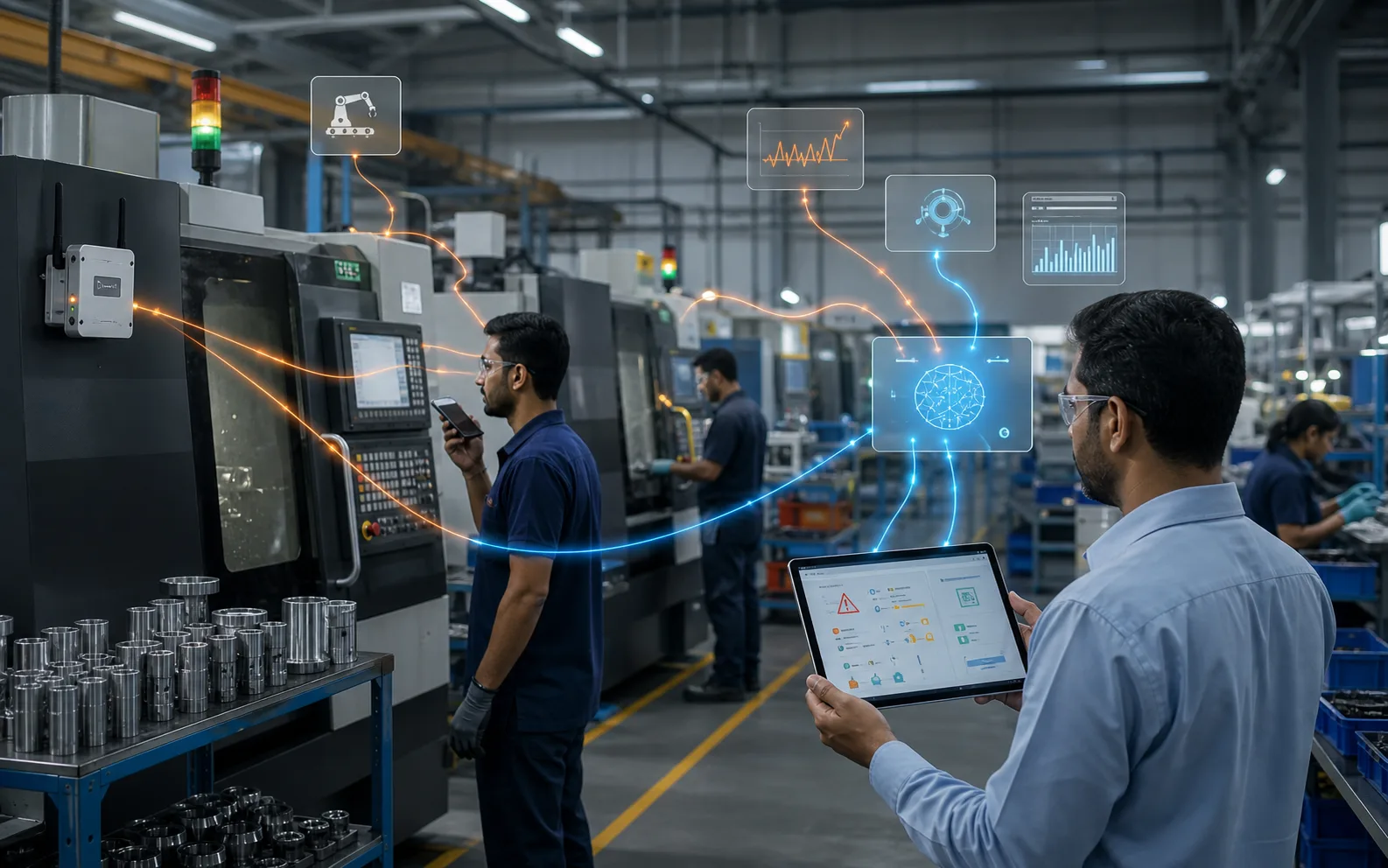
IoT vs. Industry 4.0 Terminology
IoT and Industry 4.0 are related, but they are not exactly the same thing.
Many manufacturers hear both terms in vendor presentations, webinars, proposals, and government or industry discussions. Sometimes the words are used as if they mean the same thing. That can create confusion. A factory owner may wonder whether they need IoT, Industry 4.0, automation, ERP, smart factory, digital transformation, or all of them at once.
The simple way to understand it is this: IoT is one of the technologies that can support Industry 4.0. Industry 4.0 is the broader manufacturing transformation where machines, people, software, data, automation, analytics, and business systems become more connected.
IoT is a building block. Industry 4.0 is the larger operating vision.
What IoT Means in Manufacturing
IoT stands for Internet of Things. In manufacturing, it usually means connecting physical assets such as machines, sensors, meters, gateways, tools, and devices so they can send useful data to software systems.
Manufacturing IoT can capture:
- Machine status
- Production count
- Downtime
- Energy consumption
- Temperature
- Pressure
- Vibration
- Flow
- Utility usage
- Device health
- Operator inputs
- Quality events
The goal is to make factory conditions visible digitally.
For example, instead of asking a supervisor whether a machine is running, the system can show live status. Instead of waiting for an end-of-shift report, production data can be visible during the shift.
IoT is about connected data from the physical factory.
What Industry 4.0 Means
Industry 4.0 is broader than IoT.
It refers to the fourth industrial revolution, where manufacturing becomes more connected, data-driven, automated, and intelligent. It includes IoT, but it can also include robotics, analytics, cloud systems, AI, digital twins, ERP integration, automation, cyber-physical systems, smart supply chains, and advanced production planning.
A practical Industry 4.0 factory may use:
- IoT sensors and gateways
- ERP or manufacturing software
- Real-time dashboards
- Automation systems
- Quality traceability
- Predictive maintenance
- Energy monitoring
- Connected inventory
- Data analytics
- Remote monitoring
- Digital workflows
Industry 4.0 is not one tool. It is a way of making the factory more connected and responsive.
The Relationship Between IoT and Industry 4.0
IoT provides the data foundation for many Industry 4.0 initiatives.
Without machine and process data, advanced manufacturing transformation becomes difficult. A factory cannot optimize what it cannot see. IoT helps capture the live operational data that other systems can use.
For example:
- IoT captures machine downtime.
- Analytics identifies recurring loss patterns.
- Maintenance uses the pattern to plan action.
- ERP or production software adjusts planning.
- Management reviews improvement through dashboards.
That full chain is closer to Industry 4.0. IoT is the part that captures and moves factory data.
Why Terminology Confuses Manufacturers
Terminology becomes confusing because vendors often use broad words to sell narrow tools.
A sensor vendor may call their product Industry 4.0. A dashboard vendor may call a report smart manufacturing. An ERP vendor may use digital transformation language. An automation vendor may use IoT and Industry 4.0 interchangeably.
Manufacturers should not get trapped by the label.
Instead, ask:
- What problem does this solve?
- What data does it capture?
- What workflow does it improve?
- Who will use it?
- How does it connect with production, inventory, quality, and finance?
- What decision becomes faster or better?
The label matters less than the operational improvement.
A Practical Example
Suppose a factory wants to reduce downtime.
An IoT approach may include sensors, PLC integration, gateways, machine status dashboards, and downtime reason capture.
An Industry 4.0 approach may go further. It may connect downtime data with maintenance planning, spare-parts inventory, production scheduling, management reporting, and predictive analysis.
The difference is not that one is better than the other. The difference is scope.
IoT gives visibility. Industry 4.0 connects that visibility into a larger operating system.
What Small Manufacturers Should Focus On
Small and mid-sized manufacturers do not need to start by trying to “become Industry 4.0” in one big step.
Start with a real problem:
- Downtime is unclear
- Reports are delayed
- Inventory and production do not match
- Energy cost is rising
- Quality issues repeat
- Owners lack remote visibility
- Planning is based on assumptions
Then choose the technology that solves that problem. It may be IoT. It may be ERP. It may be workflow digitization. It may be a combination.
The best approach is phased, practical, and measurable.
Common Terms Explained Simply
IoT
Connected devices and machines sending useful data to software.
IIoT
Industrial Internet of Things, usually referring to IoT used in industrial environments such as manufacturing, utilities, and process plants.
Industry 4.0
The broader transformation of manufacturing through connected systems, automation, data, analytics, and intelligent workflows.
Smart Factory
A factory where machines, systems, and people are connected through data-driven workflows.
Digital Transformation
The broader process of using digital systems to improve how the business operates.
ERP
Enterprise Resource Planning software used to manage business and operational workflows such as inventory, purchase, finance, production, and reporting.
Where AICAN Optiwise Fits
AICAN Optiwise sits in the practical manufacturing transformation layer. It helps connect production, inventory, purchase, finance, reporting, and operational visibility so manufacturers can move from scattered data to clearer control.
IoT data becomes more useful when it flows into workflows that teams use every day. Optiwise helps connect the factory’s operational information with business decisions, which is an important step toward practical Industry 4.0 adoption.
AICAN focuses on manufacturing digitization that is grounded in real factory needs, not jargon. You can learn more about the team on the About AICAN page.
FAQ
Is IoT the same as Industry 4.0?
No. IoT is a technology used to connect devices and machines. Industry 4.0 is the broader transformation of manufacturing using connected systems, automation, data, and analytics.
Do I need IoT before Industry 4.0?
Often, IoT is an important starting point because it captures factory data. But Industry 4.0 may also include ERP, quality systems, automation, and workflow digitization.
Is Industry 4.0 only for large factories?
No. Small manufacturers can adopt Industry 4.0 principles in phases by solving practical problems such as downtime visibility, inventory accuracy, and production planning.
What should I focus on first?
Focus on the operational problem, not the terminology. Choose the first project based on measurable pain and business value.
How does AICAN Optiwise support Industry 4.0?
AICAN Optiwise connects manufacturing workflows across production, inventory, purchase, finance, reporting, and operations, helping factories turn data into practical control.
Is smart factory the same as Industry 4.0?
A smart factory is often an outcome of Industry 4.0 adoption. It means the factory uses connected data and systems to operate more intelligently.
Founder’s Note
Manufacturers do not need more jargon. They need clarity.
At AICAN, we believe digital transformation should be explained in factory language. What is delayed? What is hidden? What can be measured? What decision improves? These questions matter more than labels.
Use terminology as a guide, not a distraction.
Final Thought
IoT and Industry 4.0 are connected but different. IoT captures factory data from machines and devices. Industry 4.0 uses connected systems, workflows, automation, and analytics to transform manufacturing operations.
With AICAN Optiwise, manufacturers can take a practical path: start with real operational problems, connect the right data, and build toward a more connected factory step by step.

Related Posts
Is AI Worth the Investment for My Factory?
Learn how to decide if AI is worth the investment for your factory by evaluating use cases, data readiness, costs, risks, ROI, and operational impact.
13 Jun 2026Read more →Manufacturing AI Mistakes to Avoid Before You Start
List manufacturing AI mistakes and controls for unclear use case, messy data, unsafe automation, no owner, weak security and unreviewed recommendations.
13 Jun 2026Read more →What's the Difference Between AI and Regular Automation?
Understand the difference between AI and regular automation in manufacturing, with practical examples for workflows, decisions, alerts, and predictive operations.
13 Jun 2026Read more →What Are the Risks of Using AI in Manufacturing?
Understand the risks of AI in manufacturing, including bad data, wrong recommendations, safety issues, security, job fear, over-automation, and implementation failure.
13 Jun 2026Read more →