
What Is the Difference Between IoT and Traditional Factory Automation?
Understand the difference between IoT and traditional factory automation, including machine control, data visibility, dashboards, alerts, integration, and decision-making.

What Is the Difference Between IoT and Traditional Factory Automation?
Traditional factory automation helps machines run. IoT helps the factory understand what is happening.
That is the simplest way to think about the difference.
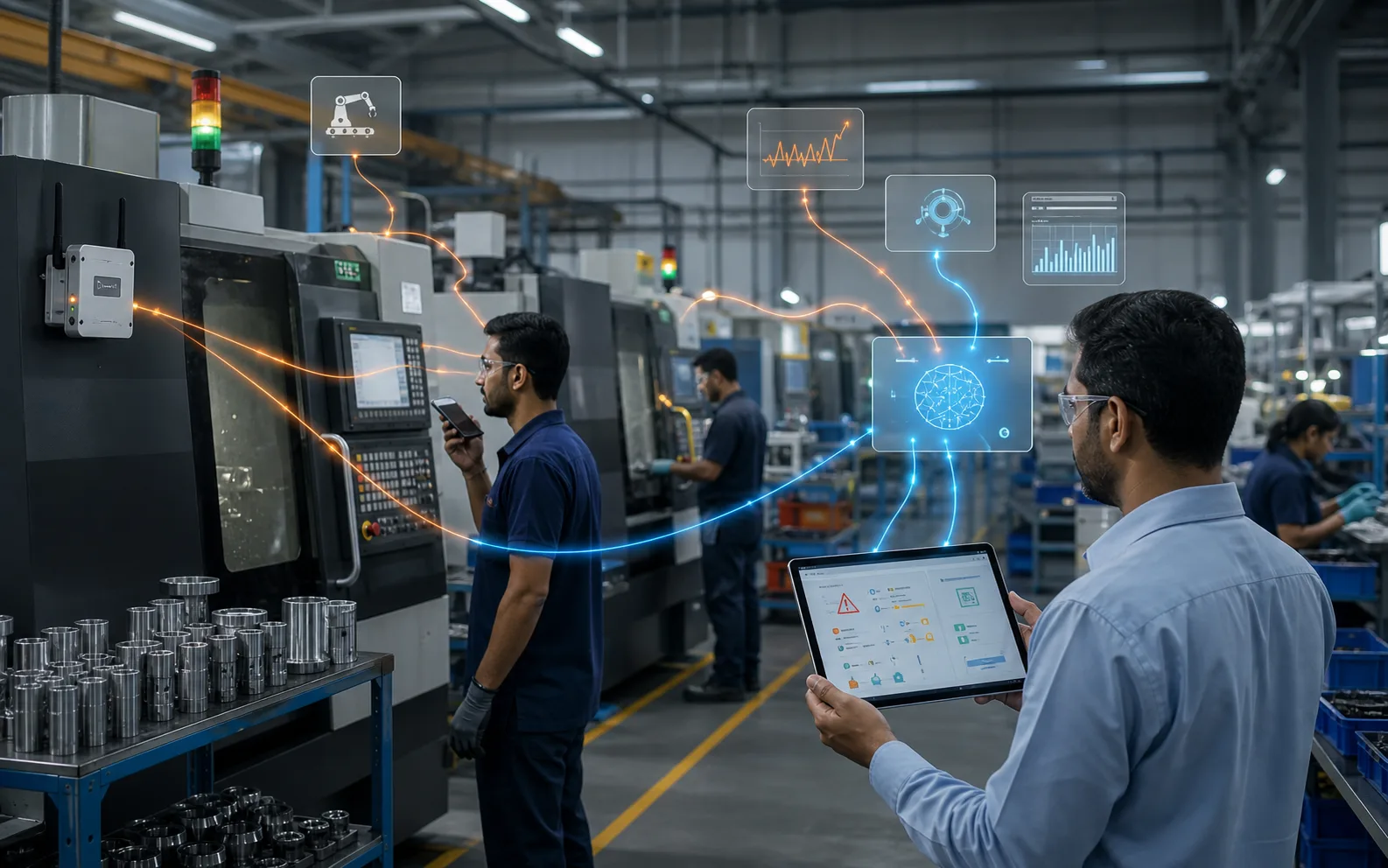
Automation is usually focused on controlling equipment, reducing manual effort, improving repeatability, and executing a process. IoT is usually focused on connecting equipment, collecting data, creating visibility, triggering alerts, and supporting decisions across production, maintenance, quality, inventory, and management.
Both are useful. They are not enemies. In many factories, they work best together.
A PLC may control a machine. Sensors may monitor process conditions. A machine may run automatically. But if the production manager cannot see whether the machine is running the right job, whether output is on plan, whether downtime is repeating, or whether dispatch is at risk, the factory still has a visibility gap.
This guide explains the difference between traditional automation and IoT for Manufacturing, where each one fits, and how AICAN Optiwise helps manufacturers turn connected data into practical operating control.
Traditional Automation Controls the Process
Traditional factory automation is mainly about making equipment perform actions automatically.
Examples include:
- PLC-controlled machines.
- Robotic arms.
- Conveyor systems.
- Automated filling, packing, or assembly lines.
- CNC or VMC machines.
- Automated inspection stations.
- Temperature or pressure control loops.
- SCADA systems for process control.
The focus is control, repeatability, speed, safety, and reduction of manual intervention.
For example, an automated packaging line may fill, seal, label, and count products with minimal manual handling. A PLC may control motor speed, sensor logic, interlocks, alarms, and safety conditions.
Automation helps the process execute correctly.
IoT Connects the Process to Visibility
IoT focuses on collecting and sharing data from machines, sensors, meters, and shop-floor devices.
Examples include:
- Machine running or stopped status.
- Production counts.
- Downtime duration.
- Cycle time.
- Energy consumption.
- Process parameters.
- Equipment alarms.
- Condition signals.
- Alerts and dashboards.
The focus is visibility, monitoring, analysis, and decision support.
For example, IoT may show that a machine stopped for 18 minutes during an urgent order, that the same stop reason has repeated three times this week, and that the current production pace may miss the shift target.
IoT helps teams understand and respond.
Control vs Context
A useful way to compare automation and IoT is control vs context.
Traditional automation controls what the machine does. IoT provides context about what the machine is doing and what it means for the factory.
Automation may answer:
- Is the machine executing the programmed sequence?
- Are sensors and actuators behaving correctly?
- Is the process within control limits?
- Is the machine safe to run?
IoT may answer:
- Is the machine running the planned job?
- Is output on target?
- How much downtime happened?
- What reason caused the stop?
- Is the customer order at risk?
- Should maintenance or planning act now?
Factories need both kinds of answers.
Automation Can Exist Without IoT
Many factories already have automation but still lack visibility.
A machine may be automated, but production data may still be written manually. A line may run with PLC control, but downtime reasons may not be captured. A process may be stable, but management may not see live output or energy usage.
This is common.
Automation improves execution inside the machine or line. It does not automatically create management visibility across the factory.
That is where IoT can add value.
IoT Can Work Without Full Automation
A factory does not need to be fully automated to use IoT.
Older machines, manual workstations, and semi-automatic processes can still provide useful data through sensors, counters, meters, operator inputs, or mobile workflows.
For example:
- A current sensor can detect whether an old machine is running.
- A proximity sensor can count cycles.
- A tablet can capture job start and completion.
- An operator can enter downtime reasons.
- An energy meter can track department-wise consumption.
This is important for small and mid-sized manufacturers. IoT is not only for modern plants. It can improve visibility in mixed environments too.
Automation Improves Repeatability, IoT Improves Learning
Automation helps reduce variation in how work is performed. IoT helps the factory learn from what happens.
Automation can make a process faster and more consistent. IoT can show whether the process is meeting production targets, where downtime is occurring, whether quality is affected, and what patterns repeat.
For example, an automated line may still lose time due to changeover, material waiting, sensor faults, quality holds, or micro-stops. IoT can help reveal these losses.
That data can then support process improvement, maintenance planning, scheduling, and operator training.
Data Flow Is the Big Difference
Traditional automation often keeps data close to the machine or control system. IoT is designed to move useful data into dashboards, alerts, reports, and business workflows.
This does not mean all data should be sent everywhere. It means the right data should reach the right people.
A production manager may need output and downtime. A maintenance engineer may need stop reasons and alarm patterns. A quality manager may need process conditions and rejection links. An owner may need dispatch risk and overall performance.
IoT makes this data flow possible when designed properly.
Where ERP Fits in the Picture
ERP systems usually manage business transactions such as orders, inventory, purchasing, finance, and sometimes production planning.
Automation controls machines. IoT captures shop-floor signals. ERP manages business records.
The strongest factory systems connect these layers.
For example:
- ERP has the customer order.
- Production planning schedules the job.
- Automation runs the machine.
- IoT captures machine status and output.
- Manufacturing software links output, downtime, material, quality, and dispatch.
When these layers are disconnected, teams keep chasing updates manually.
When Should a Factory Choose Automation?
Automation is usually the right focus when the factory needs to:
- Reduce manual handling.
- Improve process repeatability.
- Increase throughput.
- Improve safety.
- Reduce operator dependency.
- Control process parameters.
- Standardize machine operation.
Automation is a process investment. It changes how work is performed.
When Should a Factory Choose IoT?
IoT is usually the right focus when the factory needs to:
- Improve machine visibility.
- Track downtime accurately.
- Monitor production in real time.
- Capture energy or utility data.
- Monitor process conditions.
- Improve maintenance response.
- Reduce manual reporting.
- Connect shop-floor status with management decisions.
IoT is a visibility investment. It changes how information flows.
The Best Factories Use Both
Automation and IoT are strongest when combined.
Automation makes the process reliable. IoT makes the process visible. Manufacturing software connects the data to decisions.
A factory may automate a line, connect machine data through IoT, track production through dashboards, alert maintenance when downtime crosses a threshold, and show management whether customer delivery is at risk.
That is the real value: not technology layers for their own sake, but a factory that runs with better control.
Where AICAN Optiwise Fits
AICAN Optiwise helps manufacturers connect shop-floor visibility with production, inventory, quality, maintenance, and dispatch workflows.
This matters because automation and IoT data become more valuable when tied to factory decisions. A machine signal should connect to the job, the plan, the material, the quality status, and the customer commitment.
Optiwise can help manufacturers work toward:
- Machine and production visibility.
- Downtime tracking connected with work orders.
- Planned vs actual monitoring.
- Alerts for important exceptions.
- Better maintenance and production coordination.
- Management dashboards that connect factory execution with business outcomes.
AICAN builds practical systems for manufacturers that need visibility across both automated and semi-automated operations. Learn more at About AICAN.
FAQ
What is the difference between IoT and factory automation?
Factory automation controls machines and processes. IoT connects machines and devices to collect data, create visibility, trigger alerts, and support decisions.
Can a factory have automation without IoT?
Yes. Many factories have automated machines but still rely on manual reporting for production, downtime, quality, and maintenance visibility.
Can a factory use IoT without full automation?
Yes. IoT can work with older machines, semi-automatic processes, and manual workstations using sensors, meters, counters, gateways, and operator inputs.
Is IoT a replacement for automation?
No. IoT is not a replacement for automation. It complements automation by making machine and process data visible and useful for decisions.
Which should a manufacturer invest in first?
It depends on the problem. If the process itself needs control or speed, automation may be the priority. If the issue is poor visibility, delayed reporting, downtime tracking, or decision-making, IoT may be the better starting point.
How does AICAN Optiwise connect IoT and automation data?
AICAN Optiwise helps connect shop-floor data with production, maintenance, quality, inventory, and dispatch workflows so automated or connected machine data supports real factory decisions.
Founder’s Note
Automation and IoT often get mixed together in conversation, but they solve different problems.
A machine can be automated and still invisible to management. A factory can use IoT and still depend on people for judgement. The goal is not to choose one word over another. The goal is to understand what the factory needs: better control, better visibility, or both.
At AICAN, we believe the most useful technology is the one that fits the operating problem. If automation improves the process, use it. If IoT improves visibility, use it. If both are needed, connect them thoughtfully.
Final Thought
Traditional automation helps work happen. IoT helps teams see what is happening.
Manufacturers should not treat them as competing ideas. Used together, automation, IoT, and connected factory software can create stronger control, clearer visibility, and better daily decisions.

Related Posts
Is AI Worth the Investment for My Factory?
Learn how to decide if AI is worth the investment for your factory by evaluating use cases, data readiness, costs, risks, ROI, and operational impact.
13 Jun 2026Read more →Manufacturing AI Mistakes to Avoid Before You Start
List manufacturing AI mistakes and controls for unclear use case, messy data, unsafe automation, no owner, weak security and unreviewed recommendations.
13 Jun 2026Read more →What's the Difference Between AI and Regular Automation?
Understand the difference between AI and regular automation in manufacturing, with practical examples for workflows, decisions, alerts, and predictive operations.
13 Jun 2026Read more →What Are the Risks of Using AI in Manufacturing?
Understand the risks of AI in manufacturing, including bad data, wrong recommendations, safety issues, security, job fear, over-automation, and implementation failure.
13 Jun 2026Read more →