
Is IoT Worth the Investment for Small Manufacturers?
A practical ROI guide for small manufacturers evaluating IoT investment for downtime, energy, quality, production visibility, maintenance, and dispatch reliability.

Is IoT Worth the Investment for Small Manufacturers?
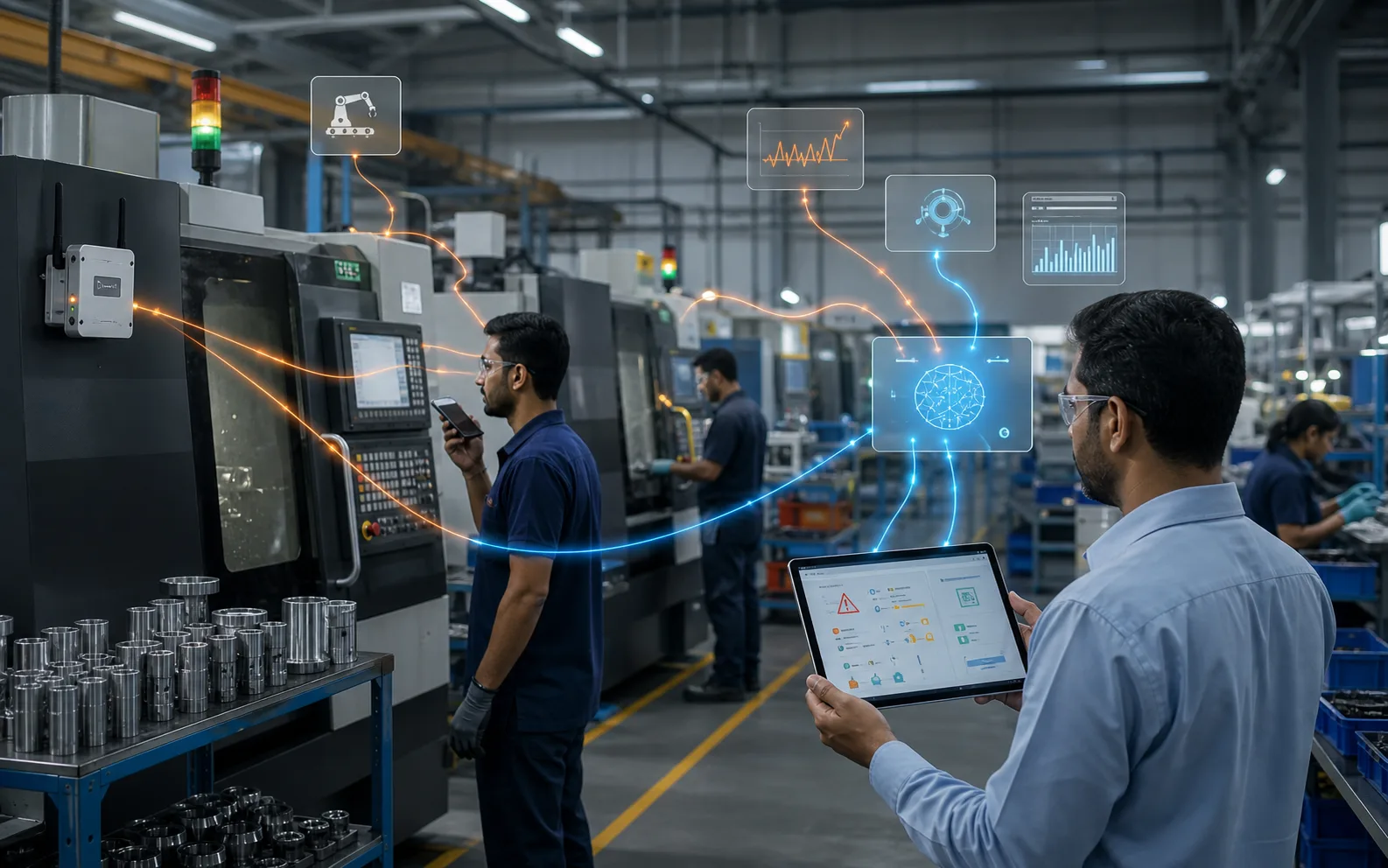
IoT can be worth the investment for small manufacturers when it is tied to a clear loss: downtime, energy waste, poor production visibility, quality problems, maintenance delays, or dispatch uncertainty. It is not worth it when it is purchased only because it sounds modern.
Small manufacturers usually cannot afford technology experiments that do not improve operations. That is why the first IoT project must be focused, measurable, and practical.
The right question is not, "Should small manufacturers use IoT?" The better question is, "Which factory problem is expensive enough that better data would pay for itself?"
Start With the Cost of the Blind Spot
Every factory has blind spots. Some are minor. Some are expensive.
A blind spot may be:
- not knowing why machines stop
- discovering production shortfall too late
- seeing energy waste only through the monthly bill
- investigating quality complaints without batch evidence
- reacting to maintenance only after breakdown
- relying on manual reports that are delayed or inaccurate
- missing dispatch risk until the last moment
If the blind spot costs money every month, IoT may be worth evaluating.
Downtime Is Often the Easiest ROI Case
For small manufacturers, a few critical machines may control a large part of output. If one machine stops often, the business suffers quickly.
IoT can track running time, stoppage time, reason codes, micro-stoppages, maintenance alerts, and production impact. If the data helps reduce repeated downtime, the investment can make sense.
The ROI does not need to come from replacing people. It may come from recovering lost production hours.
Energy Savings Can Be Practical
Energy cost can be painful for small manufacturers because margins are often tight. IoT energy monitoring can show machine-wise consumption, idle power, energy per unit, peak load patterns, and utility waste.
The first energy project can be narrow: one compressor, one high-load machine, one process, or one department.
If the data helps reduce idle energy, improve scheduling, or identify abnormal consumption, it can support ROI.
Quality Traceability Protects Customer Trust
Small manufacturers often win business through trust and responsiveness. A quality complaint can damage that trust if the factory cannot explain what happened.
IoT and digital workflows can connect inspection results with batch, machine, material lot, operator, and process conditions. This helps the team investigate complaints faster and prevent repeat issues.
Even if direct savings are harder to calculate, traceability can protect customer relationships.
Start Small to Control Risk
Small manufacturers should not begin with a plant-wide IoT rollout unless there is a strong reason. A focused pilot is safer.
Good pilot options include:
- one bottleneck machine
- one energy-heavy process
- one quality-critical line
- one maintenance-critical asset
- one production line with poor reporting
The pilot should have a clear success metric. For example, reduce unplanned downtime, improve reporting accuracy, lower idle energy, or reduce investigation time for quality issues.
Include People and Process in the ROI
IoT does not create value only through hardware. It creates value when people use the information.
ROI depends on:
- whether operators enter reason codes correctly
- whether supervisors review data daily
- whether maintenance acts on alerts
- whether owners use reports for decisions
- whether planning adjusts based on real output
- whether corrective actions are tracked
A small manufacturer may get strong value from a simple system if the review discipline is strong.
Avoid Overbuying
Small manufacturers should be careful with oversized systems. A platform with advanced features is not useful if the team only needs downtime, output, and energy visibility in the first phase.
Start with the problem. Add features only when they support a decision.
This keeps cost controlled and adoption easier.
Where AICAN Optiwise Fits
AICAN Optiwise is built for manufacturers who need practical operating control across production, inventory, purchase, sales, finance, and reporting. For small manufacturers, that connected foundation matters because every delay, stock issue, quality problem, and cost leak can affect cash flow.
Optiwise helps teams move away from scattered updates and toward clearer decisions. You can explore AICAN and learn more on About AICAN.
FAQ
Is IoT too expensive for small manufacturers?
Not if the scope is focused. A small pilot on one important machine or process can be more practical than a large rollout.
What is the best first IoT use case for a small factory?
Downtime, production count, energy monitoring, or quality traceability are common starting points because the losses are easier to understand.
How should ROI be measured?
Measure reduced downtime, recovered output, energy savings, lower rework, less manual reporting, faster maintenance response, or better dispatch reliability.
Should small manufacturers wait until they have ERP?
ERP or manufacturing software strengthens IoT value, but a focused IoT pilot can start first. The best path depends on the problem.
What is the main risk?
The main risk is buying technology without ownership or action. Data must be reviewed and used.
Founder’s Note
At AICAN, we believe small manufacturers deserve technology that respects their reality. The system should solve real problems, fit daily work, and improve control without becoming another burden.
IoT is worth it when it helps a business see and fix what is already costing money.
Final Thought
Small manufacturers do not need big-company complexity. They need focused visibility where it matters most.
Start with one painful loss. Prove value. Then expand with confidence.

Related Posts
Is AI Worth the Investment for My Factory?
Learn how to decide if AI is worth the investment for your factory by evaluating use cases, data readiness, costs, risks, ROI, and operational impact.
13 Jun 2026Read more →Manufacturing AI Mistakes to Avoid Before You Start
List manufacturing AI mistakes and controls for unclear use case, messy data, unsafe automation, no owner, weak security and unreviewed recommendations.
13 Jun 2026Read more →What's the Difference Between AI and Regular Automation?
Understand the difference between AI and regular automation in manufacturing, with practical examples for workflows, decisions, alerts, and predictive operations.
13 Jun 2026Read more →What Are the Risks of Using AI in Manufacturing?
Understand the risks of AI in manufacturing, including bad data, wrong recommendations, safety issues, security, job fear, over-automation, and implementation failure.
13 Jun 2026Read more →