
Legacy Factory Modernization With IoT
Learn how manufacturers can modernize legacy factories with IoT using retrofit sensors, gateways, operator input, ERP integration, and phased rollout.
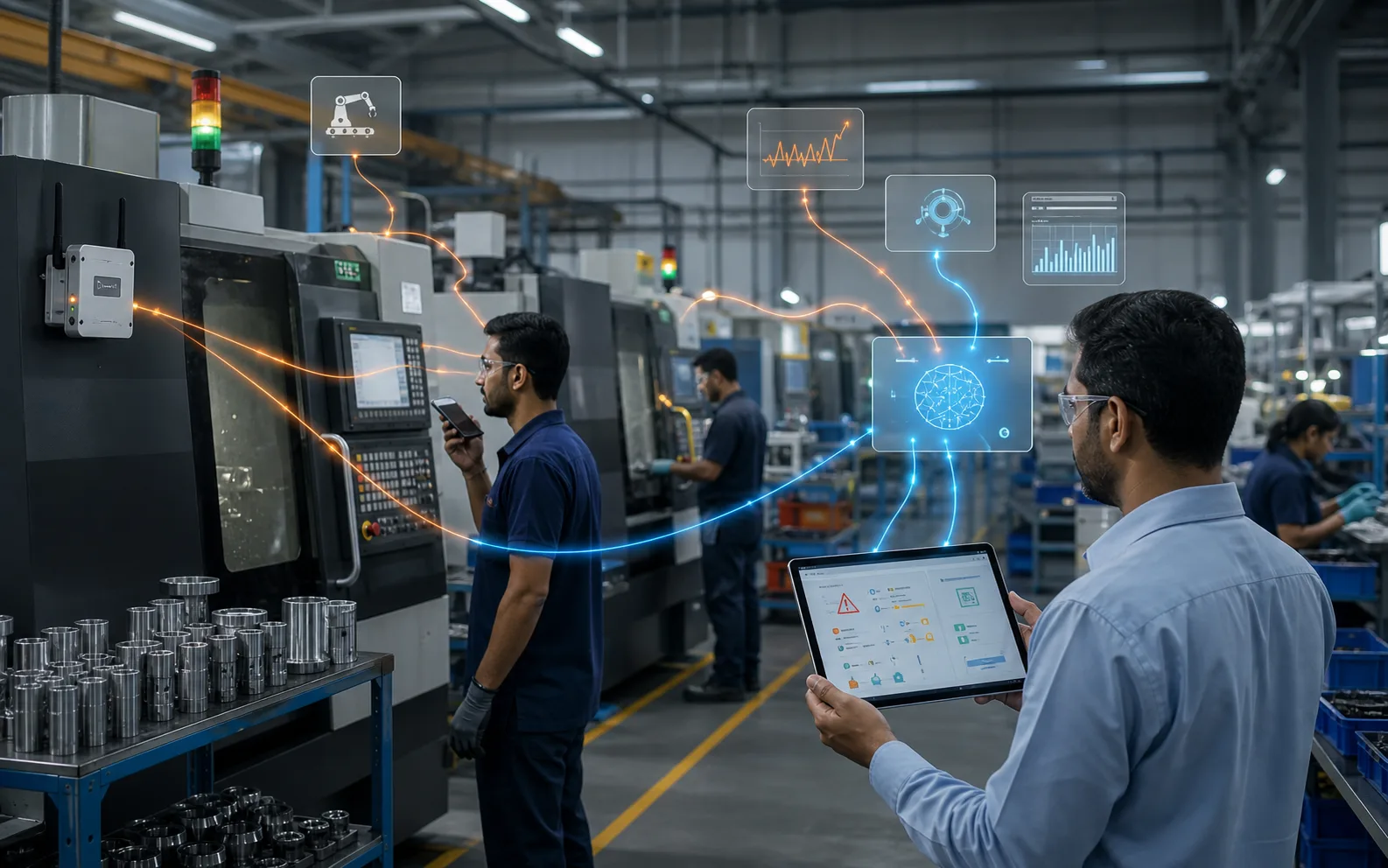
Legacy Factory Modernization With IoT
A factory does not become outdated only because the machines are old. It becomes outdated when the business cannot see what those machines are doing, why production is delayed, where quality issues begin, or how costs are changing.
Many manufacturers assume modernization means replacing machines, buying expensive automation, or rebuilding the plant around new technology. That is not always true. IoT can help modernize a legacy factory in stages by connecting existing equipment, capturing important signals, and turning shop-floor activity into usable business data.
The goal is not to make the factory look futuristic. The goal is to make it more visible, predictable, and easier to manage.
Legacy Machines Are Not the Real Problem
Old machines can still produce good output. Many are reliable, familiar to operators, and already paid for. The problem is usually not the age of the machine. The problem is lack of timely information.
In many legacy factories:
- machine status is known only by walking the floor
- production counts are entered manually
- downtime reasons are discussed after the shift
- energy consumption is seen only at the bill level
- quality records are disconnected from machine conditions
- maintenance history is not linked to actual asset behavior
- owners depend on calls and messages for basic updates
This creates a management delay. By the time the information reaches decision-makers, the loss has already happened.
IoT modernization reduces that delay.
Modernization Does Not Require Replacing Everything
A practical IoT approach works with what the factory already has. Depending on the machine and use case, data can be captured through:
- sensors for vibration, temperature, pressure, proximity, speed, or current
- energy meters for machine-wise or line-wise consumption
- counters for production quantity or cycles
- PLC data where available
- gateways that collect and transmit machine signals
- operator screens for downtime reasons and manual context
- barcode or QR scanning for material, batch, and quality traceability
Some machines may provide direct digital signals. Others may need retrofit devices. Some processes may require operator input because the machine alone cannot explain the reason for a stoppage.
The best modernization plan respects this mix.
Start With the Most Expensive Blind Spot
Legacy factories often have many possible improvement areas. Trying to modernize all of them at once can create confusion. Start with the blind spot that hurts the business most.
Common starting points include:
- bottleneck machine downtime
- inaccurate production reporting
- high energy consumption
- poor batch traceability
- repeated quality rejection
- material waiting time
- delayed maintenance response
- unclear work-in-progress status
A good first project should have visible pain, clear ownership, and measurable impact. For example, if one machine controls output for a major product line, monitoring its downtime and performance may be more useful than connecting ten low-impact machines.
Use Retrofit Sensors Carefully
Retrofit sensors are powerful because they allow old machines to become visible without major replacement. But they must be selected and placed carefully.
A vibration sensor can help detect abnormal behavior, but only if the baseline is understood. A current sensor can show machine activity, but it may not explain why the machine stopped. A counter can show output, but it may not separate good units from rejected units. An energy meter can show consumption, but it needs production context to reveal efficiency.
This is why IoT design should include process understanding. The question is not only, "Can we measure this?" The question is, "Will measuring this help us act?"
Combine Machine Data With Operator Knowledge
Legacy factories run on human experience. Operators often know when a machine sounds wrong, which setting causes trouble, which material lot behaves differently, and which stoppages happen repeatedly.
Modernization should capture that knowledge instead of ignoring it.
For example, machine status can show that a machine stopped for 18 minutes. Operator input can explain whether the reason was tool change, material wait, quality check, no manpower, power issue, cleaning, or breakdown.
Without operator context, dashboards can become incomplete. With operator context, the data becomes useful for improvement.
The system should make input easy: simple reason codes, clear screens, minimal typing, and timing that matches the actual workflow.
Connect IoT With ERP and Business Workflows
A common modernization mistake is creating a separate IoT dashboard that never connects with the rest of the business. The production team sees one system, inventory sees another, purchase uses another, finance uses spreadsheets, and management gets a summary later.
IoT data becomes more valuable when it connects with ERP workflows:
- production orders
- item codes
- batches
- raw material movement
- quality checks
- maintenance tickets
- purchase planning
- inventory levels
- dispatch commitments
- costing and finance reports
For example, knowing that a machine stopped is useful. Knowing that the stoppage affects a specific customer order, consumes extra energy, delays dispatch, and increases cost is far more useful.
Legacy modernization should not create another data island. It should reduce the number of disconnected islands.
Build a Phased Roadmap
A practical roadmap for legacy factory modernization can look like this:
Phase one: visibility. Capture machine status, production counts, downtime, and basic alerts for one important area.
Phase two: context. Add operator reason codes, product details, batch information, shift data, and quality records.
Phase three: action. Connect alerts with maintenance, planning, inventory, and management review.
Phase four: optimization. Use trends to reduce downtime, improve energy efficiency, identify recurring issues, and refine scheduling.
Phase five: scale. Expand to more machines, lines, departments, or plants only after the first area is stable.
This phased approach protects the business from overinvestment and helps teams adopt the system gradually.
Train Teams on Decisions, Not Just Screens
Training should not only teach people where to click. It should teach them what decisions the system supports.
Supervisors should know how to use downtime trends. Maintenance should know how to review abnormal machine behavior. Quality should know how to connect rejection with production conditions. Owners should know how to read performance without micromanaging every entry.
If the team understands the decision behind the dashboard, adoption improves. If they see only extra data entry, adoption suffers.
Where AICAN Optiwise Fits
AICAN Optiwise supports manufacturers who want modernization to connect with daily operations. For legacy factories, this matters because the goal is not just machine data. The goal is better control over production, inventory, purchase, sales, finance, reports, and management decisions.
Optiwise helps bring operational visibility into a structured manufacturing system so teams can move from scattered updates to clearer action. You can learn more about AICAN and the people building the product on About AICAN.
FAQ
Can old machines be connected to IoT?
Yes. Many old machines can be connected using retrofit sensors, meters, counters, gateways, PLC access where available, and operator input. The method depends on the machine and the business question.
Do we need to replace machines for modernization?
Not always. If the machine is mechanically useful, IoT can often improve visibility without replacement. Replacement should be based on productivity, reliability, safety, and cost, not only on age.
What should a legacy factory modernize first?
Start with the area where lack of visibility is causing measurable loss. Bottleneck downtime, energy waste, poor traceability, and delayed production reporting are common first choices.
Is operator input still needed after IoT?
Yes. Machines can show signals, but operators often provide context. The best systems combine automatic data capture with simple human input.
How do we avoid creating another disconnected dashboard?
Connect IoT data with ERP workflows such as production orders, inventory, quality, maintenance, purchase, dispatch, and finance. Otherwise, the system may create visibility without business action.
Founder’s Note
At AICAN, we respect the reality of Indian manufacturing. Many factories have machines that still work well, teams that know the process deeply, and constraints that make full replacement unrealistic.
Modernization should not punish that reality. It should build on it.
Our view is that a legacy factory can become much smarter when the right data is captured, connected, and used by the people responsible for daily decisions. That is the kind of practical modernization Optiwise is built to support.
Final Thought
Legacy modernization is not about making old factories look new. It is about helping good factories run with better visibility, faster response, and stronger control.
Start with one blind spot. Connect the right data. Make the decision better. Then expand with confidence.

Related Posts
Is AI Worth the Investment for My Factory?
Learn how to decide if AI is worth the investment for your factory by evaluating use cases, data readiness, costs, risks, ROI, and operational impact.
13 Jun 2026Read more →Manufacturing AI Mistakes to Avoid Before You Start
List manufacturing AI mistakes and controls for unclear use case, messy data, unsafe automation, no owner, weak security and unreviewed recommendations.
13 Jun 2026Read more →What's the Difference Between AI and Regular Automation?
Understand the difference between AI and regular automation in manufacturing, with practical examples for workflows, decisions, alerts, and predictive operations.
13 Jun 2026Read more →What Are the Risks of Using AI in Manufacturing?
Understand the risks of AI in manufacturing, including bad data, wrong recommendations, safety issues, security, job fear, over-automation, and implementation failure.
13 Jun 2026Read more →