
How Do Companies Use Machine Learning With IoT Data?
Learn how manufacturers use machine learning with IoT data for predictive maintenance, quality insights, energy optimization, demand planning, anomaly detection, and productivity improvement.

How Do Companies Use Machine Learning With IoT Data?
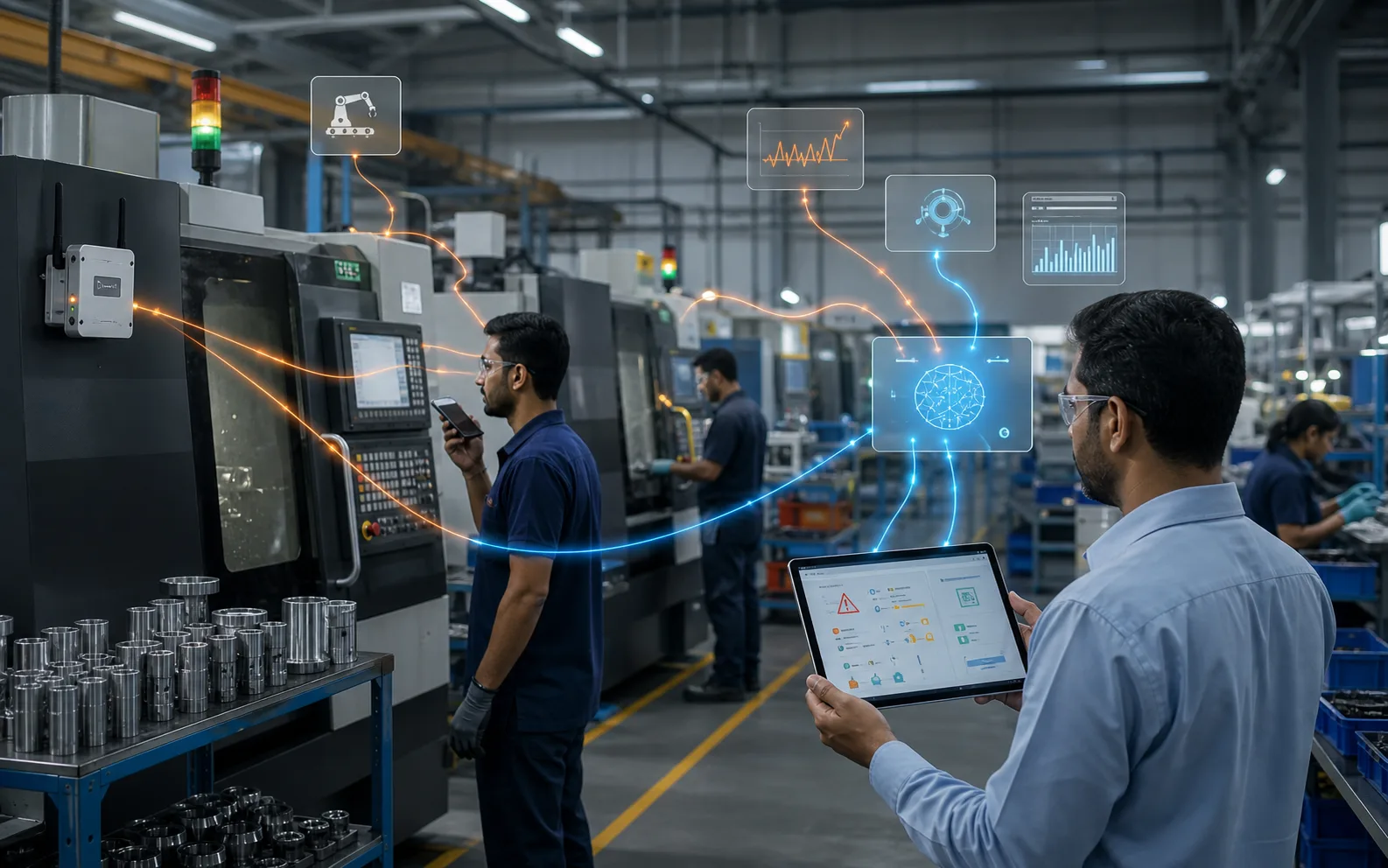
Machine learning becomes useful in manufacturing when there is enough reliable data to find patterns that people may miss. IoT provides that data from machines, sensors, meters, production lines, quality checks, maintenance records, and operator inputs.
But machine learning is not the first step for most factories. The first step is clean data and clear use cases. If the factory cannot trust machine status, downtime reasons, production counts, energy readings, or quality records, advanced analytics will not solve the problem. It will only make weak data look sophisticated.
Used properly, machine learning can help manufacturers detect abnormal behavior, predict risk, identify quality patterns, reduce waste, and improve planning.
Machine Learning Needs Good Factory Data
Machine learning models learn from historical and live data. In manufacturing, that data may include:
- machine status
- downtime history
- vibration
- temperature
- current
- pressure
- speed
- cycle time
- production count
- energy consumption
- quality results
- maintenance actions
- material lot
- operator input
- batch information
The model is only as useful as the data. If downtime reasons are inconsistent, quality results are entered late, or machine readings are not validated, insights may be unreliable.
This is why factories should build data discipline before expecting machine learning to deliver value.
Predictive Maintenance
One of the most common uses is predictive maintenance. Machine learning can study patterns in vibration, temperature, current, pressure, energy, and stoppage behavior to identify early signs of failure.
For example, a model may learn that a specific combination of vibration increase and current variation often appears before a bearing issue. Or it may detect that a machine is behaving differently from its normal baseline.
The output should not be treated as a magic answer. It should be a decision signal for maintenance teams to inspect, plan, and prioritize.
Quality Prediction
Machine learning can help quality teams find relationships between process conditions and defects.
A model may analyze:
- temperature during production
- pressure variation
- cycle time
- machine speed
- tool condition
- material lot
- operator shift
- inspection results
- rejection reasons
If certain conditions repeatedly lead to defects, the system can alert the team earlier. This can reduce rework and scrap.
The value is strongest when quality data is connected with production and process data.
Energy Optimization
Machine learning can also help identify abnormal energy use and efficiency opportunities.
For example, the model may compare energy consumption against output, product type, shift, machine condition, and idle time. It can identify when a machine is consuming more energy than expected for the same production level.
This helps teams investigate issues such as leaks, poor scheduling, equipment wear, idle running, or inefficient settings.
Anomaly Detection
Anomaly detection means identifying behavior that is unusual compared with normal operation.
This can apply to:
- machine vibration
- temperature
- energy use
- cycle time
- production output
- quality trend
- downtime frequency
- operator entries
An anomaly does not always mean failure. It means something changed enough to deserve attention. In a factory, that early attention can prevent bigger losses.
Production Planning and Bottleneck Insights
Machine learning can support planning by analyzing historical production performance, downtime, product mix, changeovers, and capacity constraints.
It may help answer:
- which jobs are likely to miss schedule?
- which product combinations create delays?
- which machines become bottlenecks under certain loads?
- how should maintenance downtime be planned?
- which shift patterns affect output?
This is useful only when connected with ERP and production planning data. IoT alone shows the floor. Business context shows why the floor matters.
Start With Clear Questions
Manufacturers should not begin by asking, "How can we use machine learning?" They should ask:
- which failures do we want to predict?
- which defects do we want to prevent?
- which energy losses do we want to reduce?
- which planning decisions are repeatedly wrong?
- which anomalies matter enough to act on?
A model without a decision is just analysis.
Where AICAN Optiwise Fits
AICAN Optiwise helps manufacturers build the connected operating foundation that advanced analytics needs: production, inventory, purchase, sales, finance, reporting, and operational visibility.
Machine learning becomes more useful when IoT data is connected with the business context around orders, materials, quality, maintenance, and cost. You can explore AICAN and learn more on About AICAN.
FAQ
Do manufacturers need machine learning before IoT?
Usually no. IoT and digital workflows create the data foundation. Machine learning becomes useful after reliable data is available.
Can machine learning predict all failures?
No. It can identify patterns and risk signals, but not every failure is predictable.
What is the best first machine learning use case?
Predictive maintenance, quality pattern detection, anomaly detection, and energy optimization are common starting points.
Does machine learning replace engineers?
No. It supports engineers by highlighting patterns and risks. People still diagnose, decide, and act.
What makes machine learning fail in factories?
Poor data quality, unclear use cases, no action ownership, and lack of integration with operations are common reasons.
Founder’s Note
At AICAN, we believe advanced analytics should be earned by good operating data. Factories do not need buzzwords. They need systems that capture reality, connect context, and help people make better decisions.
Machine learning can be powerful, but only when it has a real manufacturing question to answer.
Final Thought
Machine learning with IoT data is not about replacing judgment. It is about helping teams notice patterns earlier and act with better evidence.
Start with reliable data. Ask a clear question. Use the insight inside the daily workflow.

Related Posts
Is AI Worth the Investment for My Factory?
Learn how to decide if AI is worth the investment for your factory by evaluating use cases, data readiness, costs, risks, ROI, and operational impact.
13 Jun 2026Read more →Manufacturing AI Mistakes to Avoid Before You Start
List manufacturing AI mistakes and controls for unclear use case, messy data, unsafe automation, no owner, weak security and unreviewed recommendations.
13 Jun 2026Read more →What's the Difference Between AI and Regular Automation?
Understand the difference between AI and regular automation in manufacturing, with practical examples for workflows, decisions, alerts, and predictive operations.
13 Jun 2026Read more →What Are the Risks of Using AI in Manufacturing?
Understand the risks of AI in manufacturing, including bad data, wrong recommendations, safety issues, security, job fear, over-automation, and implementation failure.
13 Jun 2026Read more →