
What Are the Main Types of Industrial Automation Sensors?
Explore the main types of industrial automation sensors used in factories, including proximity, photoelectric, pressure, temperature, vibration, current, flow, level, and vision sensors.
What Are the Main Types of Industrial Automation Sensors?
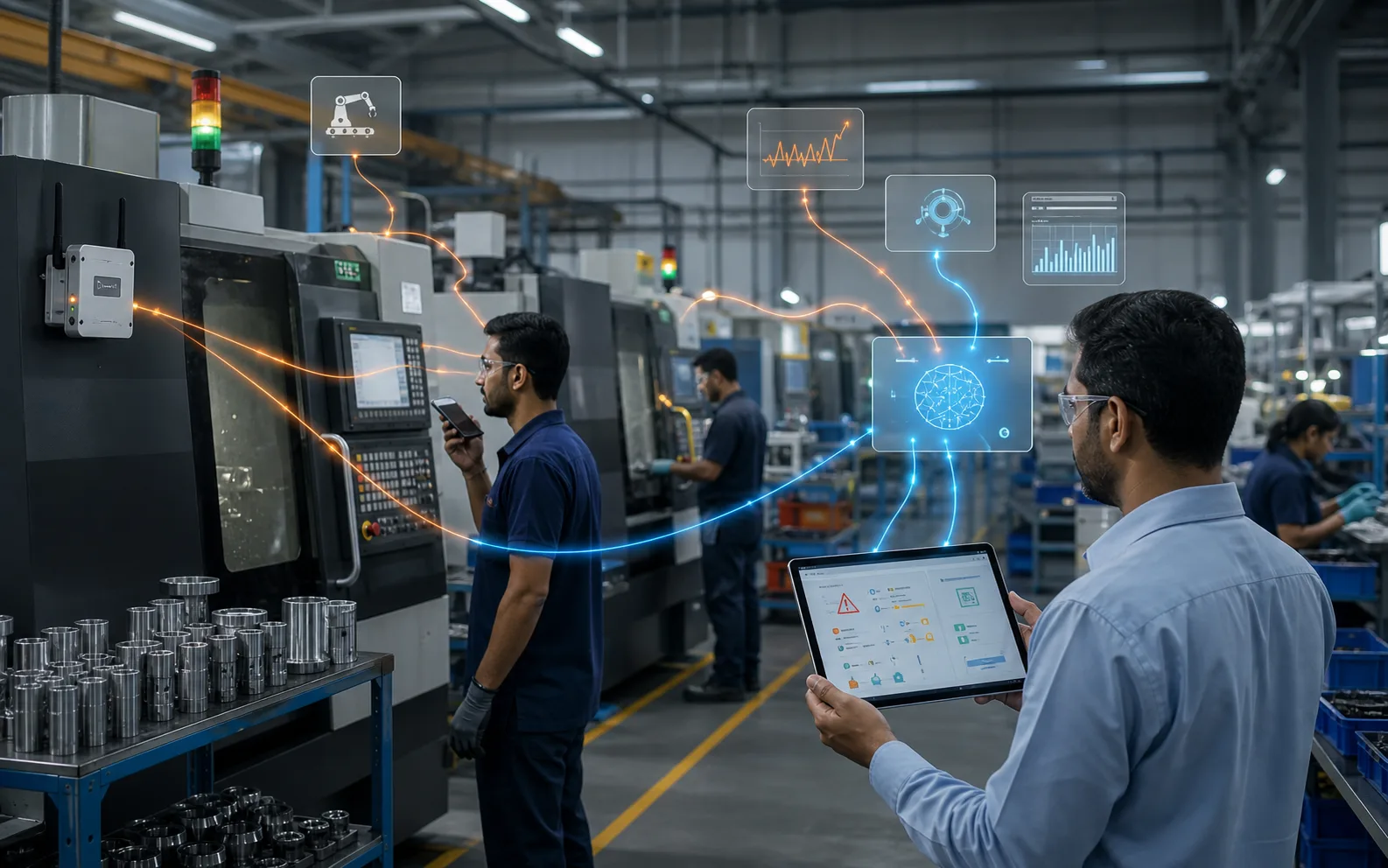
Industrial automation sensors are the devices that help machines and systems understand what is happening in the physical world.
They detect presence, distance, position, pressure, temperature, vibration, current, flow, level, speed, and other process conditions. Without sensors, automation is blind. With the right sensors, a factory can monitor machines, detect problems, count production, protect quality, support maintenance, and improve decisions.
For manufacturers evaluating AICAN Optiwise, sensor selection should always connect back to the operating goal. The factory does not need every sensor type. It needs the right sensors for the losses and decisions that matter.
Proximity sensors
Proximity sensors detect whether an object is present without physical contact.
They are commonly used for part detection, position confirmation, counting, machine cycle detection, and safety-related visibility. In manufacturing, they can help confirm whether a component reached the correct location or whether a machine action occurred.
Inductive proximity sensors are often used for metal detection. Capacitive sensors may detect non-metal materials depending on application.
Photoelectric sensors
Photoelectric sensors use light to detect objects, distance, or interruption of a beam.
They are useful on conveyors, packaging lines, counting applications, object detection, alignment checks, and automation sequences. They can detect objects where contact is not practical.
Factories often use photoelectric sensors when products are moving quickly or when detection needs to happen without touching the part.
Pressure sensors
Pressure sensors measure pressure in air, gas, hydraulic, pneumatic, water, steam, or process systems.
They are useful for monitoring compressed air, pumps, hydraulic systems, filters, process lines, and leak conditions. A pressure drop may indicate leakage or blockage. High pressure may indicate unsafe or abnormal operation.
Pressure monitoring can support both efficiency and equipment protection.
Temperature sensors
Temperature sensors measure heat in machines, motors, bearings, ovens, furnaces, panels, storage areas, or process environments.
Temperature changes can indicate equipment stress, process drift, quality risk, or safety issues. In some factories, temperature control is central to product quality.
Common sensor types may include thermocouples, RTDs, infrared sensors, or other temperature measurement devices depending on the application.
Vibration sensors
Vibration sensors monitor mechanical movement and vibration patterns.
They are especially useful for rotating equipment such as motors, pumps, compressors, fans, spindles, and bearings. Abnormal vibration can suggest imbalance, misalignment, looseness, wear, or developing failure.
Vibration sensors are often used in maintenance programs where early warning can prevent unexpected breakdowns.
Current and power sensors
Current sensors and power meters monitor electrical load and consumption.
They can help detect whether a machine is running, idle, overloaded, or consuming abnormal energy. They are useful for energy management, machine-state detection, and identifying equipment stress.
For older machines, current sensing can be a practical way to capture basic operating status without full controller integration.
Flow sensors
Flow sensors measure the movement of liquids, gases, air, coolant, lubricants, chemicals, or process fluids.
They are used where flow affects machine performance, cooling, lubrication, process quality, or utility cost. Low flow may indicate blockage, pump trouble, valve issues, or leakage. High flow may indicate waste or abnormal operation.
Flow sensors are common in process industries and utility systems.
Level sensors
Level sensors measure material or liquid level in tanks, bins, hoppers, silos, or containers.
They help avoid shortages, overflow, machine starvation, and manual checking delays. Level sensing is useful when production depends on steady material availability.
Depending on the material, technologies may include ultrasonic, radar, float, capacitive, or pressure-based level measurement.
Vision sensors and cameras
Vision sensors and industrial cameras can inspect presence, orientation, dimension, label, defect, or assembly correctness.
They are more complex than simple sensors but can be valuable where quality inspection, counting, positioning, or traceability depends on visual confirmation.
Vision systems need proper lighting, mounting, calibration, and maintenance. They should be used where visual data adds clear value.
Choosing the right sensor mix
A factory often needs a combination of sensors.
A downtime project may use current and proximity sensors. A maintenance project may use vibration and temperature sensors. A utility project may use flow, pressure, and energy sensors. A quality project may use temperature, pressure, vision, or position sensors.
The sensor mix should follow the use case.
Where AICAN Optiwise fits
AICAN Optiwise helps manufacturers connect industrial sensor data into dashboards, alerts, and operational insights. The platform supports the larger goal: turning physical factory signals into better production, maintenance, energy, and management decisions.
AICAN builds for manufacturers that need practical connected systems rather than disconnected data points. You can learn more at About AICAN.
Founder’s Note
The main sensor types are easy to list. The harder and more important work is choosing the right one for the right problem. A good automation project starts with the decision the factory wants to improve, then selects the sensor that reveals the truth behind that decision.
FAQs
What are the most common industrial sensors?
Common types include proximity, photoelectric, pressure, temperature, vibration, current, power, flow, level, and vision sensors.
Which sensor is best for downtime monitoring?
It depends on the machine. Current sensors, proximity sensors, machine-state signals, or controller data may be used.
Which sensors help predictive maintenance?
Vibration, temperature, current, pressure, and flow sensors often support maintenance insight.
Are vision sensors necessary for every factory?
No. Vision sensors are useful when visual inspection, orientation, defect detection, or traceability needs justify the complexity.
How should I choose sensors for automation?
Start with the use case, define the needed signal, check the environment, and choose a sensor reliable enough for the decision.

Related Posts
Is AI Worth the Investment for My Factory?
Learn how to decide if AI is worth the investment for your factory by evaluating use cases, data readiness, costs, risks, ROI, and operational impact.
13 Jun 2026Read more →Manufacturing AI Mistakes to Avoid Before You Start
List manufacturing AI mistakes and controls for unclear use case, messy data, unsafe automation, no owner, weak security and unreviewed recommendations.
13 Jun 2026Read more →What's the Difference Between AI and Regular Automation?
Understand the difference between AI and regular automation in manufacturing, with practical examples for workflows, decisions, alerts, and predictive operations.
13 Jun 2026Read more →What Are the Risks of Using AI in Manufacturing?
Understand the risks of AI in manufacturing, including bad data, wrong recommendations, safety issues, security, job fear, over-automation, and implementation failure.
13 Jun 2026Read more →