
Mobile Access to Factory Data via IoT
Learn how mobile IoT access helps manufacturing owners, supervisors, and maintenance teams see factory data, alerts, and production risks from anywhere.

Mobile Access to Factory Data via IoT
Factory data is most useful when the right person can see it at the right moment.
That person is not always sitting in front of a desktop screen. The owner may be traveling. The plant head may be in a meeting. The supervisor may be walking the floor. The maintenance engineer may be near the machine. Dispatch may need a quick update before calling a customer.
Mobile access to factory data helps close that gap.
But mobile access should not mean everyone watches every metric all day. It should mean the right alerts, dashboards, and approvals are available when they help a decision.
For manufacturers evaluating AICAN Optiwise, mobile IoT access is valuable when it improves responsiveness without creating noise.
Owners get visibility without constant calls
In many growing factories, the owner becomes the information hub.
Every production delay, material issue, customer update, and machine problem eventually reaches them through calls or messages. That may work when the factory is small, but it becomes exhausting as the business grows.
Mobile IoT access allows owners to check key operating signals directly: machine status, production progress, downtime, delivery risk, and exceptions. This does not replace conversations with the team. It makes those conversations sharper.
Instead of asking, “What is happening?” the owner can ask, “Why did Line 3 stop twice after lunch?”
That is a different level of control.
Supervisors can act while moving
Supervisors rarely sit in one place.
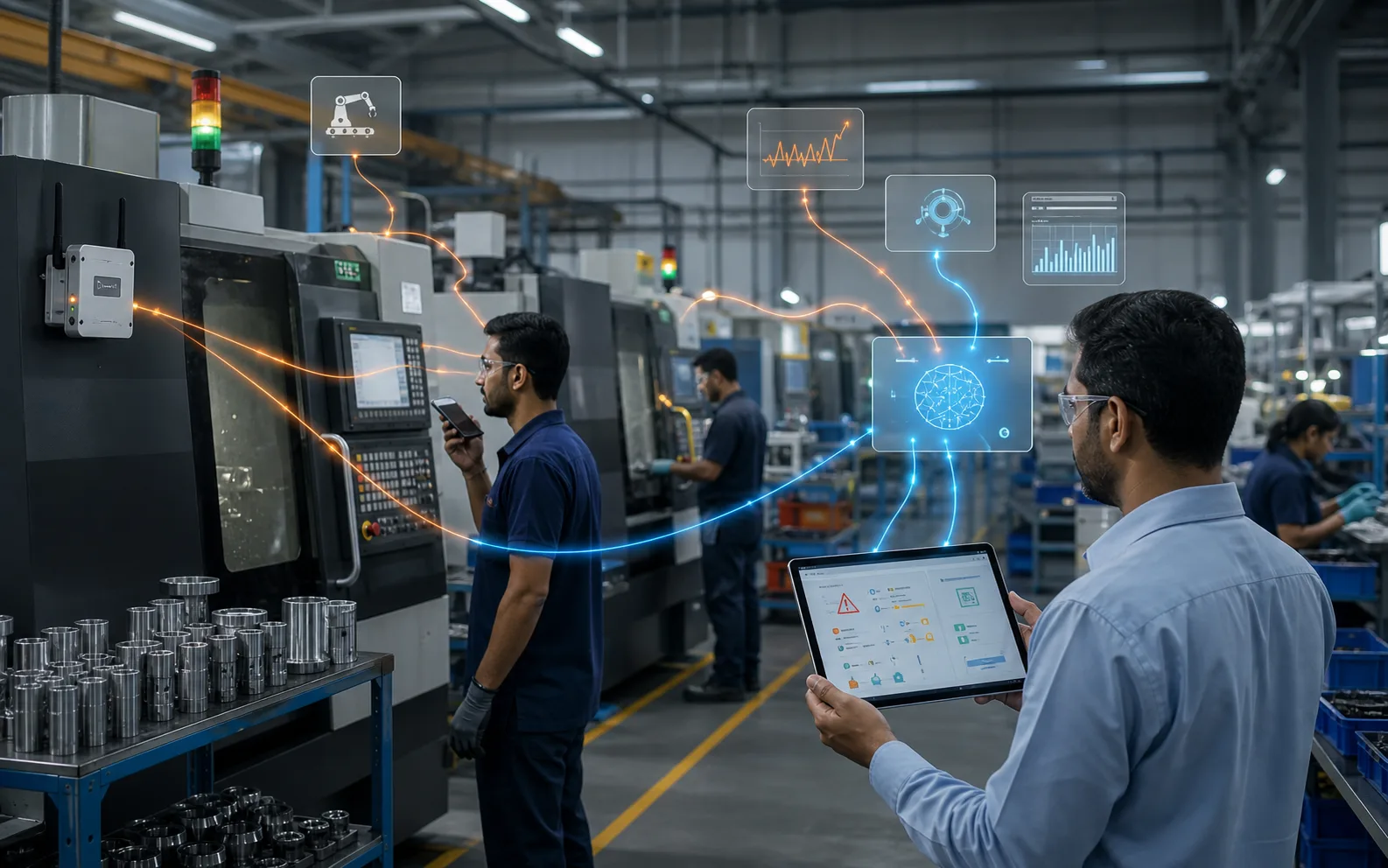
They move between machines, operators, stores, maintenance, quality, and planning. A mobile or tablet view can help them see alerts, confirm downtime reasons, review shift progress, and respond to exceptions while staying close to the work.
This is especially useful when the factory floor is large or when one supervisor handles multiple areas.
The mobile view should be simple. A supervisor does not need a full executive dashboard on a small screen. They need the next useful action: which machine needs attention, which job is falling behind, which alert is unresolved, and what needs escalation.
Maintenance response can become faster
Maintenance teams benefit when machine history and alerts are accessible near the equipment.
If an engineer receives a stoppage alert and can see recent alarms, previous issues, running history, and downtime notes from a mobile device, the first response becomes more informed. They may still need tools and inspection, but they are not starting blind.
Mobile access can also help record action taken, update status, or close an issue after verification.
This creates better maintenance history over time.
Mobile alerts need discipline
Too many alerts can make mobile access annoying.
If every small event sends a notification, users will mute the system. A good mobile IoT setup should prioritize alerts by role and importance.
For example:
- operators may need local prompts
- supervisors may need machine stoppage and production-risk alerts
- maintenance may need repeated faults or abnormal-condition alerts
- owners may need only major exceptions and summary views
Alert rules should be reviewed after go-live. The goal is not maximum notifications. The goal is useful attention.
Security matters more on mobile
Mobile access increases convenience, but it also increases security responsibility.
The platform should use proper authentication, role-based access, and a process to remove users when they leave the company. Sensitive production or customer information should not be visible to people who do not need it.
Manufacturers should also think about lost phones, shared devices, vendor access, and whether mobile users can export data.
Convenience should not weaken control.
Mobile access should not replace shop-floor discipline
A mobile dashboard is not a management system by itself.
If the team does not capture downtime reasons, respond to alerts, validate data, or run daily reviews, mobile access will only make weak information more portable.
The best mobile IoT setups support existing operating routines:
- shift reviews
- maintenance response
- owner exception checks
- dispatch updates
- supervisor escalation
- production-risk monitoring
Mobile access works best when the factory already knows what it wants to do with the data.
Where AICAN Optiwise fits
AICAN Optiwise helps manufacturers make factory visibility more accessible through practical dashboards and alerts that can support owners, supervisors, and teams beyond a fixed desk. The focus is not only remote viewing; it is faster, clearer action.
AICAN builds for manufacturers who need usable systems in real operating conditions. You can read more at About AICAN.
Founder’s Note
Mobile access should reduce anxiety, not increase it. The goal is not to make owners stare at the factory all day from their phone. The goal is to make the important signals visible when attention is needed, so the business can respond before small issues become expensive.
FAQs
Who needs mobile access to IoT data?
Owners, plant heads, supervisors, maintenance teams, and dispatch roles may benefit, depending on responsibility.
Should every alert go to mobile?
No. Mobile alerts should be role-based and meaningful. Too many alerts reduce attention.
Can mobile IoT access replace desktop dashboards?
Not completely. Mobile is useful for alerts and quick visibility, while desktop views are often better for detailed analysis and reporting.
Is mobile access safe for factory data?
It can be, if authentication, role-based access, user offboarding, and data controls are handled properly.
What is the biggest benefit of mobile IoT access?
Faster visibility for people who make decisions away from a fixed dashboard.

Related Posts
Is AI Worth the Investment for My Factory?
Learn how to decide if AI is worth the investment for your factory by evaluating use cases, data readiness, costs, risks, ROI, and operational impact.
13 Jun 2026Read more →Manufacturing AI Mistakes to Avoid Before You Start
List manufacturing AI mistakes and controls for unclear use case, messy data, unsafe automation, no owner, weak security and unreviewed recommendations.
13 Jun 2026Read more →What's the Difference Between AI and Regular Automation?
Understand the difference between AI and regular automation in manufacturing, with practical examples for workflows, decisions, alerts, and predictive operations.
13 Jun 2026Read more →What Are the Risks of Using AI in Manufacturing?
Understand the risks of AI in manufacturing, including bad data, wrong recommendations, safety issues, security, job fear, over-automation, and implementation failure.
13 Jun 2026Read more →