
Quick Wins With IoT
Discover practical quick wins with IoT for manufacturers, including downtime visibility, machine status, energy monitoring, production reporting, shift handover, quality alerts, and remote dashboards.
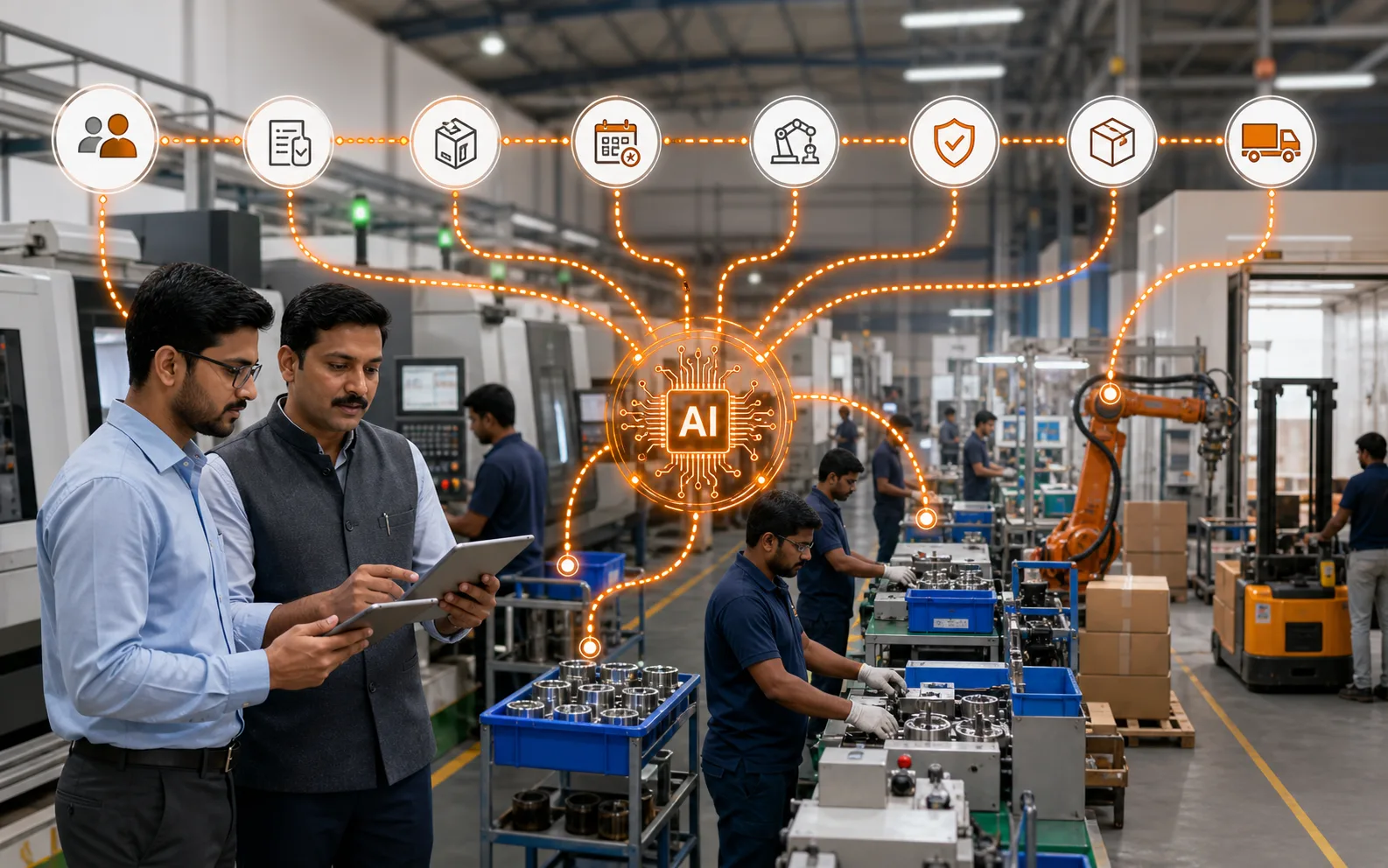
Quick Wins With IoT
Quick wins with IoT are the improvements a manufacturer can see early without trying to digitize the entire factory at once.
They matter because the first phase of an IoT project sets the tone. If the first phase is too broad, too complex, or too theoretical, teams may lose confidence. If the first phase solves a visible problem, people begin to trust the system.
A quick win should be practical, measurable, and useful to daily operations. It should help operators, supervisors, maintenance, quality, stores, or management make a better decision sooner.
The goal is not to do everything. The goal is to prove value quickly and responsibly.
Quick Win 1: Live Machine Status
One of the simplest and most valuable quick wins is live machine status.
Instead of walking the floor or calling supervisors, managers can see whether critical machines are running, idle, stopped, or offline.
This helps answer:
- Which machines are running now?
- Which machines are stopped?
- How long has a machine been stopped?
- Which machine needs attention?
- Is production active during the shift?
Live machine status is especially useful for bottleneck machines and 24/7 operations.
Quick Win 2: Downtime Reason Tracking
Machine status tells you that something stopped. Downtime reasons tell you why.
A strong quick win is to capture downtime duration and simple reason codes. This can quickly reveal whether losses come from breakdowns, material shortage, setup, tool wait, quality hold, manpower issues, or planning gaps.
Good downtime tracking helps supervisors focus on the biggest causes of lost time.
Start with a short reason list. Refine it after seeing real usage.
Quick Win 3: Shift Production Reporting
Many factories spend too much time preparing shift reports manually.
IoT can help capture production count, machine runtime, downtime, and shift output more consistently. Even if some operator input is still needed, the reporting process becomes faster and less dependent on memory.
This quick win helps:
- Supervisors
- Production planners
- Owners
- Management reviewers
- Dispatch teams
A reliable shift report can reduce many follow-up calls.
Quick Win 4: Long Stoppage Alerts
A machine stopping for a few seconds may not need escalation. A machine stopped for 30 minutes during a critical job does.
Long stoppage alerts are a practical quick win. They notify the right person when downtime crosses a threshold.
Good alerts should define:
- Which machines are critical
- What downtime duration matters
- Who receives the alert
- What action is expected
- When escalation happens
This helps reduce late response.
Quick Win 5: Energy Monitoring for Critical Machines
Energy monitoring can create early value, especially where machines, compressors, furnaces, pumps, or utilities consume significant power.
Start with critical energy users instead of the entire plant.
Useful quick-win reports include:
- Energy by machine
- Idle energy consumption
- Energy per unit
- Non-production energy use
- Abnormal spikes
- Shift-wise energy trend
Energy visibility often leads to practical cost-saving actions.
Quick Win 6: Remote Owner Dashboard
Many owners want visibility when they are not physically in the factory.
A remote dashboard can show production status, critical downtime, shift output, dispatch risk, and major alerts. This reduces dependence on repeated phone calls and delayed summaries.
The dashboard should be simple. Owners do not need every sensor reading. They need the important exceptions and daily operating picture.
Quick Win 7: Quality Alert Visibility
Quality issues are expensive when discovered late.
A quick win can be to track rejection reasons, quality holds, or abnormal quality trends by machine, shift, product, or batch.
This helps quality teams identify where problems are repeating and respond sooner.
Quality visibility should be linked with production context wherever possible.
Quick Win 8: Device Offline Alerts
IoT systems need trust. If a sensor or gateway stops sending data and nobody knows, reports become unreliable.
Device offline alerts help maintain data quality. They notify the responsible person when a device, gateway, or machine connection stops updating.
This quick win protects the system itself.
Quick Win 9: Better Shift Handover
A digital shift summary can improve handover quickly.
Instead of relying only on verbal updates or handwritten notes, the incoming shift can see:
- Production completed
- Pending jobs
- Stoppages
- Downtime reasons
- Quality issues
- Maintenance alerts
- Material shortages
- Open actions
This is especially valuable in multi-shift and 24/7 factories.
How to Choose the Right Quick Win
Choose a quick win based on pain and feasibility.
Ask:
- Which issue causes daily frustration?
- Which machine or process affects output most?
- Which data can be captured reliably?
- Which team will use the report?
- Which improvement can be reviewed within 30 to 90 days?
- Will this quick win support future expansion?
A quick win should not be random. It should be the first step in a larger roadmap.
Where AICAN Optiwise Fits
AICAN Optiwise helps manufacturers turn IoT quick wins into connected workflows. A live machine status report becomes more useful when connected with production planning. Downtime reasons become more useful when connected with maintenance and reporting. Energy visibility becomes more useful when connected with cost control.
Optiwise supports practical manufacturing digitization across production, inventory, purchase, finance, reporting, and operations, helping manufacturers expand from quick wins to stronger control.
AICAN focuses on digital transformation that starts with real factory value. You can learn more on the About AICAN page.
FAQ
What is the best first IoT quick win?
For many manufacturers, live machine status and downtime reason tracking are the best first quick wins because they reveal where production time is being lost.
How many machines should I start with?
Start with critical machines or bottlenecks. A focused first phase is usually better than trying to connect every machine immediately.
How fast can quick wins appear?
Some visibility benefits appear soon after go-live, but measurable improvement may take several weeks as users adopt the system and teams act on the data.
Are quick wins enough for long-term success?
No. Quick wins build confidence, but long-term value requires integration, training, ownership, reporting discipline, and expansion planning.
Can AICAN Optiwise support quick-start implementation?
AICAN Optiwise can help manufacturers start with practical visibility and connected workflows, then expand into broader production, inventory, purchase, finance, and reporting control.
What should I avoid in a quick-win project?
Avoid vague goals, too many machines, complex dashboards, poor training, and missing ownership. A quick win should be simple but useful.
Founder’s Note
Momentum matters in digital transformation.
At AICAN, we believe the first win should help the team believe in the system. It should solve something real, make work clearer, and create confidence for the next step.
Quick wins are not shortcuts. They are proof that the direction is right.
Final Thought
Quick wins with IoT include live machine status, downtime tracking, shift reporting, long stoppage alerts, energy monitoring, quality alerts, remote dashboards, and better handover.
Start with the pain that matters most. With AICAN Optiwise, quick wins can become the foundation for a more connected and controlled manufacturing operation.

Related Posts

Is AI Worth the Investment for My Factory?
Learn how to decide if AI is worth the investment for your factory by evaluating use cases, data readiness, costs, risks, ROI, and operational impact.
13 Jun 2026Read more →Manufacturing AI Mistakes to Avoid Before You Start
List manufacturing AI mistakes and controls for unclear use case, messy data, unsafe automation, no owner, weak security and unreviewed recommendations.
13 Jun 2026Read more →What's the Difference Between AI and Regular Automation?
Understand the difference between AI and regular automation in manufacturing, with practical examples for workflows, decisions, alerts, and predictive operations.
13 Jun 2026Read more →What Are the Risks of Using AI in Manufacturing?
Understand the risks of AI in manufacturing, including bad data, wrong recommendations, safety issues, security, job fear, over-automation, and implementation failure.
13 Jun 2026Read more →