
Real-Time IoT Visibility for Manufacturing: Signals, Context and Action
Real-Time IoT Visibility for Manufacturing. Use a worked manufacturing test, exception checks and direct Optiwise workflow evidence before rollout.
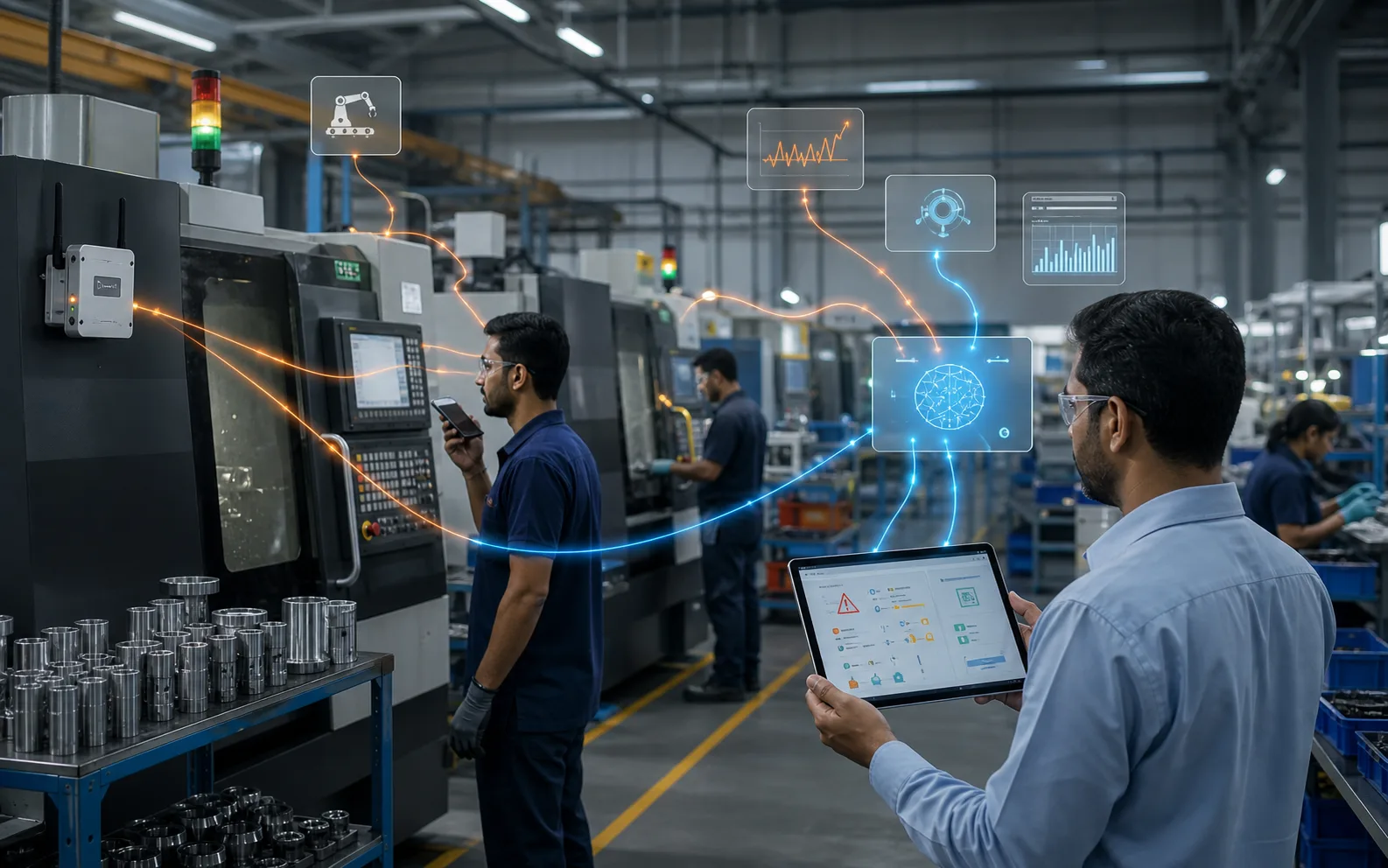
Real-Time IoT Visibility for Manufacturing: Signals, Context and Action should help you turn machine signals into production decisions. Start with one order, one item and one exception. A screen tour cannot prove that records stay connected when the work changes.
A machine changes from running to issue. The useful view attaches the current job, elapsed stop time and approved reason workflow, then checks whether output and energy patterns changed after restart.
Start with the decision the system must support
Combine a timestamped machine signal with the job, shift, operator and reason needed to act.
OptiEdge collects machine data over Modbus or OPC-UA, buffers it during connectivity loss and resynchronizes. Optiwise adds live OEE, runtime, downtime, load, cycle-time, energy and multi-plant views.
Use ISA-95 enterprise and control-system model as an external reference for the relevant data or process model. It does not prove an Optiwise feature or a business result; the product statements above come from our current feature record.
| # | Input to prepare | Evidence to retain |
|---|---|---|
| 1 | Machine and device mapping | Owner and last update |
| 2 | Signal definition and sampling rate | Definition and source |
| 3 | Job and shift context | Acceptance rule |
| 4 | Threshold, recipient and response | Exception owner |
Run one controlled workflow before expanding scope
- 1. Machine and device mapping. Confirm who maintains it and which record is authoritative.
- 2. Signal definition and sampling rate. Use the current value in the chosen test order.
- 3. Job and shift context. Record the pass condition before the demo begins.
- 4. Threshold, recipient and response. Assign the person who resolves a mismatch.
Keep the first test small enough to reconcile by hand. When the system result differs from the source documents, stop and identify whether the problem is master data, timing, transaction ownership or configuration. Adding more dashboards will not correct an unreliable event.
Test exceptions alongside the normal flow
- Device goes offline
- Signal disagrees with manual entry
- Short stop should not trigger escalation
For each exception, record the expected status, permitted action, approver and audit trail. A useful manufacturing system should make the exception visible without allowing an unapproved shortcut to rewrite history.
Verify the connected Optiwise workflow
Review workflow details, product capability, supporting guide, implementation context, connected process, book a demo. In the demo, ask us to execute the scenario with your roles and sample records. Confirm the source transaction, resulting status, notification or action, correction method and report before accepting the workflow.
Questions to ask before rollout
What should we test first?
Choose one current order with a known complication. Prepare the four inputs above, run the transaction sequence and reconcile the result with the source documents.
How do we know the page describes a real capability?
Ask for the workflow to be shown with your role permissions and sample data. Keep feature validation separate from a promised business outcome; adoption, master data and operating discipline still determine the result.
Real-time visibility means the factory can see what is happening while there is still time to act. That is the difference between a daily report and a live operating view.
A daily report may tell you yesterday’s production was short. Real-time IoT visibility can show that today’s production is falling behind at 11:30 AM, which machine is responsible, why it is stopped, and whether the order is at risk.
That time difference matters. Manufacturing problems become more expensive when they are discovered late.
Live Machine Status
The first layer of visibility is machine status. IoT can show whether a machine is running, idle, stopped, under setup, waiting for material, blocked by quality, or under maintenance.
This helps supervisors avoid constant floor walks and phone calls. It also helps owners understand whether the plant is actually producing or only appearing busy.
Live status is useful because it creates immediate awareness:
- which machines are stopped right now?
- how long have they been stopped?
- which machines are idle but powered on?
- where is production waiting?
- which stoppages need escalation?
Target vs Actual Production
Real-time production visibility compares planned output with actual output during the shift.
This is one of the most valuable views for manufacturers because it shows whether the day is still recoverable. If output is behind early, supervisors can act. If the gap is discovered only at the end of the shift, the factory has fewer options.
Useful views include:
- shift target vs actual
- machine-wise output
- line-wise output
- good quantity vs rejected quantity
- production progress by order
- hourly output trend
This helps teams move from reactive reporting to active control.
Downtime Alerts and Reason Visibility
A stoppage is more useful when it has context. Real-time IoT systems can detect a stoppage automatically and then capture or request a reason.
Common reasons include:
- machine breakdown
- material shortage
- tool change
- setup
- quality hold
- no manpower
- cleaning
- power or utility issue
- waiting for instruction
This visibility reduces arguments. Instead of debating why output was low, the team can see which losses occurred and where to act.
Energy Visibility During Production
Energy data becomes more useful when seen during production, not only after the monthly bill.
IoT can show:
- machine-wise energy use
- idle power consumption
- energy per unit
- peak load events
- abnormal consumption
- utility equipment behavior
This helps operations and finance work with the same data. If energy per unit rises during a specific product or shift, the team can investigate while the issue is still current.
Quality Visibility
Real-time quality visibility helps teams catch problems earlier.
Depending on the process, IoT and digital workflows can show:
- inspection results
- rejection trend
- batch-linked quality data
- process condition during production
- machine or shift patterns
- abnormal readings that may affect quality
This is valuable because defects are easier to control when they are detected early. Waiting until final inspection can increase rework, scrap, and customer risk.
Maintenance and Condition Alerts
Real-time visibility also supports maintenance.
A system can alert maintenance teams when a machine shows abnormal vibration, temperature, current, pressure, repeated stoppages, or unusual energy consumption.
The alert does not replace diagnosis. It tells the team where to look sooner.
This is especially useful for critical assets where unexpected downtime affects dispatch or customer commitments.
Order and Dispatch Risk
Real-time factory data becomes most valuable when connected with production orders and dispatch dates.
If a priority order is behind, management should know before the dispatch date is missed. If a machine stoppage affects a customer commitment, planning and sales should not discover it at the last moment.
IoT plus ERP context can show:
- which orders are at risk
- which machine is causing the delay
- whether material is available
- whether another line can take the job
- whether customer communication is needed
This turns visibility into business action.
Where AICAN Optiwise Fits
AICAN Optiwise helps manufacturers connect factory visibility with business workflows across production, inventory, purchase, sales, finance, and reporting. Real-time data is strongest when it helps teams act across departments.
Optiwise supports connected manufacturing control rather than scattered updates. You can explore AICAN and learn more on About AICAN.
FAQ
Is real-time visibility necessary for every machine?
Not always. Start with critical machines, bottlenecks, high-cost processes, or areas where delays hurt customers.
What is the most useful real-time dashboard?
For many factories, target vs actual output, machine status, downtime reason, quality trend, and order risk are the most useful starting points.
Does real-time data create too many alerts?
It can if poorly configured. Alerts should be role-based, threshold-based, and action-oriented.
Can real-time visibility work with old machines?
Yes. Existing machines can often be connected with retrofit sensors, meters, gateways, counters, and operator input.
Who should use real-time visibility?
Operators, supervisors, maintenance, quality, planning, owners, and finance may all need different views of the same operational truth.
Founder’s Note
At AICAN, we believe real-time visibility should make the factory calmer, not noisier. The goal is not to flood teams with dashboards. The goal is to show the right person the right problem early enough to act.
That is where connected systems become genuinely useful.
Final Thought
Real-time data is valuable because time matters. The earlier a factory sees a problem, the more options it has.
IoT gives visibility. A connected operating system turns that visibility into action.

Related Posts
Is AI Worth the Investment for My Factory?
Learn how to decide if AI is worth the investment for your factory by evaluating use cases, data readiness, costs, risks, ROI, and operational impact.
13 Jun 2026Read more →Manufacturing AI Mistakes to Avoid Before You Start
List manufacturing AI mistakes and controls for unclear use case, messy data, unsafe automation, no owner, weak security and unreviewed recommendations.
13 Jun 2026Read more →What's the Difference Between AI and Regular Automation?
Understand the difference between AI and regular automation in manufacturing, with practical examples for workflows, decisions, alerts, and predictive operations.
13 Jun 2026Read more →What Are the Risks of Using AI in Manufacturing?
Understand the risks of AI in manufacturing, including bad data, wrong recommendations, safety issues, security, job fear, over-automation, and implementation failure.
13 Jun 2026Read more →