
How Do I Transition from Manual Operations to Sensor-Based Automation?
Learn a practical roadmap for moving from manual factory operations to sensor-based automation without overwhelming teams or disrupting production.

How Do I Transition from Manual Operations to Sensor-Based Automation?
The best transition from manual operations to sensor-based automation starts with one painful manual routine, not with a full factory overhaul.
Manual operations often contain valuable knowledge. Operators know the machines. Supervisors know the bottlenecks. Maintenance teams know recurring failures. The goal is not to erase that knowledge. The goal is to capture reliable signals automatically and let people spend more time solving problems.
A rushed automation project can create fear, confusion, and bad data. A staged transition creates trust.
For manufacturers evaluating AICAN Optiwise, sensor-based automation should begin with practical visibility and grow into deeper control only when the foundation is stable.
Start with a clear manual pain point
Do not begin by asking, “Which sensors should we install?”
Begin by asking, “Which manual activity is slowing us down or hiding problems?” It might be manual production count, handwritten downtime logs, repeated machine checks, delayed maintenance reporting, utility readings, quality inspection records, or end-of-shift reconciliation.
A clear pain point gives the automation project a measurable purpose.
Map the current workflow honestly
Before installing sensors, document how the work happens today.
Who records data? When is it recorded? Where does it go? Who uses it? What mistakes happen? What gets delayed? What decisions depend on it?
This mapping often reveals that the problem is not only manual work. It may be unclear responsibility, duplicate reporting, late review, or missing feedback. Sensors can help, but only if the workflow is cleaned up too.
Choose a small pilot area
Pick one line, machine, process, or utility area where the value is visible.
A good pilot is important enough to matter but contained enough to manage. It should have clear users, clear data signals, and a practical improvement target.
For example, a factory might start by tracking machine running status and downtime on a bottleneck machine, or energy usage on a high-consumption utility area.
Keep people involved from the beginning
Automation fails when it appears suddenly and people feel watched rather than helped.
Operators should know what is being measured and why. Supervisors should know how the data will be used. Maintenance teams should know what new responsibilities they will own. Managers should commit to using the data fairly.
The message should be honest: sensors are being introduced to reduce blind spots, not to blame every loss on workers.
Capture automatic signals and human context together
Sensors can capture events, but people often know the reason.
A sensor may detect that a machine stopped. The operator may know it stopped because material was late, tooling was unavailable, quality was on hold, or maintenance was waiting. A good system combines automatic event capture with simple human input for context.
This creates better data than either approach alone.
Build dashboards around action
Do not build dashboards only because data exists.
Each screen should answer a practical question: Is the line running? Are we behind plan? Which machine needs attention? Which downtime reason repeats? Which sensor is abnormal? Which job is at risk?
AICAN Optiwise can help turn sensor signals into dashboards and alerts that support production, maintenance, and management decisions.
Train by role, not by feature list
Different people need different training.
Operators need to know what to do during alerts and how to add context. Supervisors need to review performance and exceptions. Maintenance needs to inspect sensors and respond to machine health signals. Managers need to read trends without misusing the data.
Training should use the factory’s real examples, not generic automation slides.
Review results before scaling
After the pilot, review what actually improved.
Did reporting become faster? Did downtime become clearer? Did the team respond sooner? Did data match reality? Were operators comfortable? Did maintenance get better evidence? Did management use the dashboard in meetings?
If the pilot reveals problems, fix them before scaling. Scaling bad habits only makes them more expensive.
Move from visibility to automation carefully
Sensor-based automation can start with monitoring and later support alerts, workflows, maintenance triggers, quality checks, or control actions. Do not jump straight to automated decisions unless the data is reliable and the process is understood.
The usual maturity path is: manual records, sensor visibility, alerts, workflow integration, analytics, and then selective automation.
Where AICAN Optiwise fits
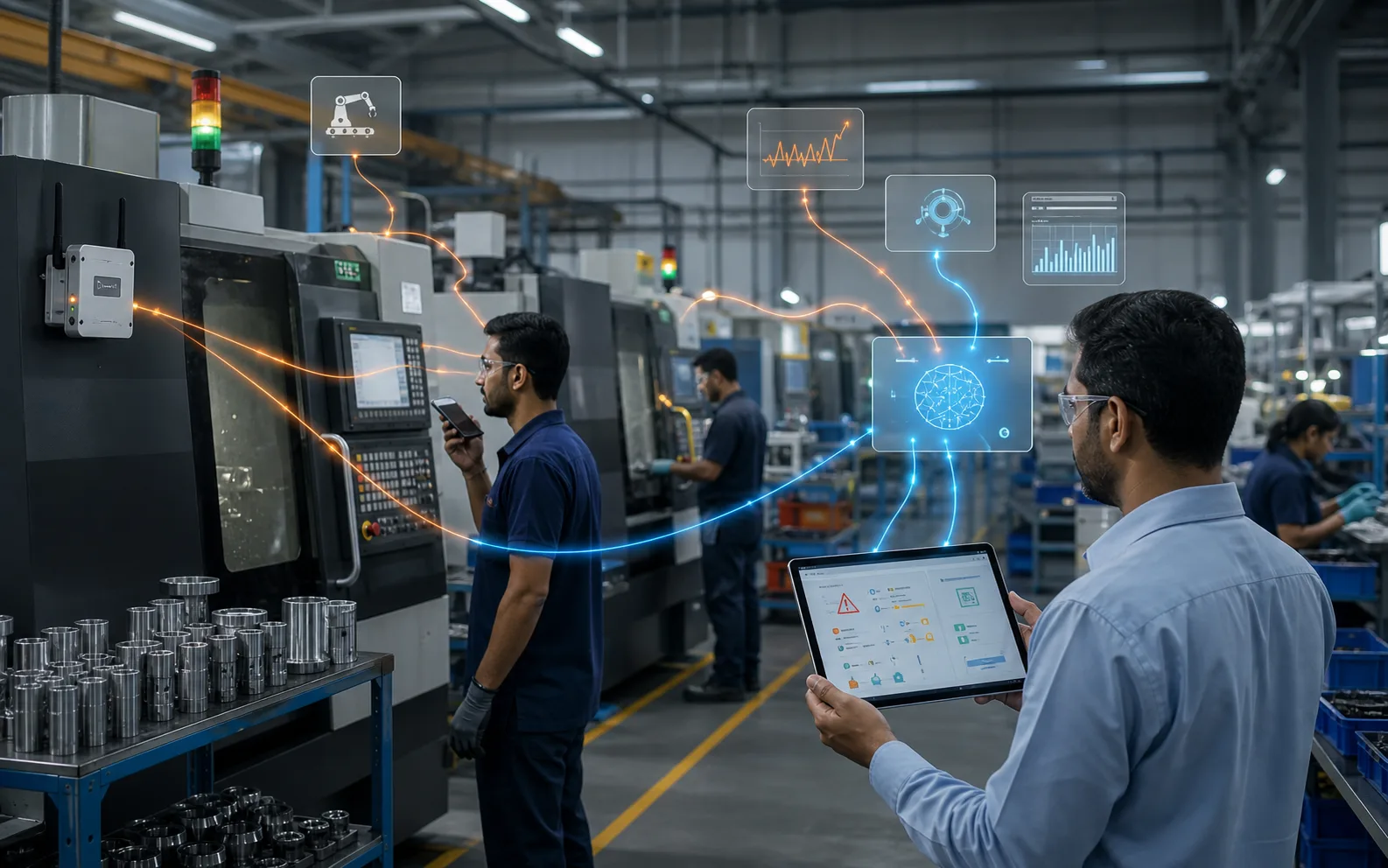
AICAN Optiwise helps manufacturers move from manual visibility to connected operations by bringing machine and sensor signals into dashboards, alerts, and reports. The platform can support a staged transition without forcing the factory to digitize everything at once.
AICAN builds for manufacturers that want practical automation grounded in real factory workflows. Learn more at About AICAN.
Founder’s Note
Manual systems are not stupid. They often exist because people found a way to keep production moving. The job of automation is to respect that reality, remove avoidable friction, and make the truth visible earlier. Start small, build trust, then scale.
FAQs
What is the first step toward sensor-based automation?
Identify one manual process that causes delay, error, or poor visibility, then design a small sensor-backed pilot.
Will automation replace manual judgement?
No. Sensors capture signals; people still provide context, judgement, and improvement decisions.
Should I automate the whole factory at once?
Usually no. Start with one high-value area and scale after proving reliability and adoption.
How do I reduce worker resistance?
Explain the purpose clearly, involve teams early, train by role, and use data to solve process problems instead of blaming people.
How does AICAN Optiwise help this transition?
It can connect sensor and machine data into dashboards, alerts, and reports so manual visibility can gradually become digital operating discipline.

Related Posts
Is AI Worth the Investment for My Factory?
Learn how to decide if AI is worth the investment for your factory by evaluating use cases, data readiness, costs, risks, ROI, and operational impact.
13 Jun 2026Read more →Manufacturing AI Mistakes to Avoid Before You Start
List manufacturing AI mistakes and controls for unclear use case, messy data, unsafe automation, no owner, weak security and unreviewed recommendations.
13 Jun 2026Read more →What's the Difference Between AI and Regular Automation?
Understand the difference between AI and regular automation in manufacturing, with practical examples for workflows, decisions, alerts, and predictive operations.
13 Jun 2026Read more →What Are the Risks of Using AI in Manufacturing?
Understand the risks of AI in manufacturing, including bad data, wrong recommendations, safety issues, security, job fear, over-automation, and implementation failure.
13 Jun 2026Read more →