
What AI Tools Are Available for My Factory?
Explore AI tools available for factories, including AI assistants, ERP-connected AI, predictive maintenance, quality analytics, inventory AI, planning tools, and safety support.

What AI Tools Are Available for My Factory?
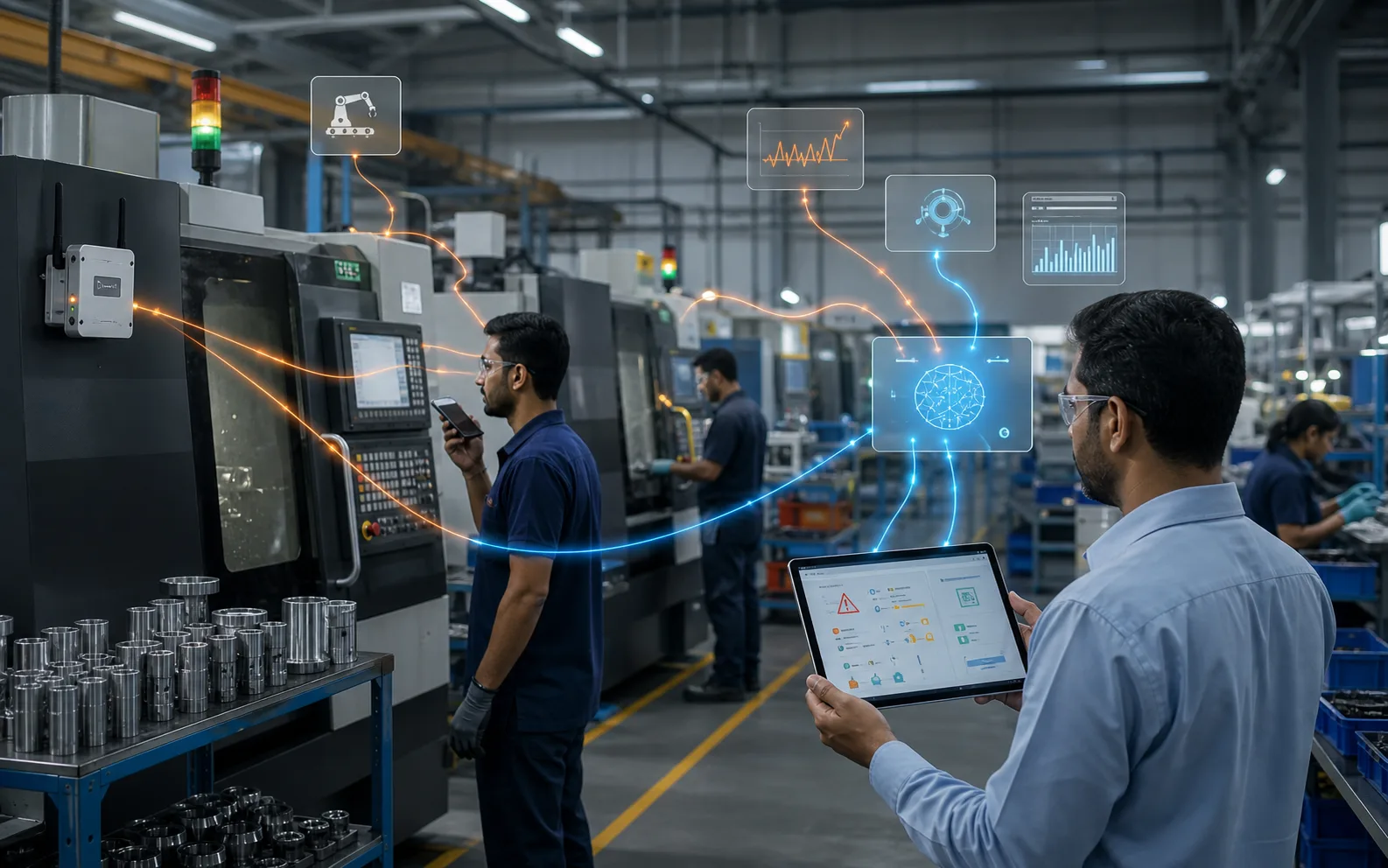
Factories can use many types of AI tools, but they are not all built for the same problem. Some tools help with documents. Some analyze ERP data. Some monitor machines. Some inspect products. Some support planning, inventory, safety, or supplier decisions.
The right AI tool depends on the factory problem you want to solve.
A manufacturer should not begin by asking, “Which AI tool is best?” The better question is, “Where are we losing time, money, quality, or visibility?”
1. AI Assistants for Documents and Reports
These are usually the easiest AI tools to start with. They help teams write, summarize, and organize information.
They can be used for:
- SOP drafts
- Training guides
- Work instructions
- Daily report summaries
- Customer update drafts
- Vendor follow-up messages
- Meeting notes
- Audit preparation notes
- Internal FAQs
These tools are useful because many manufacturing teams spend a lot of time explaining the same processes repeatedly.
However, manufacturers must be careful with sensitive information. Do not upload BOMs, costs, customer details, supplier rates, or confidential production data into tools that are not approved for business use.
2. ERP-Connected AI Tools
ERP-connected AI is often more valuable than a standalone AI assistant because it works with real operational data.
It can help answer questions such as:
- Which orders are delayed?
- Which raw materials are short?
- Which purchase orders are pending?
- Which production jobs are not moving?
- Which quality issues repeated this month?
- Which dispatches are blocked?
- Which customers have open commitments?
- Which vendors are regularly late?
This kind of AI is powerful because it sits close to the actual manufacturing workflow.
3. AI for Predictive Maintenance
Predictive maintenance tools analyze machine data and maintenance history to identify failure risk.
They may use:
- Vibration data
- Temperature readings
- Runtime
- Energy consumption
- Pressure data
- Alarm history
- Downtime logs
- Spare usage
- Maintenance records
These tools are useful when machine downtime is expensive. They are not always the best first AI tool for every factory because they may require sensors, machine connectivity, and historical data.
4. AI for Quality Control
Quality AI tools help manufacturers reduce defects and improve inspection.
There are two broad types.
The first type analyzes quality records: rejection reasons, inspection results, complaint notes, supplier batches, and corrective actions.
The second type uses computer vision to inspect images or video for visible defects.
Computer vision can be useful, but it needs controlled lighting, good camera placement, enough defect examples, and proper validation. It should not be treated as a plug-and-play solution for every product.
5. AI for Inventory Management
Inventory AI tools help analyze stock movement, consumption, ageing, reorder risk, slow-moving items, and abnormal usage.
They can help answer:
- Which items are overstocked?
- Which items may run out soon?
- Which materials are not moving?
- Which items are consumed faster than expected?
- Which vendors affect stock availability?
For manufacturers, this can directly improve cash flow and production reliability.
6. AI for Production Planning
Production planning AI helps planners compare orders, material availability, machine capacity, due dates, quality holds, and dispatch priorities.
It does not remove the planner. It reduces the manual checking needed before making a schedule decision.
This is useful for factories with:
- Make-to-order production
- Multi-stage production
- Frequent schedule changes
- Material shortages
- Shared machines
- Urgent customer commitments
7. AI for Supplier and Purchase Management
AI can help purchase teams compare supplier performance, price history, delivery reliability, quality issues, and lead time risk.
This is useful because the cheapest supplier is not always the best supplier. A supplier that causes rejections or late production may cost more in the long run.
8. AI for Safety and Compliance
AI can help with incident summaries, safety training material, PPE monitoring, compliance documentation, audit checklists, and corrective action tracking.
Safety-related AI should be implemented carefully. Human responsibility and compliance controls remain essential.
9. AI for Finance and Management Visibility
AI can help owners and managers summarize business signals:
- Production status
- Dispatch readiness
- Pending orders
- Inventory value
- Purchase delays
- Quality cost
- Customer commitments
- Cash flow indicators
This helps leadership act faster without waiting for every department to prepare manual reports.
How to Choose the Right AI Tool
Before selecting a tool, ask:
- What problem does it solve?
- What data does it need?
- Is the data available and reliable?
- Does it integrate with ERP or existing systems?
- Can users understand it?
- How is sensitive data protected?
- What is the expected ROI?
- Who reviews the AI output?
- What happens if the AI is wrong?
A tool that cannot answer these questions may not be ready for manufacturing operations.
Standalone AI vs. AI-Enabled ERP
Standalone AI tools are useful for simple tasks such as writing SOPs, summarizing notes, and drafting communication.
AI-enabled ERP is more useful when the problem is operational. If you want AI to understand stock, production, purchase, quality, dispatch, and finance, it needs connected data.
For most manufacturers, AI should eventually move closer to the ERP and operating workflows.
Where AICAN Optiwise Fits
AICAN Optiwise brings AI into a manufacturing operating system instead of leaving it as a disconnected tool. It combines ERP, workflows, reports, IoT readiness, and AI agents across sales, purchase, inventory, production, shopfloor, quality, dispatch, and finance visibility.
For MSME manufacturers, this matters because operational AI needs context. Optiwise helps create that context by connecting the workflows that already run the factory.
You can explore the product at aican.co.in and read more about AICAN’s manufacturing-first journey at About AICAN.
Founder’s Note
AICAN’s belief is that manufacturers do not need random AI tools scattered across departments. They need one connected operating layer where AI can understand the real movement of orders, materials, production, quality, and dispatch.
That is why Optiwise is built around manufacturing workflows first. AI becomes useful only when it has the right context, and context comes from connected operations.
FAQ
What is the easiest AI tool for a factory?
An AI assistant for SOPs, report summaries, training material, and internal documentation is usually the easiest starting point.
What is the most useful AI tool for manufacturers?
ERP-connected AI is often the most useful because it works with real operational data.
Do AI tools need sensors?
Only some tools do. Predictive maintenance and machine monitoring may need sensors. Documentation, reporting, inventory analysis, and ERP AI may not.
Can small factories use AI tools?
Yes. Small factories should start with practical tools that reduce manual work and improve visibility.
Should I buy separate AI tools or use an AI-enabled ERP?
If your problem is operational, AI-enabled ERP is usually stronger because it connects AI to the workflows that matter.
Final Thought
The best AI tool is not the most advanced one. It is the one that solves a real factory problem, fits your data, protects your information, and gets used by your team.
Next step: Explore AICAN Optiwise if you want AI built into manufacturing ERP workflows rather than another standalone tool.

Related Posts
Is AI Worth the Investment for My Factory?
Learn how to decide if AI is worth the investment for your factory by evaluating use cases, data readiness, costs, risks, ROI, and operational impact.
13 Jun 2026Read more →Manufacturing AI Mistakes to Avoid Before You Start
List manufacturing AI mistakes and controls for unclear use case, messy data, unsafe automation, no owner, weak security and unreviewed recommendations.
13 Jun 2026Read more →What's the Difference Between AI and Regular Automation?
Understand the difference between AI and regular automation in manufacturing, with practical examples for workflows, decisions, alerts, and predictive operations.
13 Jun 2026Read more →What Are the Risks of Using AI in Manufacturing?
Understand the risks of AI in manufacturing, including bad data, wrong recommendations, safety issues, security, job fear, over-automation, and implementation failure.
13 Jun 2026Read more →