
What Should I Look for in Manufacturing AI Software?
Learn what manufacturers should look for in AI software, including ERP integration, data security, usability, workflow fit, explainability, ROI, and implementation support.
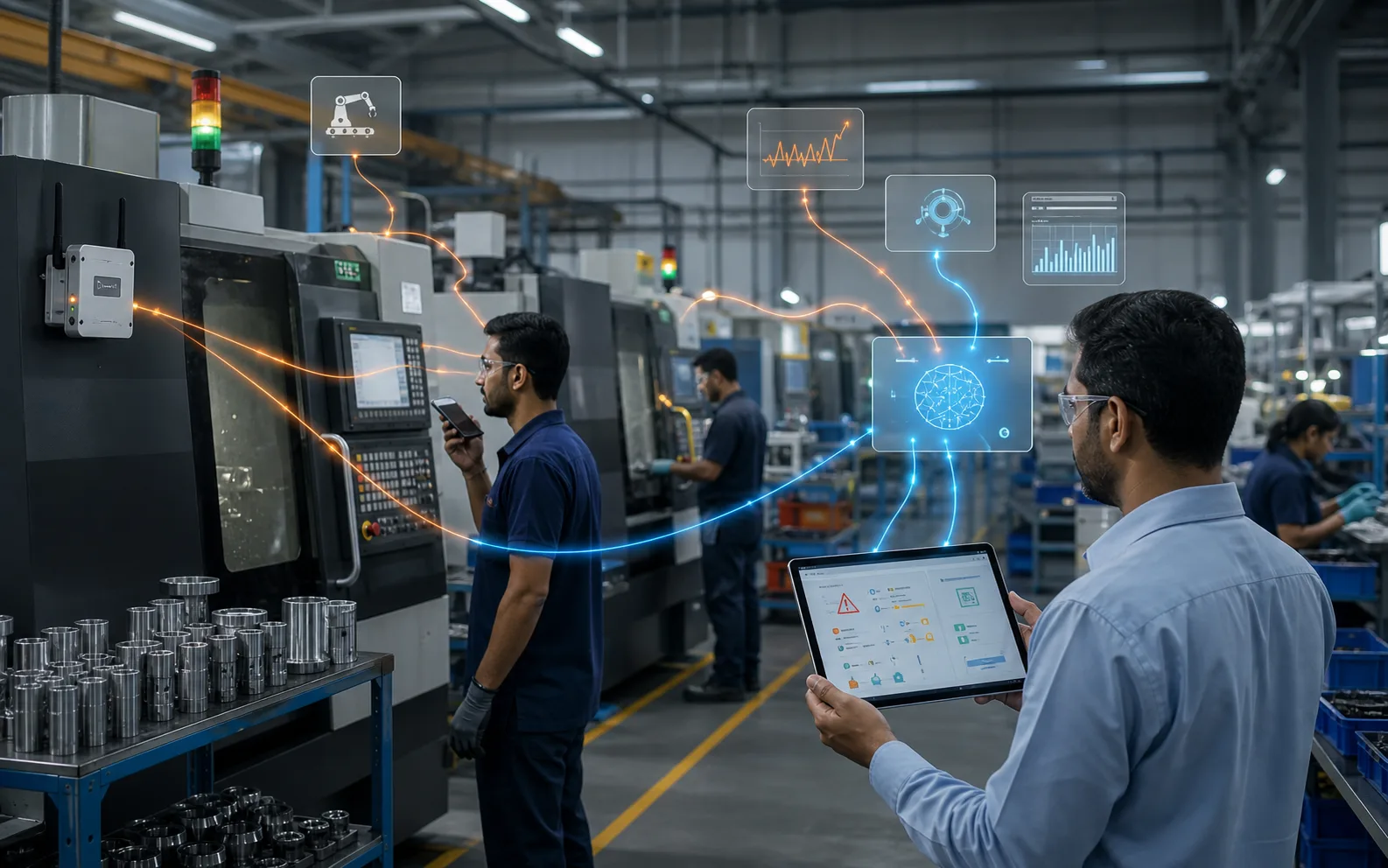
What Should I Look for in Manufacturing AI Software?
Manufacturing AI software should solve factory problems, not just look impressive in a demo. The right software should connect with real workflows, protect sensitive data, support users, and produce insights that help teams act.
A manufacturer should evaluate AI software with the same seriousness as ERP, because bad AI can create confusion, wrong decisions, and wasted investment.
Start With Workflow Fit
The first question is not “How advanced is the AI?” The first question is “Does this fit our manufacturing workflow?”
Good manufacturing AI should understand areas such as:
- Sales orders
- Purchase orders
- Inventory
- BOM and material planning
- Production progress
- Shopfloor activity
- Quality checks
- Dispatch
- Maintenance
- Finance visibility
Generic AI tools can help with documents, but operational AI needs manufacturing context.
ERP Integration
AI becomes more useful when it connects with ERP data. Without ERP integration, teams may need to export spreadsheets manually, upload data, and interpret results separately.
Look for software that can work with live or structured operational data while respecting user permissions.
AI should help answer practical questions:
- Which orders are delayed?
- Which materials are short?
- Which vendors are late?
- Which jobs are stuck?
- Which defects are increasing?
- Which dispatches are at risk?
Data Security and Permissions
Manufacturing data is sensitive. AI software may touch BOMs, costs, vendor rates, customer orders, production plans, quality records, and financial information.
Ask vendors:
- Where is the data stored?
- Who can access it?
- Is company data used for training?
- Can permissions be role-based?
- Is there an audit trail?
- How are integrations secured?
A useful AI tool must also be a responsible data tool.
Explainability
Manufacturing teams should understand why AI is giving a recommendation. If AI says a machine is at risk, the maintenance team needs to know what signal triggered the alert. If AI flags a supplier, purchase needs to know whether the reason is late delivery, quality rejection, or price variation.
Black-box recommendations are dangerous in operational environments.
Usability for Factory Teams
Manufacturing AI software should be usable by real teams, not only technical experts.
A production supervisor, storekeeper, planner, quality engineer, or owner should be able to use it without needing a data science background.
Look for:
- Clear dashboards
- Simple prompts
- Role-based views
- Actionable alerts
- Mobile-friendly workflows
- Local language support where needed
- Easy reporting
Implementation Support
AI software does not succeed only because it is installed. It succeeds when users adopt it.
Ask vendors about:
- Process mapping
- Data cleanup
- Training
- Pilot planning
- Integration support
- User onboarding
- Post-go-live support
- ROI review
Weak implementation can ruin a strong product.
ROI Measurement
Good AI software should help measure value. It should connect to outcomes such as time saved, downtime reduced, defects reduced, inventory improved, planning speed, or better decision visibility.
If a vendor cannot explain how ROI will be measured, be cautious.
Scalability
The software should grow with the factory. A manufacturer may start with reports and inventory, then expand into production, quality, maintenance, IoT, and AI agents.
Choose software that supports this journey without forcing a full rebuild every time.
What to Avoid
Avoid AI software that:
- Gives vague claims without use cases
- Requires perfect data before any value
- Has weak security answers
- Cannot integrate with ERP
- Produces insights without explanation
- Needs technical users for every action
- Does not support implementation
- Has no ROI measurement
- Feels disconnected from manufacturing workflows
Where AICAN Optiwise Fits
AICAN Optiwise is built specifically for manufacturers as an AI-native operating system. It combines ERP, workflows, IoT readiness, reports, and AI agents across sales, purchase, inventory, production, shopfloor, quality, dispatch, and finance visibility.
This matters because manufacturing AI should not sit outside operations. Optiwise brings AI into the workflows where decisions are actually made.
Learn more at aican.co.in and About AICAN.
Founder’s Note
AICAN’s view is that manufacturing AI software should be practical enough for daily use and strong enough for long-term scale. It should not be a fancy layer on messy operations.
Optiwise is built to give manufacturers connected workflows first, then AI that can understand those workflows. That is how AI becomes useful rather than decorative.
FAQ
What is the most important feature in manufacturing AI software?
Workflow fit is the most important. The software must understand manufacturing operations, not just generic business data.
Should AI software integrate with ERP?
Yes. ERP integration makes AI more useful because it gives access to structured operational context.
Is data security important for manufacturing AI?
Very important. Manufacturing AI may touch sensitive customer, vendor, cost, production, and quality data.
Do users need technical skills?
Good manufacturing AI software should be usable by non-technical teams with proper training.
How should ROI be measured?
Measure time saved, downtime reduced, defects reduced, stockouts avoided, reporting speed, and decision improvement.
Final Thought
Manufacturing AI software should make factory decisions clearer and faster. Choose the tool that fits your workflows, protects your data, and helps your team act.
Next step: Explore AICAN Optiwise if you want AI built into manufacturing ERP workflows rather than bolted on later.

Related Posts
Is AI Worth the Investment for My Factory?
Learn how to decide if AI is worth the investment for your factory by evaluating use cases, data readiness, costs, risks, ROI, and operational impact.
13 Jun 2026Read more →Manufacturing AI Mistakes to Avoid Before You Start
List manufacturing AI mistakes and controls for unclear use case, messy data, unsafe automation, no owner, weak security and unreviewed recommendations.
13 Jun 2026Read more →What's the Difference Between AI and Regular Automation?
Understand the difference between AI and regular automation in manufacturing, with practical examples for workflows, decisions, alerts, and predictive operations.
13 Jun 2026Read more →What Are the Risks of Using AI in Manufacturing?
Understand the risks of AI in manufacturing, including bad data, wrong recommendations, safety issues, security, job fear, over-automation, and implementation failure.
13 Jun 2026Read more →