
What's Stopping More Manufacturers From Using AI?
Understand the real barriers stopping manufacturers from adopting AI, including cost concerns, poor data, worker fear, unclear ROI, and legacy systems.
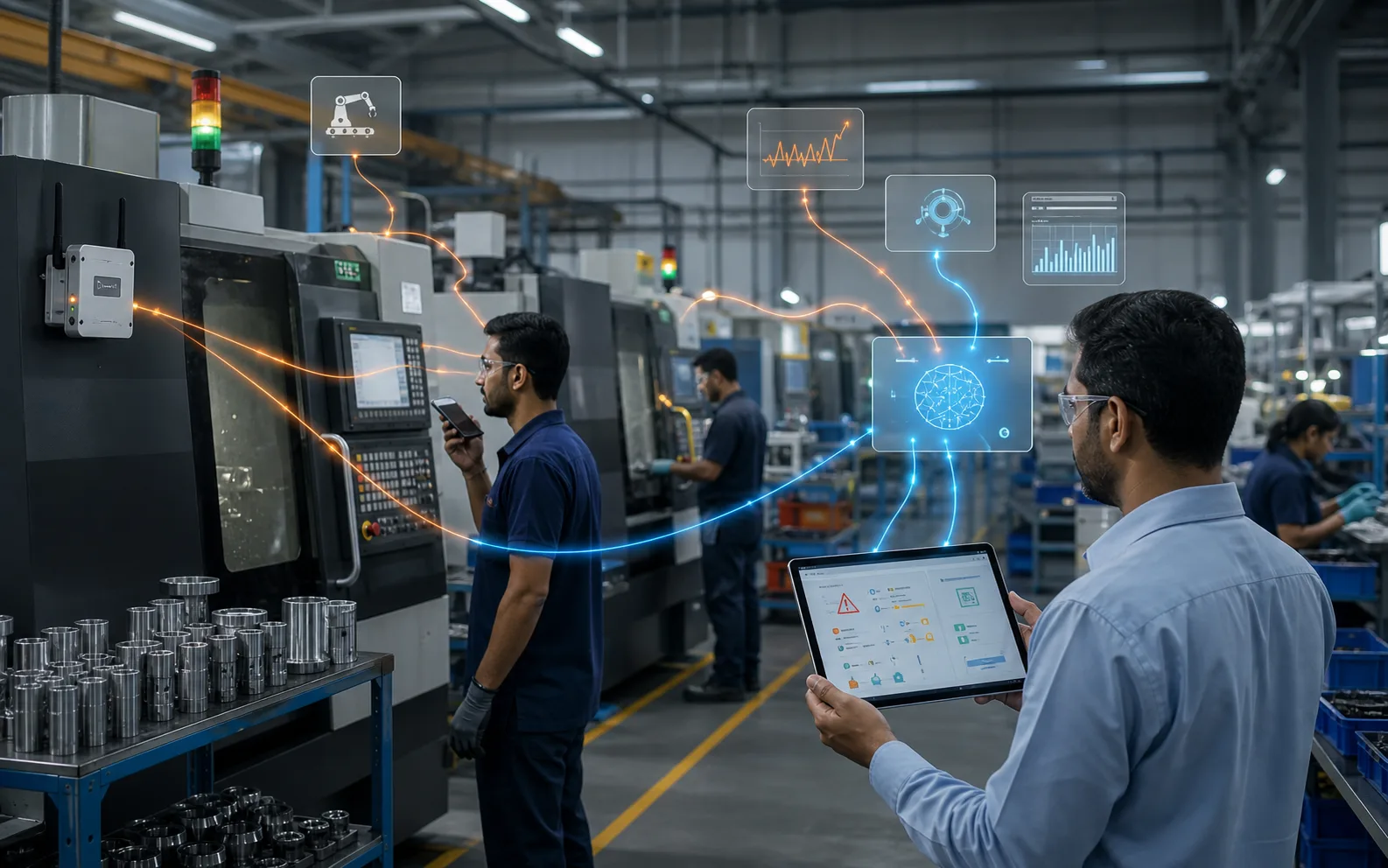
What's Stopping More Manufacturers From Using AI?
AI is discussed everywhere, but many manufacturers still hesitate to use it. This hesitation is not always resistance to technology. Often it comes from practical concerns: unclear ROI, messy data, worker fear, old systems, implementation risk, and uncertainty about where to begin.
Manufacturing leaders are careful because factories cannot pause operations for experiments. A failed AI project can waste money, confuse teams, and reduce trust in future digital initiatives. That is why adoption is slower than headlines suggest.
Artificial intelligence in manufacturing becomes easier to adopt when factories stop treating it as a giant transformation and start treating it as a practical way to improve specific decisions.
Barrier 1: Poor Data Quality
Many factories still depend on spreadsheets, manual registers, WhatsApp updates, and delayed reporting. When data is scattered, AI has no reliable operating base.
Poor item masters, inaccurate stock, incomplete production entries, missing downtime reasons, and inconsistent quality records make AI recommendations weak. Manufacturers know this, even if they do not use technical language. They worry that the system will produce wrong outputs because the inputs are not dependable.
The solution is to start by cleaning the data required for one use case, not the entire factory at once.
Barrier 2: Unclear ROI
Manufacturers want to know whether AI will pay back. This is reasonable. The challenge is that AI vendors sometimes speak in broad promises instead of specific outcomes.
ROI becomes clearer when tied to measurable problems: fewer stockouts, reduced scrap, faster reporting, improved delivery reliability, lower urgent purchases, better machine uptime, or fewer manual follow-ups.
If a project cannot explain the business result it is targeting, it is not ready.
Barrier 3: Fear Among Workers
Workers may see AI as a threat to jobs, independence, or reputation. Supervisors may worry that every delay will be monitored. Department heads may worry that the system will expose old process gaps.
This fear can quietly block adoption. People may delay entries, avoid using features, or keep parallel manual records.
Manufacturers need transparent communication. AI should be introduced as a tool to reduce confusion and improve decisions, not only as a monitoring layer.
Barrier 4: Legacy Systems and Disconnected Tools
Many factories already have some software, but it may not connect production, inventory, purchase, sales, finance, and quality properly. Adding AI on top of disconnected tools can make the situation more complex.
AI adoption needs an operating foundation. The factory must know where orders, stock, production status, and quality records live. Without this, AI becomes another dashboard rather than a decision system.
Barrier 5: Trying to Do Too Much Too Soon
Some manufacturers delay AI because they think it requires a full transformation. Others begin too aggressively and overwhelm the team.
The practical path is phased adoption. Start with one high-impact problem, prove value, train users, and expand. This builds confidence and reduces implementation risk.
Where AICAN Optiwise Fits
AICAN Optiwise helps manufacturers overcome AI adoption barriers by first connecting the core factory workflows: production, inventory, purchase, sales, finance, reporting, IoT readiness, and AI. This gives the business a clearer operating base before advanced intelligence is added.
For Indian manufacturers, this matters because AI adoption must fit real shopfloor conditions. Explore the platform at aican.co.in and the company’s manufacturing context at About AICAN.
Founder’s Note
AICAN’s founder-led belief is that manufacturers do not avoid AI because they lack ambition. They avoid it when the path feels unclear, risky, or disconnected from daily operations. The right system should reduce that uncertainty by starting with practical workflows and measurable outcomes.
AI adoption should feel like better control, not another burden.
FAQ
Why are manufacturers slow to adopt AI?
Common reasons include poor data quality, unclear ROI, worker concerns, old systems, and uncertainty about where to start.
What is the biggest barrier to AI in manufacturing?
Data readiness is often the biggest barrier. If operations are not recorded reliably, AI outputs will not be dependable.
How can small manufacturers start safely?
Choose one measurable problem, connect the required data, train the responsible team, and review results before expanding.
Is cost the main reason manufacturers avoid AI?
Cost matters, but unclear value and implementation risk are often bigger concerns than price alone.
Final Thought
Manufacturers are not wrong to be cautious about AI. But waiting for a perfect moment can also be costly. The safest way forward is practical adoption: one problem, one workflow, one measurable result at a time.
Next step: Explore AICAN Optiwise to see how a connected manufacturing operating system can make AI adoption more practical and less risky.

Related Posts
Is AI Worth the Investment for My Factory?
Learn how to decide if AI is worth the investment for your factory by evaluating use cases, data readiness, costs, risks, ROI, and operational impact.
13 Jun 2026Read more →Manufacturing AI Mistakes to Avoid Before You Start
List manufacturing AI mistakes and controls for unclear use case, messy data, unsafe automation, no owner, weak security and unreviewed recommendations.
13 Jun 2026Read more →What's the Difference Between AI and Regular Automation?
Understand the difference between AI and regular automation in manufacturing, with practical examples for workflows, decisions, alerts, and predictive operations.
13 Jun 2026Read more →What Are the Risks of Using AI in Manufacturing?
Understand the risks of AI in manufacturing, including bad data, wrong recommendations, safety issues, security, job fear, over-automation, and implementation failure.
13 Jun 2026Read more →