
AI Quality Inspection vs Human Inspection
Compare AI quality inspection and human inspection in manufacturing, including accuracy, consistency, judgement, cost, speed, and the best hybrid approach.
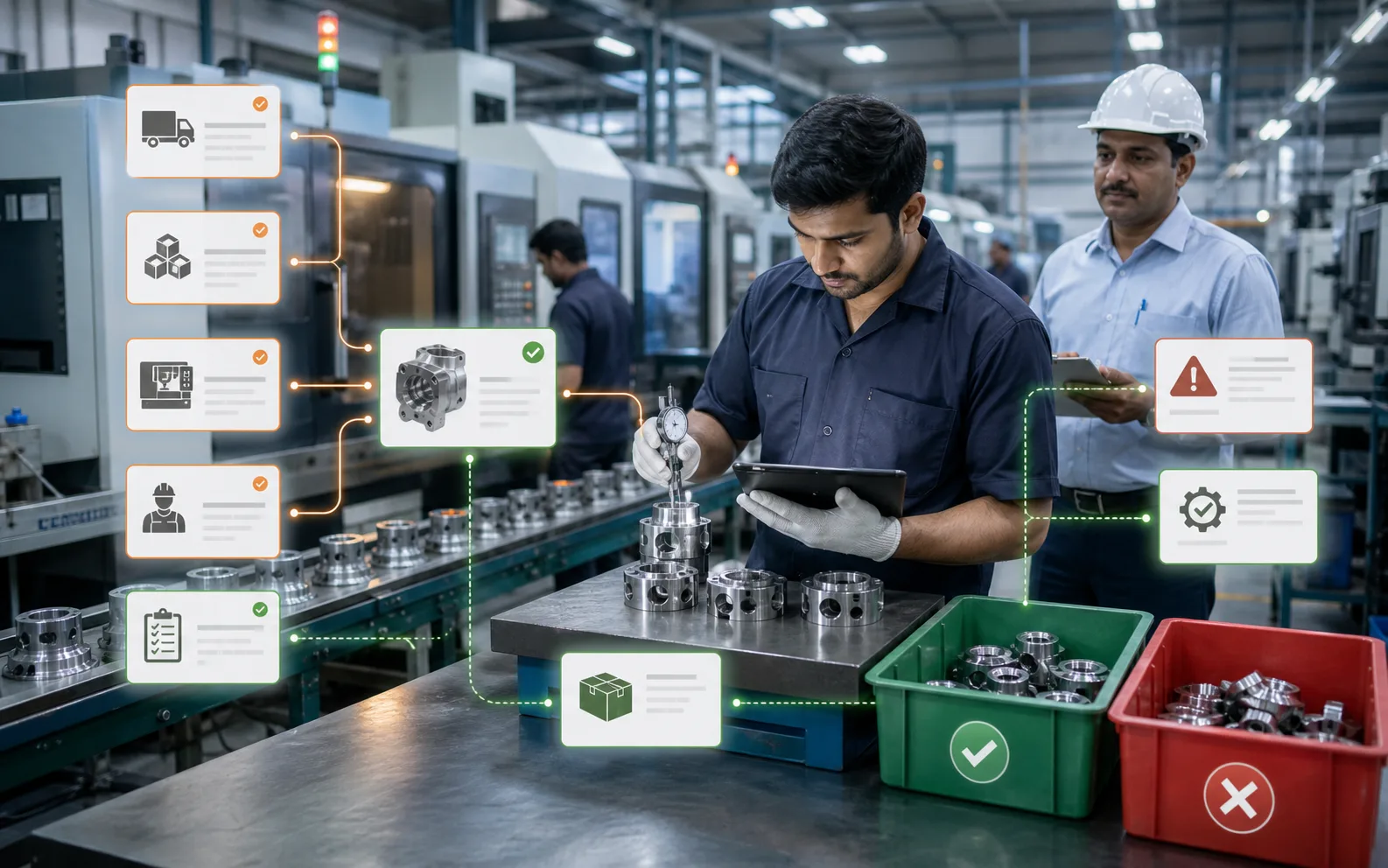
AI Quality Inspection vs Human Inspection
AI quality inspection and human inspection should not be treated as enemies. In most factories, the strongest quality system combines both. AI brings consistency, speed, pattern recognition, and the ability to analyse large amounts of data. Human inspectors bring judgement, context, practical experience, and responsibility.
The right balance depends on product type, defect complexity, production volume, customer requirements, and available data. A high-volume visual inspection process may benefit heavily from AI vision. A complex functional judgement may still require experienced human review.
Artificial intelligence in manufacturing improves quality best when it supports people rather than replacing accountability.
What AI Inspection Does Well
AI inspection is strong where defects are visible, repeatable, measurable, and data-rich. It can detect scratches, dimensional deviations, missing components, colour variation, surface defects, or pattern differences when trained properly.
AI also works consistently. It does not get tired, distracted, or inconsistent across shifts. It can inspect at high speed and record results digitally for traceability.
Beyond visual inspection, AI can analyse quality trends across batches, machines, suppliers, shifts, and process parameters.
What Human Inspection Does Well
Human inspectors understand context. They can judge unusual situations, investigate root causes, interpret borderline cases, and connect quality issues to real production conditions.
Humans are also better at handling new defect types that the system has not seen before. They can ask questions, challenge assumptions, and make decisions where customer requirements or practical trade-offs matter.
Quality ownership cannot be fully delegated to a model.
Where AI Can Fail
AI can fail if training data is weak, lighting conditions change, product variation is high, defects are rare, or the system is not maintained. It may also miss defects outside its training patterns.
This is why validation, calibration, and human review are important. AI inspection should be monitored like any critical quality process.
The Best Approach Is Hybrid
A hybrid inspection model uses AI for speed, consistency, data capture, and early detection, while humans handle verification, exceptions, root-cause analysis, and corrective action.
For example, AI can flag suspect items, and inspectors can review the flagged cases. AI can detect defect trends, and quality teams can investigate process causes. This gives the factory both scale and judgement.
Where AICAN Optiwise Fits
AICAN Optiwise helps manufacturers connect quality with production, inventory, purchase, sales, finance, reports, IoT readiness, and AI workflows. This matters because inspection results become more valuable when linked to batch, machine, material, process, and customer context.
Explore aican.co.in and About AICAN for more on AICAN’s manufacturing-first approach.
Founder’s Note
AICAN’s founder-led belief is that quality should combine discipline and judgement. AI can make inspection faster and more consistent, but experienced people remain essential for understanding why defects happen and how to prevent them.
The future of quality is not AI versus humans. It is AI helping humans build better systems.
FAQ
Is AI inspection more accurate than human inspection?
It can be more consistent for defined visual or measurable defects, but accuracy depends on training data, environment, and validation.
Will AI replace quality inspectors?
AI may reduce repetitive inspection effort, but quality professionals remain important for verification, root cause, corrective action, and customer accountability.
When should a factory use AI inspection?
Use AI where defects are frequent, visible, measurable, high-volume, or costly to miss. Start with a controlled pilot.
What is the safest inspection model?
A hybrid model is often safest: AI for detection and consistency, humans for judgement and accountability.
Final Thought
AI inspection is powerful, but quality is bigger than detection. The best factories use AI to strengthen human inspection, improve traceability, and prevent repeat defects.
Next step: Explore AICAN Optiwise to see how connected workflows can support stronger quality control and AI-ready inspection data.

Related Posts
How Sensors Help With Quality Control in Manufacturing
Explain quality-control sensors through measured property, tolerance, calibration evidence, sampling, false alerts and human disposition.
11 Jun 2026Read more →
Track Quality Issues in ERP: Inspection to Disposition
Follow an inspection issue through stock hold, approved rework or scrap, quantity reconciliation and corrective-action checks, with a 50-part example.
28 May 2026Read more →How Can IoT Improve My Quality Control Process?
Learn how IoT improves quality control by connecting inspection data, batch traceability, machine conditions, process parameters, and corrective action.
13 May 2026Read more →
Predictive Maintenance Software: A Growing Manufacturing Tech Career
Learn why predictive maintenance software is creating manufacturing tech careers in IoT, analytics, AI, machine data, and ERP-connected operations.
3 May 2026Read more →