
How Sensors Help With Quality Control in Manufacturing
Explain quality-control sensors through measured property, tolerance, calibration evidence, sampling, false alerts and human disposition.
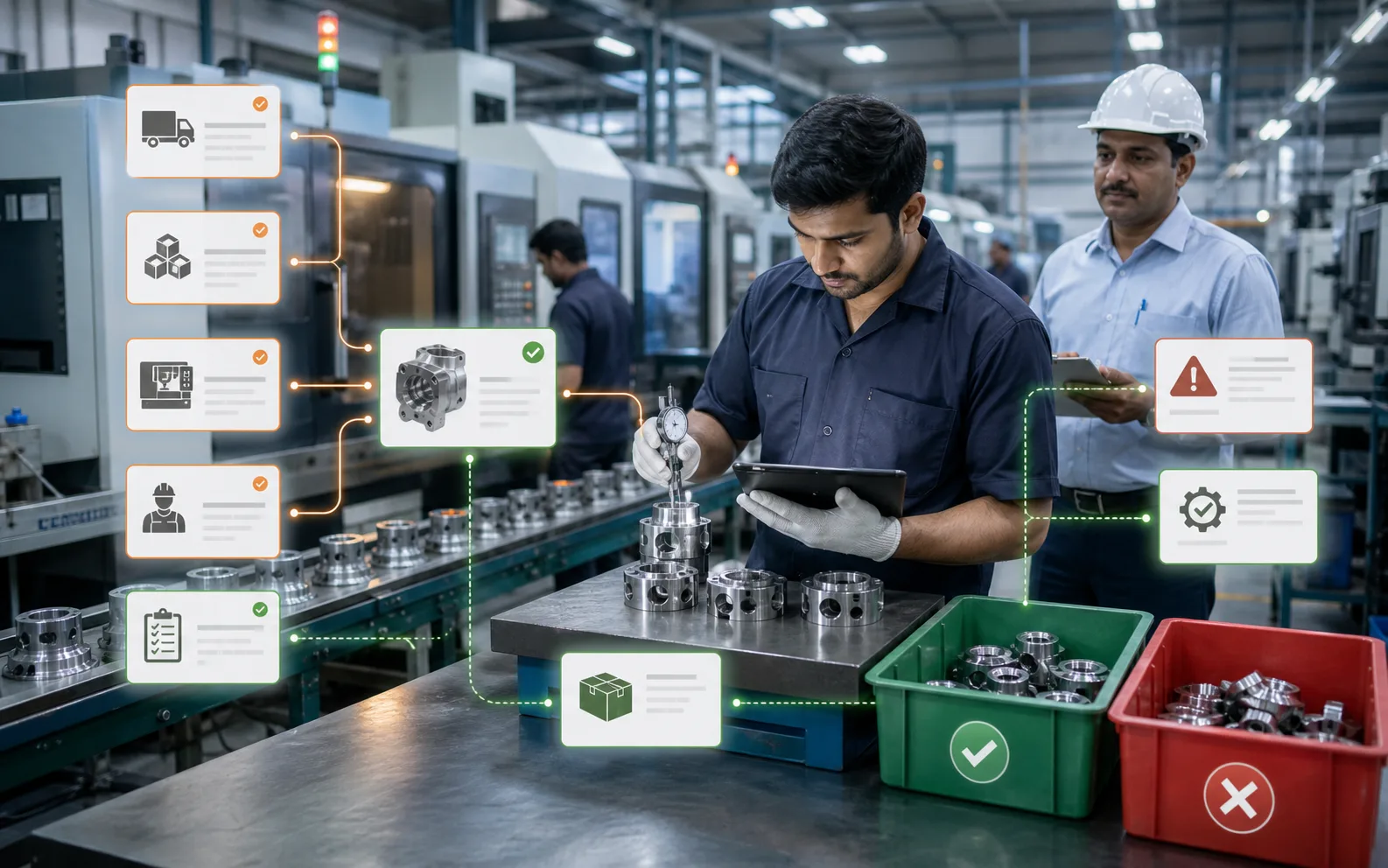
Sensors can support quality control, but they do not make quality decisions alone. A sensor reading becomes useful only when the factory knows what property is measured, what tolerance applies and who decides what happens when a reading is outside the limit.
Optiwise connects sensor-supported signals with production, quality and action records so the result can lead to hold, rework, inspection or maintenance review.
Direct answer
Sensors help quality control only when the measured property, tolerance, reference check, sampling rule, false-alert handling and disposition owner are defined.
Factory example
A temperature signal moves outside tolerance during a curing process. The sensor alert triggers an inspection hold, but the quality owner confirms the reading against a reference before deciding rework or acceptance. The sensor speeds action without replacing disposition control.
Implementation path in Optiwise
- Define the measured property and tolerance.
- Confirm sensor values against a reference when needed.
- Let quality owners make disposition decisions with evidence.
Worksheet for your factory
Use this as the working checklist before you change software settings, write SOPs or ask the team to follow a new report.
| Record | What to capture | Why it matters |
|---|---|---|
| Measured property | Temperature, vibration, power, count, pressure or dimension signal | Defines what the sensor actually observes |
| Tolerance or trigger | Allowed range or alert rule | Prevents vague alarms |
| Reference check | Manual instrument, controller value or standard sample | Confirms the signal is believable |
| Sampling rule | Continuous, periodic or event-based | Matches the process risk |
| False-alert handling | How operators confirm or dismiss an alert | Prevents alert fatigue |
| Disposition owner | Quality, production or maintenance person | Turns signal into decision |
How Optiwise supports this workflow
- Use OptiSense, Assembly Monitor, OptiScope and machine-data patterns where the signal matches the quality problem.
- Connect alerts with inspection records, production batches and corrective actions.
- Show missing or stale signals before using a reading for quality action.
- Keep the final disposition in quality workflow instead of treating every sensor alert as automatic rejection.
Explore the connected Optiwise workflows for production, inventory, purchasing, quality, IoT, and AI agents.
Checks before you use the number for decisions
- Confirm the owner of the record and the person who reviews exceptions.
- Write the unit of measure, time period and source system beside every number.
- Mark missing, stale or manually corrected data instead of hiding it inside the final score.
- Keep approval evidence for changes that affect stock, production, quality or customer commitments.
Reference source
For general manufacturing ERP and MRP context, compare this workflow with Deskera MRP resources, then adapt the records to your own factory process.
FAQs
Can sensors replace quality inspectors?
Sensors can reduce blind spots and speed review, but inspection owners still set tolerances, confirm exceptions and decide disposition.
What quality-control problem is a good sensor use case?
Use sensors where a measurable condition affects defects: unstable temperature, abnormal vibration, missed assembly step, high idle load, cycle drift or process variation.

Related Posts

Track Quality Issues in ERP: Inspection to Disposition
Follow an inspection issue through stock hold, approved rework or scrap, quantity reconciliation and corrective-action checks, with a 50-part example.
28 May 2026Read more →How Can IoT Improve My Quality Control Process?
Learn how IoT improves quality control by connecting inspection data, batch traceability, machine conditions, process parameters, and corrective action.
13 May 2026Read more →
Predictive Maintenance Software: A Growing Manufacturing Tech Career
Learn why predictive maintenance software is creating manufacturing tech careers in IoT, analytics, AI, machine data, and ERP-connected operations.
3 May 2026Read more →AI Quality Inspection vs Human Inspection
Compare AI quality inspection and human inspection in manufacturing, including accuracy, consistency, judgement, cost, speed, and the best hybrid approach.
11 Apr 2026Read more →