
Budget-Friendly Ways to Start Improving Your Shop Floor
Start improving your shop floor on a budget with downtime tracking, digital checklists, inventory visibility, quality logs, training, and simple analytics.

Budget-Friendly Ways to Start Improving Your Shop Floor
Improving the shop floor does not always require a huge budget.
Factories can begin with simple, high-impact improvements: better downtime tracking, digital production updates, quality checklists, inventory visibility, training, and basic analytics. The goal is to reduce confusion before investing in advanced automation.
Start where daily pain is visible.
Track Downtime Clearly
Downtime is expensive, but many factories do not track it properly.
Start by recording machine, duration, reason, shift, and action taken. This alone can reveal improvement opportunities.
Digitize Production Updates
Move from delayed paper reports to simple digital production updates.
This helps supervisors and managers see progress earlier.
Improve Inventory Visibility
Material shortages can stop production.
Better visibility into available stock, pending purchase, and critical items can improve shop floor flow.
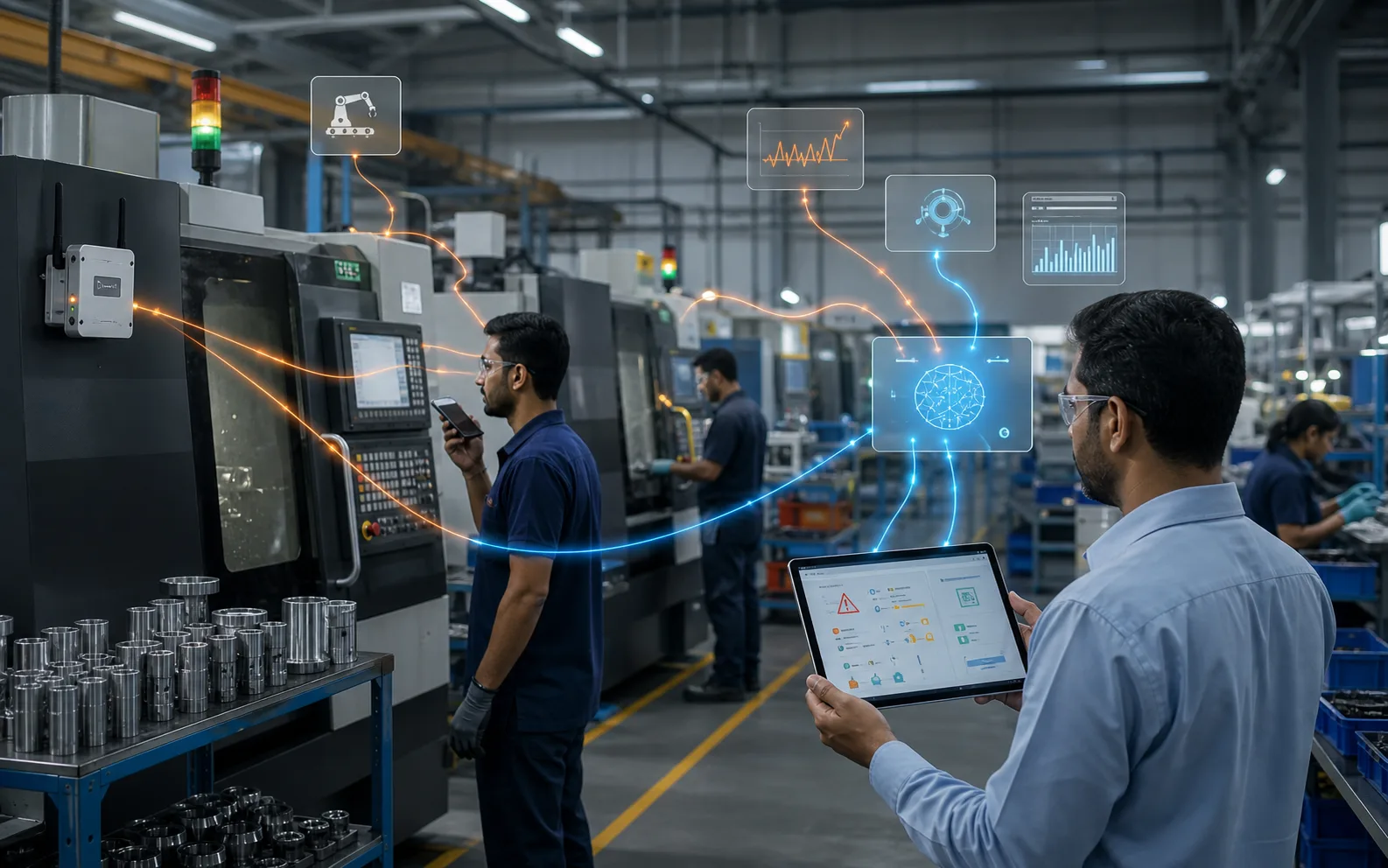
AICAN Optiwise helps connect production, inventory, purchase, sales, finance, reports, IoT readiness, and AI workflows in one platform.
Use Digital Quality Checklists
Quality issues become easier to track when checks are consistent.
Digital checklists help identify repeated defects and missed steps.
Train Supervisors and Operators
Training is one of the best low-cost improvements.
Teach teams why data accuracy, downtime reasons, quality logs, and timely updates matter.
Where AICAN Optiwise Fits
AICAN Optiwise can support budget-conscious manufacturers by starting with connected visibility and expanding into deeper AI workflows over time.
Learn more at About AICAN.
Founder’s Note
A better shop floor begins with discipline, not expensive equipment. Small improvements become powerful when repeated daily.
Start with clarity. Then scale.
FAQ
What is the cheapest shop floor improvement?
Better downtime and production tracking can be a strong low-cost starting point.
Do small factories need advanced automation first?
No. Start with visibility and data discipline.
Can software help on a budget?
Yes, if it solves practical workflows and avoids unnecessary complexity.
What should be improved first?
Downtime, production updates, inventory shortages, quality checks, and training.
Final Thought
Shop floor improvement can start small.
Better data, cleaner routines, and practical visibility can make a real difference. That is the grounded improvement path AICAN supports.

Related Posts
Is AI Worth the Investment for My Factory?
Learn how to decide if AI is worth the investment for your factory by evaluating use cases, data readiness, costs, risks, ROI, and operational impact.
13 Jun 2026Read more →Manufacturing AI Mistakes to Avoid Before You Start
List manufacturing AI mistakes and controls for unclear use case, messy data, unsafe automation, no owner, weak security and unreviewed recommendations.
13 Jun 2026Read more →What's the Difference Between AI and Regular Automation?
Understand the difference between AI and regular automation in manufacturing, with practical examples for workflows, decisions, alerts, and predictive operations.
13 Jun 2026Read more →What Are the Risks of Using AI in Manufacturing?
Understand the risks of AI in manufacturing, including bad data, wrong recommendations, safety issues, security, job fear, over-automation, and implementation failure.
13 Jun 2026Read more →