
Can AI Reduce Equipment Downtime? Records, Signals and Limits
Use downtime, maintenance, spare, operator and IoT records to reduce equipment downtime risk while avoiding claims that AI prevents every failure.
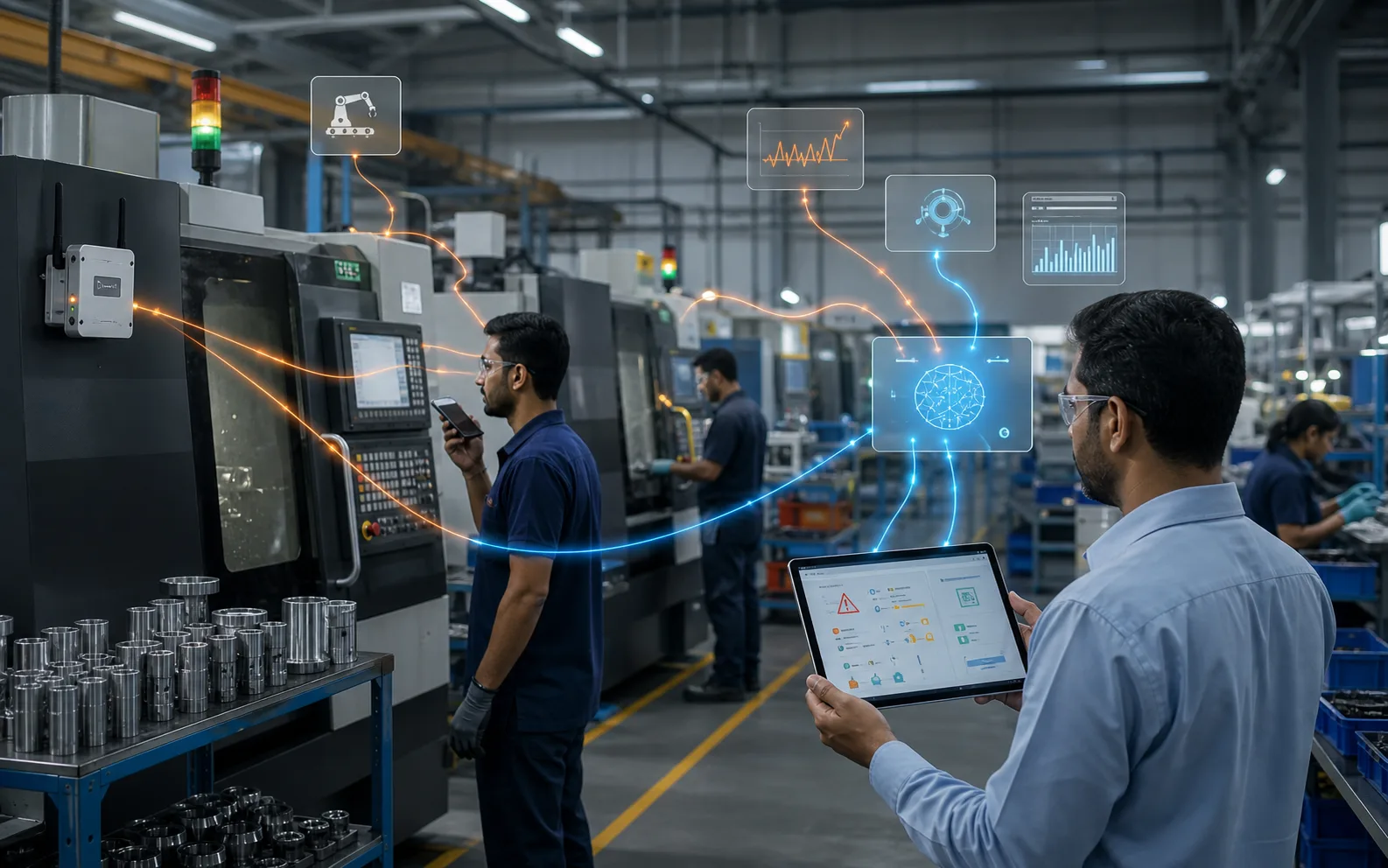
AI can help with downtime only when the factory records why machines stop. A model cannot fix a missing reason code, a late spare part or a maintenance job that nobody owns.
Optiwise connects machine signals, production context and action records so downtime review can move from daily blame to specific follow-up.
Direct answer
AI can support downtime reduction when it reads clean runtime, stop reason, maintenance, spare and production records; it should not be sold as a promise that machines will not fail.
Factory example
A press stops repeatedly after tool change. The signal shows stop time, but the useful finding comes from combining shift, product, operator note, spare availability and maintenance history. The action is a setup checklist and planned inspection, not an unsupported claim that AI will prevent the next breakdown.
Worksheet for the decision
| Area | What to check | Why it matters |
|---|---|---|
| Runtime signal | Running, idle or stopped state | Shows when the loss happened |
| Stop reason | Tooling, material, operator, breakdown or planned stop | Shows who owns the action |
| Maintenance history | Last job, open task and due inspection | Separates repeat failures from one-off stops |
| Spare availability | Critical spare status and purchase lead time | Prevents diagnosis without recovery plan |
| Production context | Product, route, shift and batch | Finds patterns by job type |
| Approval owner | Maintenance or production lead | Keeps recommendations supervised |
How Optiwise supports this workflow
- Capture runtime, downtime, load, cycle and efficiency views through Optiwise IoT where machine access is available.
- Connect production records with machine-state data so stop review includes job and shift context.
- Use AI queries to find recurring downtime patterns after data quality is accepted.
Use the related Optiwise workflows for AI agents, production, inventory, purchasing, quality and industrial IoT.
Implementation notes
For downtime work, separate signal capture from root-cause action. A machine signal can show when a stop happened, but the reason may still come from an operator, supervisor or maintenance note. Keep planned maintenance, no-material stoppage, no-operator stoppage and true breakdown separate. That prevents the team from assigning every stop to maintenance when the real issue is planning or material readiness.
Source and control checks
For AI risk and governance language, compare your project controls with the NIST AI Risk Management Framework. For connected device access and security planning, also review CISA cybersecurity performance goals where applicable.
Before using the recommendation, confirm the record owner, source timestamp, approval rule and missing-data handling. Keep customer results, savings numbers, safety certification and regulatory claims out of the page unless there is separate evidence for that exact claim.
Buyer review before rollout
Before rollout, review one finished transaction from start to end. Check the source record, the recommended action, the approval step, the person who accepted or rejected it and the operational result. This review catches weak data, vague ownership and unsafe automation before the workflow reaches more users. Keep the pilot narrow until the team can explain the recommendation in plain factory language.
FAQs
Can AI prevent all equipment downtime?
No. AI can flag patterns and support earlier action, but machine failures still depend on maintenance discipline, parts, environment and operator practice.
What data is needed first?
Start with machine state, reason code, shift, product, maintenance history and spare status.

Related Posts
Is AI Worth the Investment for My Factory?
Learn how to decide if AI is worth the investment for your factory by evaluating use cases, data readiness, costs, risks, ROI, and operational impact.
13 Jun 2026Read more →Manufacturing AI Mistakes to Avoid Before You Start
List manufacturing AI mistakes and controls for unclear use case, messy data, unsafe automation, no owner, weak security and unreviewed recommendations.
13 Jun 2026Read more →What's the Difference Between AI and Regular Automation?
Understand the difference between AI and regular automation in manufacturing, with practical examples for workflows, decisions, alerts, and predictive operations.
13 Jun 2026Read more →What Are the Risks of Using AI in Manufacturing?
Understand the risks of AI in manufacturing, including bad data, wrong recommendations, safety issues, security, job fear, over-automation, and implementation failure.
13 Jun 2026Read more →