
Can IoT Improve Product Quality in Manufacturing?
Learn how IoT can improve product quality through process monitoring, traceability, early alerts, defect analysis, quality holds, and better production visibility.

Can IoT Improve Product Quality in Manufacturing?
IoT can improve product quality when it helps the factory see quality risk earlier.
It does not replace quality standards, inspection discipline, skilled operators, process control, or root-cause analysis. But it can make the conditions around quality more visible: machine status, process parameters, temperature, pressure, vibration, cycle time, energy, inspection results, rejection patterns, and batch traceability.
Many quality problems are discovered too late. A batch is produced, inspection finds defects, production stops, rework begins, and everyone tries to reconstruct what happened. Which machine ran the job? Which shift? What was the process condition? Was there a downtime event? Did temperature drift? Did cycle time change? Was material different?
If the data is missing or scattered, quality investigation becomes guesswork.
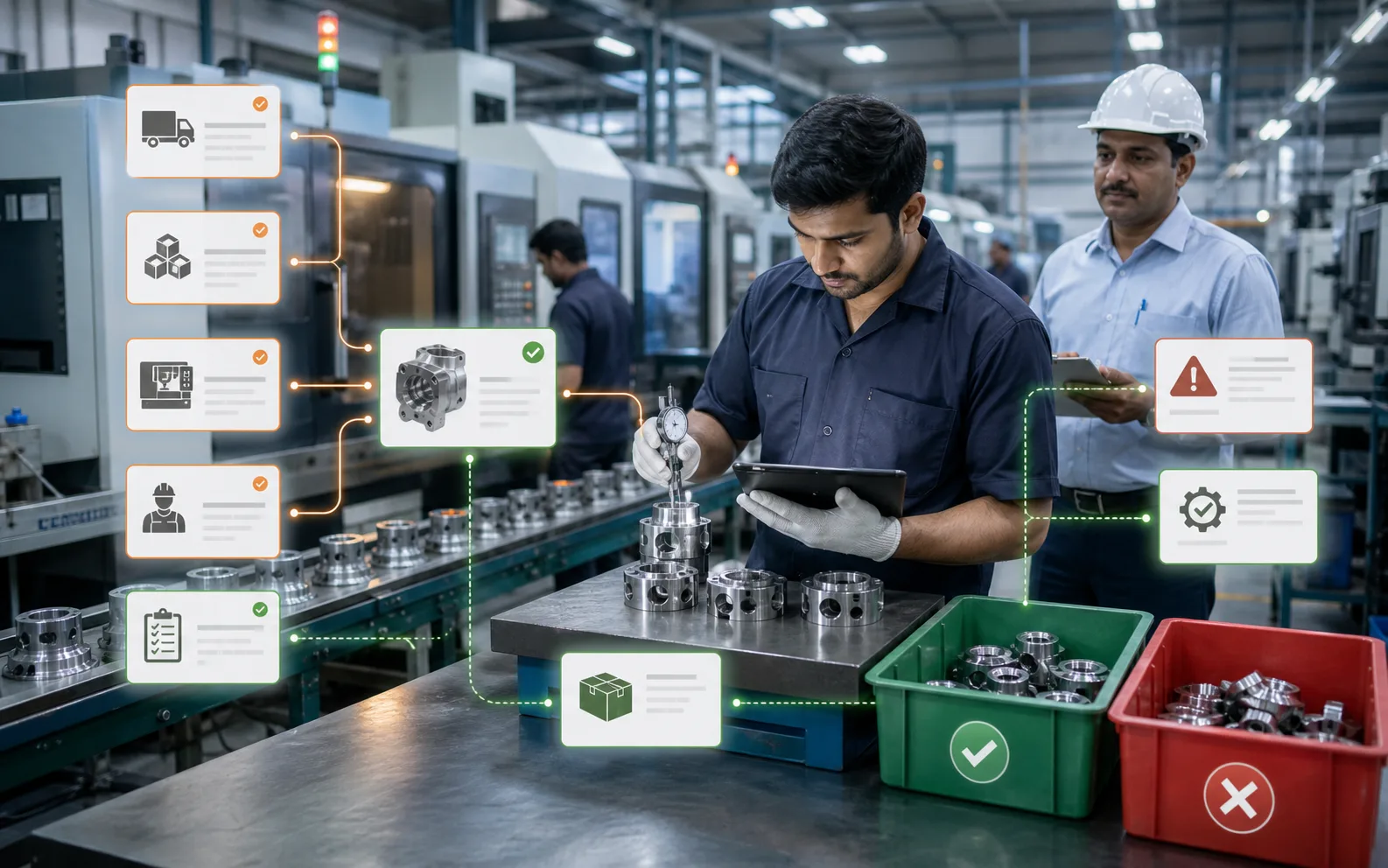
IoT for Manufacturing helps by capturing useful signals from machines, sensors, meters, and connected workflows so teams can identify risk earlier and investigate problems with better evidence.
This guide explains how IoT supports product quality and how AICAN Optiwise can help connect quality data with production, maintenance, inventory, and dispatch decisions.
Quality Starts Before Inspection
Inspection is important, but quality is created during the process.
A final inspection report may show defects, but the causes often began earlier:
- Process temperature drifted.
- Pressure was unstable.
- Machine vibration increased.
- Cycle time changed.
- Tool wear affected output.
- Material batch behaved differently.
- Setup was not stable.
- Operator adjustment was not recorded.
- Machine stopped and restarted during production.
IoT can help monitor these process conditions so quality teams do not rely only on inspection after production is complete.
Process Parameter Monitoring
Some products depend heavily on process parameters.
Examples include temperature, pressure, humidity, speed, vibration, current, flow, weight, torque, and timing. The right parameters depend on the industry and process.
IoT can help track these values during production and alert teams if they move outside defined limits.
This can support:
- Earlier detection of process drift.
- Better control of quality-sensitive operations.
- Faster investigation when defects occur.
- Traceability of conditions by batch or job.
- Reduced dependence on manual readings.
The key is selecting parameters that actually affect quality. Tracking a value nobody uses adds noise.
Early Alerts Before Defects Spread
A quality issue becomes more expensive when it continues unnoticed.
IoT can help trigger alerts when process conditions, machine behavior, or production patterns suggest risk.
Useful quality-related alerts may include:
- Temperature outside allowed range.
- Pressure instability.
- Cycle time variation.
- Machine vibration abnormality.
- Rejection rate crossing threshold.
- Inspection pending too long.
- Quality hold blocking dispatch.
- Repeat defect on the same machine or operation.
These alerts help teams pause, inspect, adjust, or investigate before the issue spreads across more quantity.
Traceability by Job, Batch, Machine, and Shift
When quality problems occur, traceability matters.
The factory should be able to answer:
- Which batch was affected?
- Which machine produced it?
- Which operator or shift ran it?
- Which material lot was used?
- What process conditions were recorded?
- Was there downtime during the job?
- Were inspections completed on time?
- Which finished goods are linked to the issue?
IoT supports traceability by capturing process and machine data. Manufacturing software connects that data with jobs, batches, material, quality checks, and dispatch.
Traceability is not only useful for compliance. It also reduces investigation time.
Reducing Manual Reading Errors
Manual readings have limits.
Operators may record values late. Readings may be rounded. Paper registers may be incomplete. Values may be entered only once per shift, even though the process changes during production.
IoT can capture selected readings automatically or more frequently, reducing dependence on memory and manual entry.
This is especially useful when:
- Readings are critical to quality.
- Conditions change quickly.
- Manual checks are inconsistent.
- Batch-level evidence is important.
- Quality investigation needs timestamped data.
Manual checks may still be needed. IoT simply improves the evidence base.
Connecting Quality With Machine and Maintenance Data
Quality problems are sometimes caused by machine condition.
A worn tool, unstable pressure, vibration issue, poor lubrication, sensor fault, or repeated stoppage can affect output quality.
IoT can help connect quality results with machine behavior:
- Did rejection rise after a maintenance issue?
- Did defects occur on one machine more than others?
- Did vibration or current change before defects increased?
- Did repeated minor stops affect product consistency?
- Did setup overrun or restart affect quality?
This connection helps quality and maintenance teams work together.
Quality Holds Need Visibility
Quality improvement is not only about detecting defects. It is also about managing quality flow.
A job may be completed but waiting for inspection. A batch may be on hold. Rework may be pending. A dispatch may be blocked by quality approval.
Connected systems can show:
- Inspection pending.
- First-piece approval status.
- In-process inspection status.
- Final QC status.
- Quality hold duration.
- Rework status.
- Dispatch blocked due to quality.
This prevents production and dispatch teams from assuming that produced quantity is ready quantity.
Defect Trend Analysis
IoT and connected quality data can help identify patterns.
Teams can review defects by:
- Product.
- Machine.
- Operation.
- Shift.
- Material lot.
- Process parameter.
- Operator group.
- Time period.
This supports better root-cause analysis. Instead of treating every rejection as isolated, the factory can see repeated patterns and act permanently.
What IoT Cannot Fix Alone
IoT cannot fix poor quality discipline by itself.
It cannot replace:
- Clear specifications.
- Standard operating procedures.
- Calibration.
- Operator training.
- Good tooling.
- Preventive maintenance.
- Inspection discipline.
- Root-cause analysis.
- Corrective action ownership.
If the process does not act on quality signals, data will not improve quality. IoT is useful only when teams respond to what it reveals.
Where AICAN Optiwise Fits
AICAN Optiwise helps manufacturers connect quality with production, inventory, maintenance, and dispatch visibility.
For product quality, this connection matters because defects are rarely isolated. They may be linked to material, machine condition, process parameters, operation timing, inspection delays, or rework flow.
Optiwise can help manufacturers work toward:
- Quality status visibility across jobs and batches.
- Process and machine data connected to production context.
- Rejection and rework tracking.
- Quality hold visibility.
- Better traceability for investigation.
- Alerts for quality-related exceptions.
- Coordination between production, quality, maintenance, and dispatch.
AICAN builds manufacturing systems that help factories use data for practical quality control, not just reporting. Learn more at About AICAN.
FAQ
Can IoT improve product quality?
Yes. IoT can improve product quality by monitoring process parameters, detecting abnormal conditions, supporting traceability, reducing manual reading errors, and helping teams identify defect patterns earlier.
Does IoT replace quality inspection?
No. IoT does not replace inspection. It supports inspection and quality control by providing better process and machine data before, during, and after production.
What quality data can IoT capture?
IoT can capture temperature, pressure, humidity, vibration, current, speed, flow, cycle time, machine status, alarms, inspection readings, rejection data, and other process-specific signals.
How does IoT help with traceability?
IoT helps by recording process and machine conditions linked to jobs, batches, machines, shifts, material lots, and inspection results. This improves investigation when quality issues occur.
Can IoT reduce rejection and rework?
IoT can support rejection and rework reduction by making process drift, machine issues, and defect patterns visible earlier. Actual improvement depends on corrective action by the factory team.
How does AICAN Optiwise support quality improvement?
AICAN Optiwise helps connect quality data with production, maintenance, inventory, and dispatch workflows so quality issues can be tracked, investigated, and acted on with better context.
Founder’s Note
Quality issues become harder when the factory has to investigate with incomplete memory.
People try to remember which machine ran, what settings were used, whether the machine stopped, what material came in, and why inspection was delayed. That is a lot to reconstruct after the damage is visible.
At AICAN, we believe quality improves when the process becomes more visible. IoT helps when it gives teams the evidence they need early enough to act.
Final Thought
IoT can improve product quality by turning hidden process conditions into usable signals.
It helps teams see drift, connect defects with machine and batch data, manage quality holds, and investigate issues with facts. The technology does not replace discipline, but it gives disciplined teams a much better view of what is really happening.

Related Posts
How Sensors Help With Quality Control in Manufacturing
Explain quality-control sensors through measured property, tolerance, calibration evidence, sampling, false alerts and human disposition.
11 Jun 2026Read more →Track Quality Issues in ERP: Inspection to Disposition
Follow an inspection issue through stock hold, approved rework or scrap, quantity reconciliation and corrective-action checks, with a 50-part example.
28 May 2026Read more →How Can IoT Improve My Quality Control Process?
Learn how IoT improves quality control by connecting inspection data, batch traceability, machine conditions, process parameters, and corrective action.
13 May 2026Read more →
Predictive Maintenance Software: A Growing Manufacturing Tech Career
Learn why predictive maintenance software is creating manufacturing tech careers in IoT, analytics, AI, machine data, and ERP-connected operations.
3 May 2026Read more →