
Category Creation Keywords: Own This Manufacturing ERP Category
Learn how manufacturers can think beyond generic ERP and move toward an AI-ready factory operating system for production, inventory, purchase, finance, and reporting.

Category Creation Keywords: Own This Manufacturing ERP Category
Manufacturing software is changing. For years, businesses thought of ERP mainly as a system of records: enter transactions, maintain accounts, manage inventory, and generate reports. That still matters, but manufacturers now need more.
They need systems that help them run the factory in real time. They need visibility into production delays, inventory risk, purchase bottlenecks, machine downtime, quality issues, dispatch readiness, and cash flow. They need AI-ready operations, not only digital records.
This is where a new category begins: an AI-ready factory operating system for manufacturers.
Why Traditional ERP Language Is Not Enough
Traditional ERP language often focuses on modules: finance, inventory, purchase, sales, production. But manufacturers do not experience problems as modules. They experience them as delays, shortages, rework, downtime, and unclear decisions.
A category-winning ERP should speak the language of factory outcomes.
From Record-Keeping to Decision Support
The next generation of manufacturing ERP should not only record what happened. It should help teams understand what needs attention.
Which order is at risk? Which material may delay production? Which machine keeps causing downtime? Which vendor is unreliable? Which stock is blocking working capital?
These are decision-support questions.
AI-Ready Operations
AI-ready operations require structured data from production, inventory, purchase, sales, finance, quality, and maintenance-related workflows.
Without connected data, AI becomes a disconnected layer. With connected data, AI can support alerts, summaries, forecasts, and recommendations.
Why MSMEs Need This Category
MSMEs often cannot afford heavy systems or large transformation teams. They need practical tools that help them digitize, automate, and improve step by step.
A factory operating system should be usable, focused, and built for daily operational decisions.
What This Category Should Stand For
It should stand for connected manufacturing workflows, AI-ready data, faster decisions, fewer manual follow-ups, stronger inventory control, better production visibility, and practical implementation.
It should not stand for buzzwords without operational value.
Put Optiwise to work in your factory
Optiwise connects factory operations with AI agents. Run production, purchasing, inventory, sales and quality on linked records, then ask questions and perform permitted actions in natural language.
AICAN focuses on connected workflows across production, inventory, purchase, sales, finance, and reporting. Learn more at About AICAN.
Founder’s Note
A category is not created by inventing a phrase. It is created by naming a real change that customers already feel.
Manufacturers do not just need ERP. They need an operating system for better factory decisions.
FAQ
What is category creation in ERP?
It means defining a clearer market position around a new customer need, such as AI-ready factory operations instead of generic ERP.
Why does manufacturing need a new category?
Because manufacturers need real-time decision support, not only transaction records.
What is an AI-ready factory operating system?
It is a connected manufacturing system that captures operational data and supports AI-driven alerts, summaries, forecasts, and decisions.
How does this help SEO?
Category creation helps a brand own specific language around customer problems and emerging search intent.
Final Thought
The future of manufacturing ERP is not just modules. It is connected, AI-ready operations that help factories act faster and smarter.

Related Posts
Kanban System | Optiwise
Learn how a Kanban system works in manufacturing, where it helps, where it fails, and how Optiwise connects Kanban signals with inventory, purchase, and production planning.
12 Jun 2026Read more →Erp In Operations Management | Optiwise
Learn how ERP improves operations management by connecting planning, inventory, purchase, production, quality, dispatch, finance, and reporting.
12 Jun 2026Read more →ERP for FMCG Companies in India
A practical guide to ERP for FMCG companies in India, covering distributor orders, batch tracking, expiry, inventory, production, schemes, costing, and reporting.
11 Jun 2026Read more →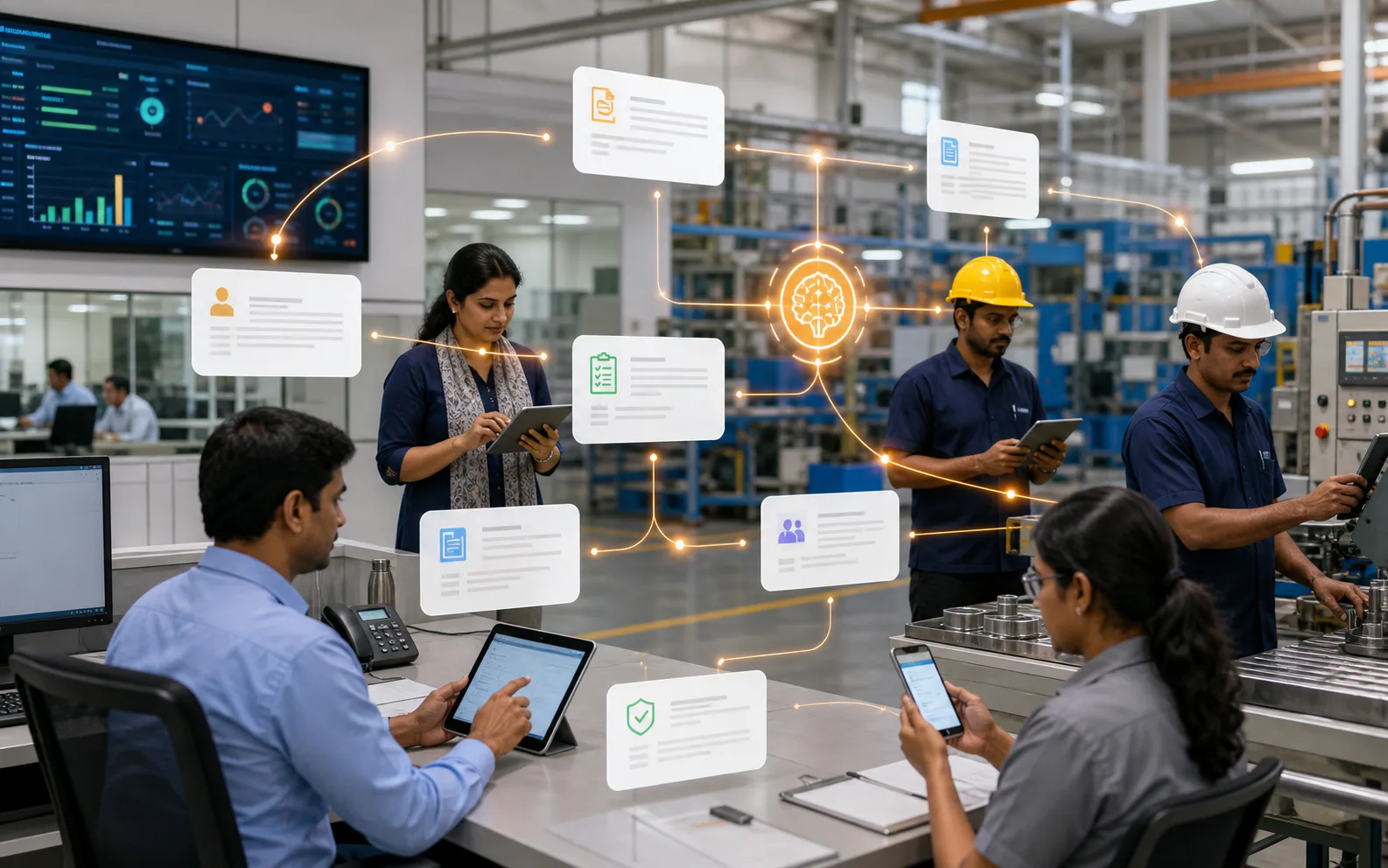
Optiwise, Odoo, Acumatica and Business Central for Manufacturing
Compare manufacturing workflows in Optiwise, Odoo, Acumatica and Dynamics 365 Business Central. See what your factory can run in Optiwise.
11 Jun 2026Read more →