
Factory ERP India
Learn what factory ERP in India should include, from production planning and inventory to purchase, dispatch, finance, reporting, and AI-ready workflows.

Factory ERP India
Factory ERP in India should help manufacturers run day-to-day operations with better visibility, control, and coordination. A factory is not only an accounting unit. It is a live operating system where materials move, machines run, orders change, vendors delay, quality issues appear, and customers expect delivery updates.
A good factory ERP connects these moving parts.
Many manufacturers begin with spreadsheets, accounting software, or department-specific tools. These may work for a while, but as operations grow, gaps appear. Production does not know purchase status. Stores does not trust stock data. Sales keeps asking for dispatch updates. Finance receives cost information late. Management waits for reports.
Factory ERP solves this by creating one connected operational view.
What Factory ERP Should Include
A factory ERP should include production planning, work orders, BOMs, inventory, purchase, vendor management, sales orders, dispatch, finance, quality, maintenance-related tracking, approvals, and reporting.
The exact modules depend on the business, but the system should connect core workflows. If production, inventory, and purchase are not connected, the ERP will not solve the real factory problem.
Production Planning and Work Orders
Factory ERP should help teams plan what to produce, when to produce it, which materials are required, and what capacity is available.
Work orders should connect to BOMs, material issue, production progress, scrap, rework, and completion status.
This gives planners and managers visibility into execution.
Inventory Control
Factories need accurate stock visibility for raw materials, WIP, finished goods, spares, consumables, and packing material.
ERP should track goods receipt, material issue, returns, transfers, stock adjustment, slow-moving stock, reorder levels, and inventory valuation.
Inventory control is one of the biggest reasons manufacturers need ERP.
Purchase and Vendor Visibility
Purchase should be connected to production requirements and inventory status. ERP should show purchase requisitions, approvals, purchase orders, expected delivery, vendor performance, goods receipt, and invoice matching.
This reduces procurement delays and improves material readiness.
Dispatch and Customer Commitments
Factory ERP should help dispatch teams see finished goods readiness, quality clearance, packing status, documents, transport planning, and invoice status.
Sales teams should be able to track order status without endless internal follow-ups.
Finance and Costing
ERP should connect operations with finance. Material consumption, production cost, inventory value, purchase liability, customer billing, receivables, and profitability should be visible.
Without this connection, business decisions are delayed.
AI-Ready Factory ERP
AI-ready ERP can support alerts, summaries, forecasting, and decision support. But AI needs structured data from production, inventory, purchase, sales, finance, quality, and maintenance.
Factory ERP is the foundation for practical AI.
Where AICAN Optiwise Fits
AICAN Optiwise is built for manufacturers who need connected factory operations across production, inventory, purchase, sales, finance, and reporting. It helps Indian manufacturers move from scattered workflows to a more controlled operating system.
AICAN focuses on practical manufacturing visibility and AI-ready operations. Learn more at About AICAN.
Founder’s Note
A factory ERP should feel like the factory’s nervous system. It should help every team understand what is happening and what needs attention.
The goal is not just software adoption. The goal is a calmer, more reliable factory.
FAQ
What is factory ERP?
Factory ERP is software that connects production, inventory, purchase, sales, dispatch, finance, and reporting for manufacturing operations.
Why do Indian factories need ERP?
ERP helps reduce manual follow-ups, improve stock accuracy, control production, manage purchase delays, and improve decision-making.
Is factory ERP different from accounting software?
Yes. Accounting software focuses mainly on finance. Factory ERP connects operational workflows with finance.
Can factory ERP support AI?
Yes, if it captures structured operational data that AI can use for alerts, forecasts, and summaries.
Final Thought
Factory ERP in India should solve real operational problems. Choose a system that connects production, inventory, purchase, dispatch, finance, and reporting into one reliable flow.

Related Posts
Kanban System | Optiwise
Learn how a Kanban system works in manufacturing, where it helps, where it fails, and how Optiwise connects Kanban signals with inventory, purchase, and production planning.
12 Jun 2026Read more →Erp In Operations Management | Optiwise
Learn how ERP improves operations management by connecting planning, inventory, purchase, production, quality, dispatch, finance, and reporting.
12 Jun 2026Read more →ERP for FMCG Companies in India
A practical guide to ERP for FMCG companies in India, covering distributor orders, batch tracking, expiry, inventory, production, schemes, costing, and reporting.
11 Jun 2026Read more →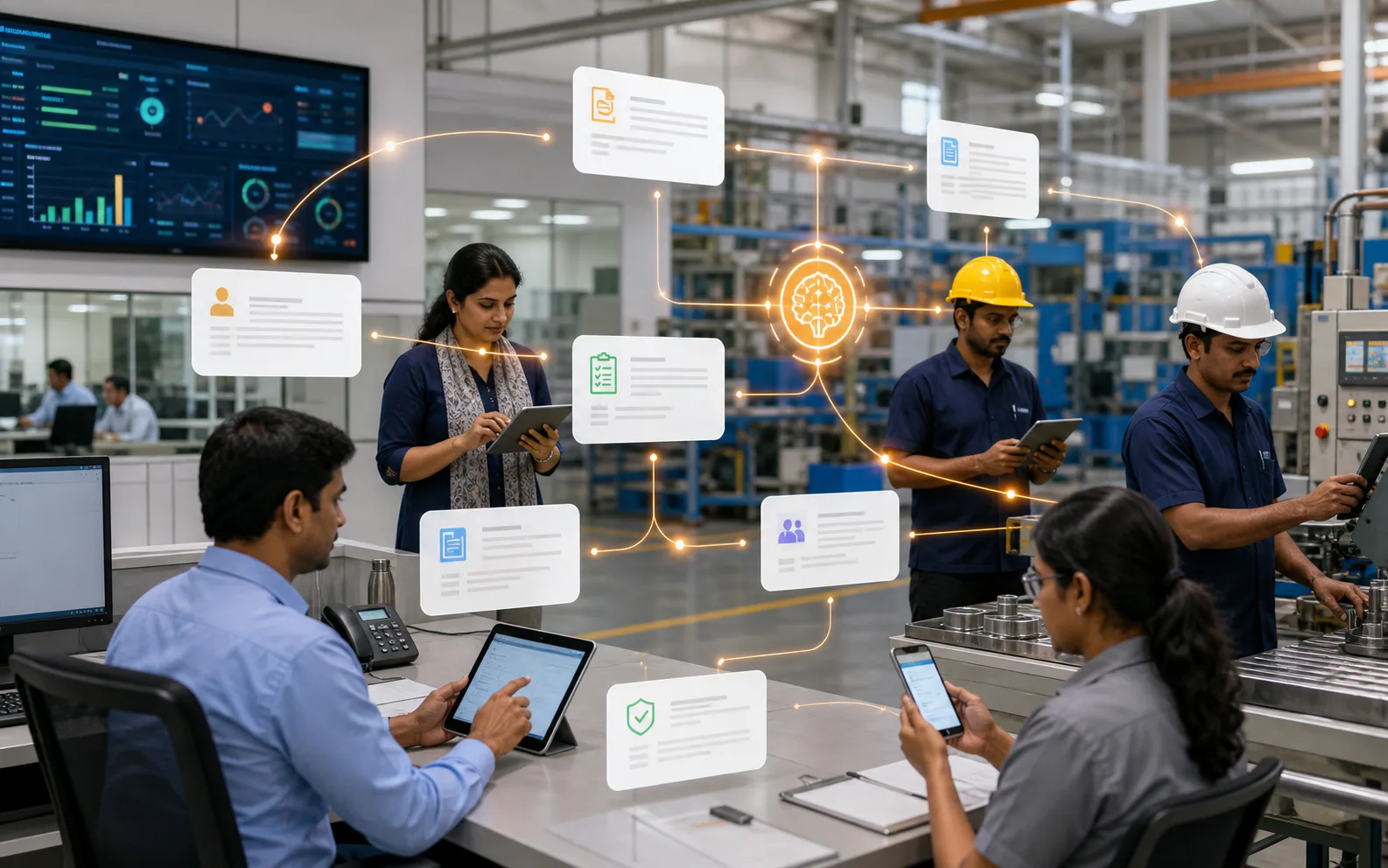
Optiwise, Odoo, Acumatica and Business Central for Manufacturing
Compare manufacturing workflows in Optiwise, Odoo, Acumatica and Dynamics 365 Business Central. See what your factory can run in Optiwise.
11 Jun 2026Read more →