
How Does AI Improve Manufacturing Quality Control?
Learn how AI improves manufacturing quality control through early defect detection, pattern analysis, traceability, inspection support, and corrective action.

How Does AI Improve Manufacturing Quality Control?
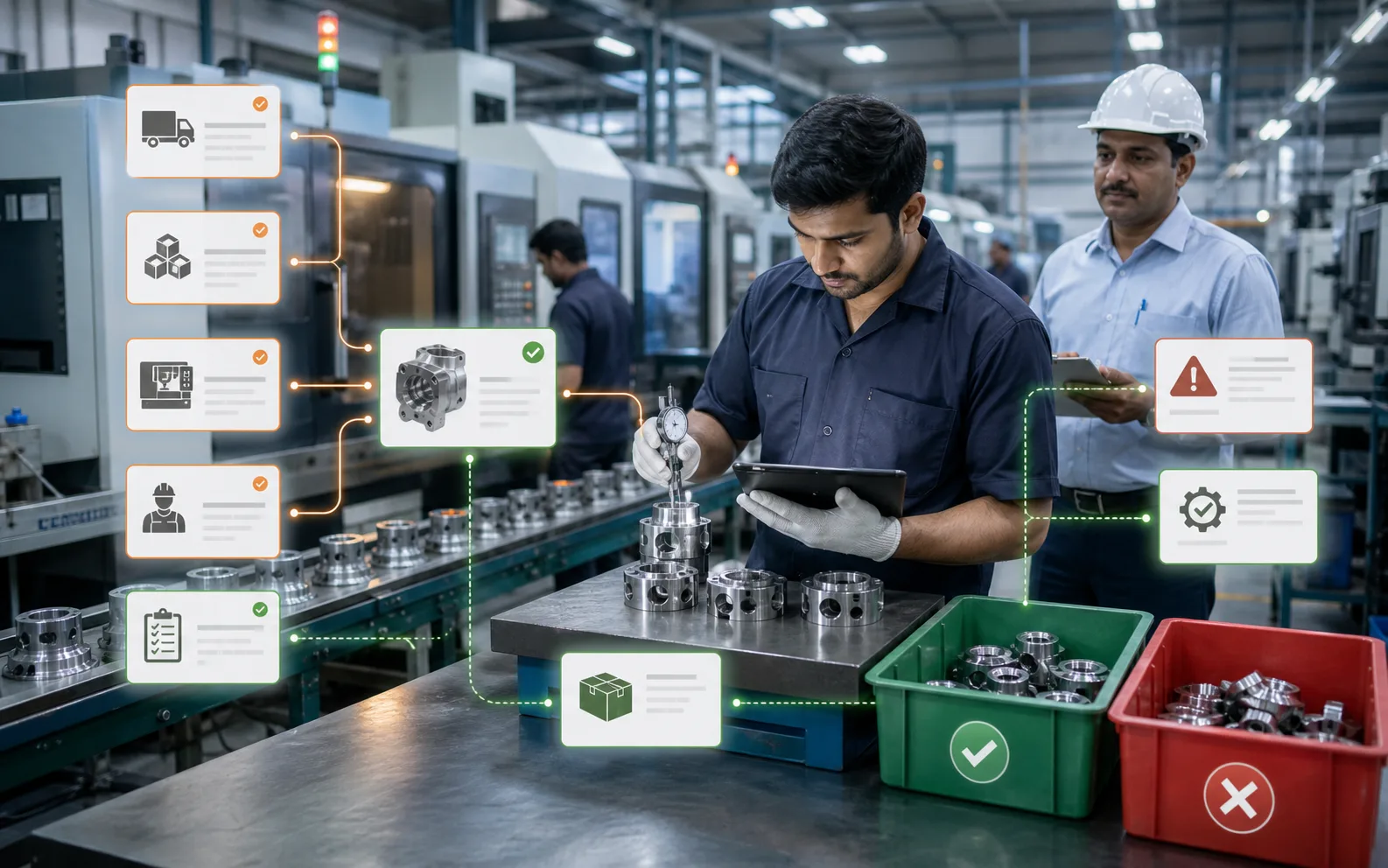
Quality control is one of the strongest use cases for AI in manufacturing because defects usually follow patterns. A rejection may look sudden, but it often has signals: a raw material batch, a machine setting, a tool condition, a shift pattern, an operator change, a supplier issue, or a process variation. AI helps identify these signals faster than manual review.
Traditional quality control often catches problems at inspection points. That is necessary, but it can be late. By the time defects are found, material, machine time, labour, and delivery schedules may already be affected. Artificial intelligence in manufacturing helps quality teams move from detection to prevention.
The aim is not to remove inspectors. It is to give inspectors and managers better information so they can focus on the highest-risk areas and understand root causes sooner.
AI Spots Patterns Humans May Miss
Quality teams handle large amounts of data: inspection results, rejection reasons, batch numbers, supplier details, machine conditions, process parameters, operator notes, customer complaints, and rework history. Humans can review this data, but it is difficult to see every relationship manually.
AI can compare these variables and highlight patterns. For example, a certain defect may increase when material comes from a specific vendor. A dimension variation may appear more often on one machine after extended running hours. A customer complaint may trace back to a process stage that was assumed to be stable.
This pattern recognition helps teams investigate with direction instead of guessing.
AI Supports Early Warning, Not Just Final Inspection
A strong quality system does not wait until final inspection to react. AI can support early warnings by monitoring in-process data, previous defect trends, material lots, machine history, and operator inputs.
If a batch begins showing early signs of deviation, the system can alert the quality team before more quantity is produced. This reduces scrap, rework, and customer risk.
Even in factories without advanced machine vision, AI can still help through structured quality records and trend analysis.
AI Improves Traceability
When a defect occurs, the first question is: where did it come from? Traceability connects the defect to raw material, production batch, machine, operator, process step, inspection result, and dispatch record.
AI becomes more useful when traceability is strong. It can quickly narrow down likely causes and affected batches. This helps the factory respond faster, contain issues, and avoid repeating the same mistake.
For manufacturers serving demanding customers, traceability is not only operationally useful. It is part of customer trust.
AI Can Help Standardize Inspection Decisions
Quality decisions can vary between people, shifts, or plants. AI-supported systems can help standardize inspection criteria, flag unusual results, and reduce dependence on memory or informal judgement.
This does not mean replacing quality professionals. It means giving them consistent information and reducing subjectivity where possible. Over time, this improves repeatability.
AI Helps Close Corrective Actions
Many factories identify quality problems but struggle to close corrective actions. AI can help track repeated defects, overdue actions, and whether corrective steps actually reduced the issue.
This is where quality control becomes quality improvement. The system does not only record rejection. It helps the team learn from it.
Where AICAN Optiwise Fits
AICAN Optiwise connects manufacturing workflows across production, inventory, purchase, sales, finance, reporting, IoT readiness, and AI. For quality control, this connected view matters because defects rarely belong to one department alone. They may involve material, process, machine, planning, or dispatch pressure.
Optiwise helps manufacturers create the operational base needed for AI-supported quality insights. You can explore the platform at aican.co.in and learn about AICAN’s manufacturing-first approach at About AICAN.
Founder’s Note
AICAN’s founder-led perspective is that quality should not depend only on catching mistakes at the end. Indian manufacturers need systems that make problems visible earlier and help teams prevent repetition.
AI is valuable when it turns quality data into action, not when it simply creates another report.
FAQ
Can AI detect defects automatically?
Yes, in some environments, especially with machine vision and sensor data. But many factories can also use AI for quality trend analysis, traceability, and inspection alerts without full automation.
Does AI replace quality inspectors?
No. AI supports inspectors by highlighting risk, patterns, and exceptions. Human judgement remains important for verification and corrective action.
What data is needed for AI quality control?
Inspection results, rejection reasons, batch details, supplier data, machine history, process parameters, and corrective action records are useful starting points.
Is AI quality control useful for small factories?
Yes. Small factories can start with structured defect tracking and trend analysis before moving to advanced automation.
Final Thought
AI improves quality control by helping factories see patterns earlier, act faster, and learn from defects. The best result is not just fewer rejected parts. It is a factory that understands why defects happen and how to prevent them.
Next step: Explore AICAN Optiwise to see how connected manufacturing workflows can support stronger quality control.

Related Posts
How Sensors Help With Quality Control in Manufacturing
Explain quality-control sensors through measured property, tolerance, calibration evidence, sampling, false alerts and human disposition.
11 Jun 2026Read more →Track Quality Issues in ERP: Inspection to Disposition
Follow an inspection issue through stock hold, approved rework or scrap, quantity reconciliation and corrective-action checks, with a 50-part example.
28 May 2026Read more →How Can IoT Improve My Quality Control Process?
Learn how IoT improves quality control by connecting inspection data, batch traceability, machine conditions, process parameters, and corrective action.
13 May 2026Read more →
Predictive Maintenance Software: A Growing Manufacturing Tech Career
Learn why predictive maintenance software is creating manufacturing tech careers in IoT, analytics, AI, machine data, and ERP-connected operations.
3 May 2026Read more →