
How Can Manufacturers Retrain Workers for AI Jobs?
Learn how manufacturers can retrain workers for AI-enabled jobs through role-based training, ERP skills, data discipline, digital workflows, and practical AI adoption.
How Can Manufacturers Retrain Workers for AI Jobs?
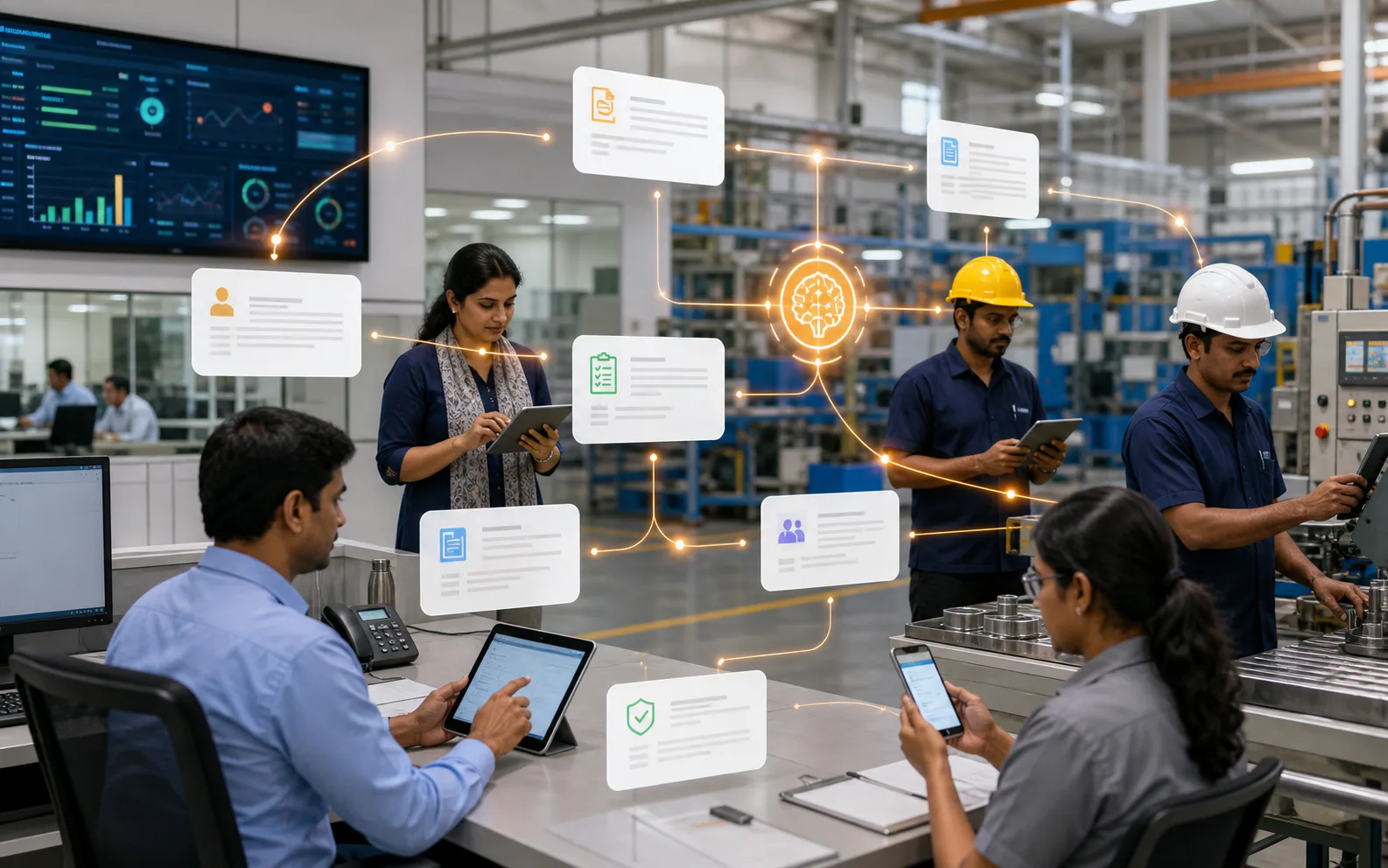
Manufacturers can retrain workers for AI jobs by teaching practical digital skills, not by turning everyone into data scientists. Most factory teams need to learn how AI fits into their existing work: production, inventory, quality, maintenance, purchase, dispatch, and reporting.
Retraining should be role-based, hands-on, and connected to real factory examples.
Start with Awareness
Workers first need to understand what AI is and what it is not.
AI is not only robots. It can also summarize reports, identify defects, highlight stock risks, predict machine issues, and help create SOPs.
Awareness reduces fear.
Train by Role
Different workers need different training.
Production supervisors need AI for delayed jobs, output trends, bottlenecks, and planning risk.
Quality teams need AI for defect patterns, complaint summaries, and corrective action.
Maintenance teams need AI for downtime analysis and predictive alerts.
Stores teams need AI for slow-moving stock, abnormal consumption, and reorder risk.
Owners and managers need AI for dashboards and decision summaries.
Teach Data Discipline
AI depends on data. Workers should understand why accurate entries matter.
Training should cover:
- Correct item names
- Timely production updates
- Clear rejection reasons
- Proper downtime codes
- Accurate stock movement
- Clean vendor and customer records
Good AI starts with good factory habits.
Use Real Factory Examples
Generic AI training is less effective. Use examples from the factory:
- A delayed job
- A repeated defect
- A stock mismatch
- A machine breakdown
- A purchase delay
- A dispatch issue
Workers learn faster when training matches their daily reality.
Create AI Champions
Select a few people from each department to become AI champions. They can support others, collect feedback, and help improve adoption.
This is especially useful in MSME factories.
Keep Human Judgment Central
Training should make one thing clear: AI supports decisions, but people remain accountable.
Workers should know when to trust AI, when to question it, and when to escalate.
Build New Career Paths
AI creates new roles:
- ERP power user
- AI workflow coordinator
- Quality analytics lead
- Maintenance planning analyst
- Digital production supervisor
- Manufacturing data analyst
- Implementation support specialist
Retraining should help workers move into these roles.
Where AICAN Optiwise Fits
AICAN Optiwise helps manufacturers introduce AI inside familiar workflows. Because it connects ERP, workflows, reports, IoT readiness, and AI agents across sales, purchase, inventory, production, shopfloor, quality, dispatch, and finance visibility, workers can learn AI through real operational tasks.
Learn more at AICAN Optiwise and About AICAN.
Founder’s Note
AICAN’s belief is that AI adoption should include the people who run the factory every day. Workers should not be treated as obstacles to technology. They are the ones who understand the process.
Optiwise is built to support retraining by making AI practical, workflow-based, and useful to real manufacturing teams.
FAQ
Do workers need coding to work with AI?
No. Most workers need practical AI usage, ERP understanding, and data discipline.
How should retraining begin?
Start with awareness, then role-based training using real factory examples.
Who should be trained first?
Supervisors, planners, quality teams, maintenance teams, stores teams, and managers are good early groups.
Can older workers learn AI?
Yes, if training is practical and tied to daily work.
What is an AI champion?
An AI champion is a trained team member who supports adoption in their department.
Final Thought
Retraining workers for AI is not about replacing factory knowledge. It is about upgrading that knowledge with digital tools. The best manufacturing teams will combine experience with AI-supported visibility.
Next step: Explore AICAN Optiwise if your factory wants AI adoption that supports and trains real manufacturing teams.

Related Posts

Will AI Create More Jobs Than It Destroys?
Explore whether AI will create more jobs than it destroys, with a practical view of manufacturing, automation, new roles, reskilling, and business transformation.
13 Jun 2026Read more →Manufacturing AI vs. Hiring More Workers
Compare manufacturing AI with hiring more workers and learn when automation, better systems, training, or additional people are the right answer.
7 Jun 2026Read more →
Will AI Replace My Production Planning Job?
Understand how AI affects production planning jobs, what tasks may change, and how planners can become more valuable with AI-supported scheduling and visibility.
6 Jun 2026Read more →Do I Need Special Skills to Use AI in Manufacturing?
Learn what skills manufacturing teams need to use AI, including process knowledge, data discipline, prompt clarity, review judgment, ERP understanding, and change readiness.
6 Jun 2026Read more →