
How Do I Monitor My Factory From Home With IoT?
Learn how factory owners and managers can monitor production, downtime, machine status, inventory, alerts, and reports remotely using IoT and connected manufacturing software.

How Do I Monitor My Factory From Home With IoT?
Factory monitoring from home is no longer only for very large manufacturers.
With IoT and connected manufacturing software, factory owners, plant heads, and managers can see production status, machine availability, downtime alerts, shift output, energy usage, inventory movement, and key reports without being physically present on the shop floor every minute.
But remote monitoring should be designed carefully. The goal is not to create anxiety by watching every second of production from a phone. The goal is to give decision-makers timely visibility, so they know when things are on track, when intervention is needed, and what questions to ask the team.
A good remote monitoring system helps the owner sleep better, not worry more.
What Remote Factory Monitoring Actually Means
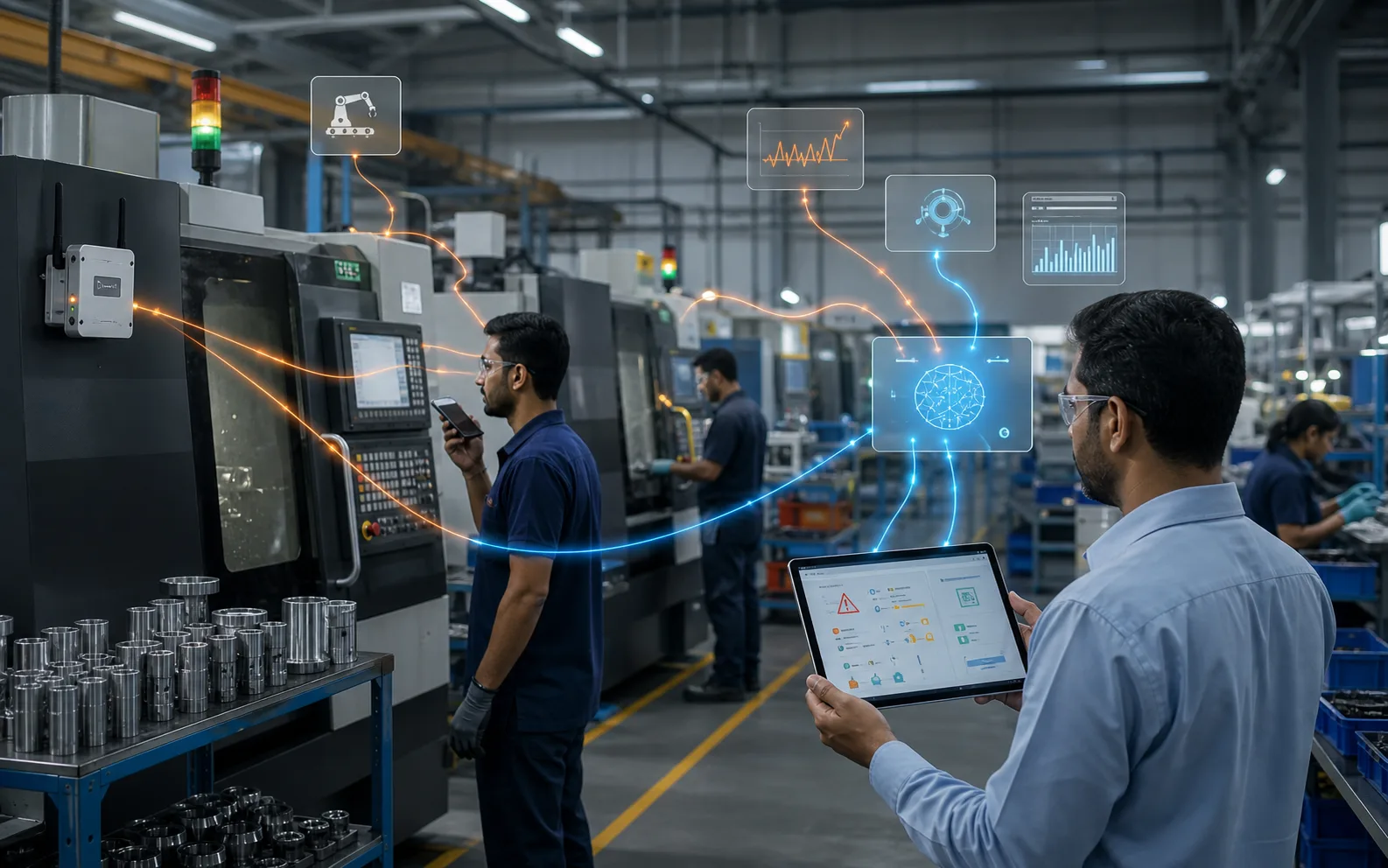
Remote monitoring means the factory’s important operational data is captured from machines, people, devices, and business workflows, then made available through secure dashboards, alerts, and reports.
This may include:
- Machine running, idle, and stopped status
- Production completed against plan
- Downtime duration and reasons
- Shift-wise output
- Rejection or quality issues
- Energy consumption
- Maintenance alerts
- Inventory availability
- Material shortages
- Purchase or dispatch status
- Supervisor remarks
- Daily performance summaries
The key word is “important.” Remote monitoring should not flood the owner with every small event. It should highlight what matters.
For example, a ten-second stoppage may not need owner attention. A machine stopped for one hour during a critical dispatch job may need an alert. A small variation in production may be normal. A major delay in a high-priority order may need escalation.
The system should be configured around decision importance, not data noise.
How IoT Sends Factory Data to Remote Dashboards
A remote monitoring setup usually has several layers.
First, the factory data is captured. Machines may send data through PLCs, controllers, sensors, meters, or gateways. Operators may enter downtime reasons, rejection reasons, job confirmations, or manual updates through tablets or screens. Inventory and production transactions may come from ERP or manufacturing software.
Second, the data is processed. Raw signals need to be converted into useful information such as machine running status, output count, downtime duration, or alert conditions.
Third, the data is displayed. Owners and managers can view dashboards on laptops, tablets, or mobile devices. They may also receive alerts by email, app notification, or other configured communication channels.
The best remote monitoring systems do not simply show raw machine data. They connect machine data with business context.
For example, “Machine stopped” is useful. But “Machine stopped for 42 minutes on urgent order WO-248 because material is unavailable” is much more useful.
What Should an Owner Monitor From Home?
Owners do not need to monitor everything. In fact, monitoring too much can reduce clarity.
The most useful remote view should focus on a few high-value areas:
- Is today’s production plan on track?
- Which machines or lines are stopped?
- Which stoppages are critical?
- Are there material shortages affecting production?
- Are rejection levels normal?
- Are important orders at risk?
- Is energy consumption unusually high?
- Are supervisors updating reasons properly?
- What changed since the last shift?
A daily owner dashboard should be simple enough to understand in a few minutes, but detailed enough to drill down when something looks wrong.
For example, the top view may show overall production progress, critical downtime, pending dispatch risk, and inventory exceptions. If the owner clicks into downtime, they can see machine, reason, duration, shift, job, and responsible team.
Remote monitoring should work like a control tower. It should show the right alerts and allow deeper investigation when required.
Live View vs Daily Summary
Remote monitoring usually needs both live visibility and summary reporting.
Live visibility is useful during active production. It helps the owner or plant head know whether machines are running, whether a critical job has stopped, or whether an issue needs escalation.
Daily summaries are useful for management review. They show what happened across the day or shift: production achieved, downtime reasons, rejection trends, material issues, maintenance problems, and pending actions.
Both views serve different purposes.
If an owner only watches live dashboards, they may react too quickly to normal shop-floor fluctuations. If they only read daily summaries, they may discover urgent problems too late. A balanced system gives live alerts for exceptions and structured reports for review.
Alerts Are More Important Than Constant Watching
A good remote monitoring system should reduce the need to keep checking the dashboard.
This is where alerts matter. Alerts can notify the right person when a condition crosses a threshold. For example:
- A critical machine is stopped for more than 15 minutes
- A production order is behind plan
- Rejection rate crosses an acceptable limit
- Energy consumption is unusually high
- Material shortage is blocking production
- A gateway or device has gone offline
- A shift has ended without production confirmation
Alerts should be designed carefully. Too many alerts create fatigue. Too few alerts leave the owner blind. The best alerts are tied to action.
Before creating an alert, ask:
- Who should receive it?
- What action should they take?
- What threshold makes sense?
- Should the owner receive it immediately or only after escalation?
- Is this alert urgent or only informative?
Remote monitoring becomes useful when alerts help the team respond faster, not when they create constant noise.
The Role of Supervisors in Remote Monitoring
Remote monitoring does not remove the need for supervisors. It actually makes their role more important.
The owner may see that a machine is stopped, but the supervisor usually knows the local context. Is the stoppage due to changeover? Is material pending? Is maintenance already working? Is the operator on break? Is the job waiting for quality approval?
For remote monitoring to work well, supervisors must keep the system updated. They should ensure downtime reasons are entered correctly, urgent issues are escalated, and shift summaries are reliable.
If supervisors do not use the system properly, remote dashboards become incomplete. The owner may see numbers but not understand the situation.
This is why remote monitoring should be introduced as a team visibility system, not as a replacement for communication. The dashboard should reduce unnecessary calls, but it should also make important conversations more specific.
Instead of asking, “What is happening in the factory?” the owner can ask, “Why has Line 2 been waiting for material for 45 minutes on this order?”
That is a better conversation.
Security Matters in Remote Access
Remote factory monitoring must be secure.
A factory dashboard may include production information, customer orders, inventory status, cost data, machine availability, and operational weaknesses. This data should not be exposed casually.
Basic security practices include:
- User-specific logins instead of shared passwords
- Role-based access control
- Strong password policies
- Removal of access when employees leave
- Secure device and network configuration
- Limited access to sensitive reports
- Regular review of user permissions
- Clear escalation if a device is lost or compromised
Factories should also avoid unsafe shortcuts such as exposing machine networks directly to the public internet. The remote monitoring architecture should be designed with proper separation between machine control systems and business dashboards.
Owners should be able to monitor the factory safely without increasing operational risk.
Can You Control Machines From Home?
Some advanced systems may allow remote commands, but most manufacturers should be careful with remote control.
Remote visibility is different from remote control. Seeing machine status, downtime, production progress, and alerts is usually safer and more practical. Starting, stopping, or changing machine settings remotely can create safety and operational risks if not designed with strict controls.
For many factories, the first goal should be remote monitoring, not remote operation.
If remote control is ever considered, it should involve qualified automation professionals, safety interlocks, authorization rules, audit logs, and clear operating procedures. In most small and mid-sized manufacturing environments, read-only monitoring plus local action is the better first step.
How Remote Monitoring Helps Owners
Remote monitoring is especially useful for owners who cannot be physically present all day.
It helps them:
- See whether production is on track
- Identify major delays early
- Reduce dependence on phone updates
- Review shift performance from anywhere
- Ask better questions in meetings
- Track whether recurring issues are improving
- Understand whether material, maintenance, or quality is blocking output
- Monitor multiple units or departments
- Stay informed without interrupting the team constantly
The biggest benefit is not that the owner can watch the factory all day. The biggest benefit is that the owner can know when attention is needed.
Remote Monitoring for Multiple Factory Locations
For manufacturers with more than one unit, remote monitoring becomes even more valuable.
A central dashboard can compare production, downtime, inventory, quality, and dispatch risk across locations. Management can see which plant is performing well, which one needs support, and whether problems are local or systemic.
For example, if the same material shortage affects two plants, the issue may be procurement planning. If one unit has repeated downtime on a similar machine, the issue may be maintenance practice. If rejection rates differ between plants, process discipline may need review.
Multi-location visibility helps leadership manage by evidence instead of travelling constantly or depending only on local reports.
What Can Go Wrong With Remote Monitoring?
Remote monitoring can fail if it becomes either too shallow or too noisy.
A shallow system shows only broad numbers without enough detail to act. For example, “production behind plan” is useful, but not enough. The owner needs to know which job, which machine, which reason, and what action is pending.
A noisy system sends too many alerts and creates stress. If every small stoppage reaches the owner’s phone, people will start ignoring alerts.
Other common problems include:
- Poor data entry from the shop floor
- No ownership for updating downtime reasons
- Dashboards that are too complex for quick review
- Alerts without clear action responsibility
- Unsecured remote access
- Data shown without business context
- Manual reporting continuing separately, causing conflicting numbers
Remote monitoring should be designed around decisions. What does the owner need to know? What should the supervisor handle locally? What should be escalated? What should appear only in daily reports?
Where AICAN Optiwise Fits
AICAN Optiwise helps manufacturers connect factory visibility with practical business workflows. For remote monitoring, this means owners and managers can look beyond isolated machine status and understand production, inventory, purchase, quality, finance, and reporting in a more connected way.
Optiwise can support dashboards and workflows that help teams understand whether production is on track, where downtime is happening, whether material is available, and what needs attention. This makes remote monitoring more useful because the owner sees operational meaning, not just raw data.
AICAN focuses on manufacturing digital transformation that is practical for real factories. Remote visibility should help owners stay informed, support their teams, and make better decisions without turning every small shop-floor event into panic. You can learn more on the About AICAN page.
FAQ
Can I monitor my factory from my phone?
Yes, if your manufacturing software or IoT platform supports mobile-friendly dashboards or alerts. The better question is what information should appear on the phone. Mobile views should focus on critical status, alerts, and summaries rather than every detailed report.
Do I need IoT sensors on every machine?
No. Start with critical machines, bottleneck processes, or areas where visibility will create clear value. Some data may come from PLCs, sensors, meters, operator input, or existing production software. Not every machine needs the same level of monitoring.
Is remote factory monitoring secure?
It can be secure if designed properly with role-based access, user-specific logins, secure connectivity, permission reviews, and separation between machine control systems and business dashboards. Security should be planned from the start.
Can I control machines remotely through IoT?
Remote control is possible in some advanced environments, but it should be approached carefully because of safety and operational risks. Most factories should begin with remote visibility and local action rather than remote machine control.
What alerts should a factory owner receive?
Owners should receive alerts for important exceptions, such as long stoppages on critical machines, urgent orders falling behind, major quality issues, material shortages blocking production, or abnormal energy consumption. Routine minor events should usually stay with supervisors.
How does AICAN Optiwise help with remote monitoring?
AICAN Optiwise connects manufacturing visibility with production, inventory, purchase, finance, and reporting workflows. This helps owners monitor not only machine status but also the operational impact of what is happening inside the factory.
Founder’s Note
Many factory owners carry the factory in their head even when they are not physically there. They keep checking with supervisors, calling teams, asking for updates, and trying to understand whether the day is going well.
Remote monitoring should reduce that mental load. It should give owners confidence that they can see what matters, trust the team, and intervene only when intervention is useful.
At AICAN, we believe visibility should create calm control. A connected factory should not mean constant anxiety. It should mean fewer blind spots, better conversations, and faster action when something truly needs attention.
Final Thought
You can monitor your factory from home with IoT by connecting machine data, operator inputs, production workflows, inventory updates, and alerts into a secure dashboard.
The best remote monitoring system does not overwhelm you with data. It shows what matters, helps your team respond faster, and gives you enough context to make better decisions. When connected with AICAN Optiwise, remote factory monitoring can become part of a broader manufacturing control system, not just a screen full of machine signals.

Related Posts
Is AI Worth the Investment for My Factory?
Learn how to decide if AI is worth the investment for your factory by evaluating use cases, data readiness, costs, risks, ROI, and operational impact.
13 Jun 2026Read more →Manufacturing AI Mistakes to Avoid Before You Start
List manufacturing AI mistakes and controls for unclear use case, messy data, unsafe automation, no owner, weak security and unreviewed recommendations.
13 Jun 2026Read more →What's the Difference Between AI and Regular Automation?
Understand the difference between AI and regular automation in manufacturing, with practical examples for workflows, decisions, alerts, and predictive operations.
13 Jun 2026Read more →What Are the Risks of Using AI in Manufacturing?
Understand the risks of AI in manufacturing, including bad data, wrong recommendations, safety issues, security, job fear, over-automation, and implementation failure.
13 Jun 2026Read more →