
How Do I Track Quality Issues in Real Time?
Learn how manufacturers can track quality issues in real time using shop floor checks, defect capture, quality holds, rejection reports, and connected ERP visibility.
How Do I Track Quality Issues in Real Time?
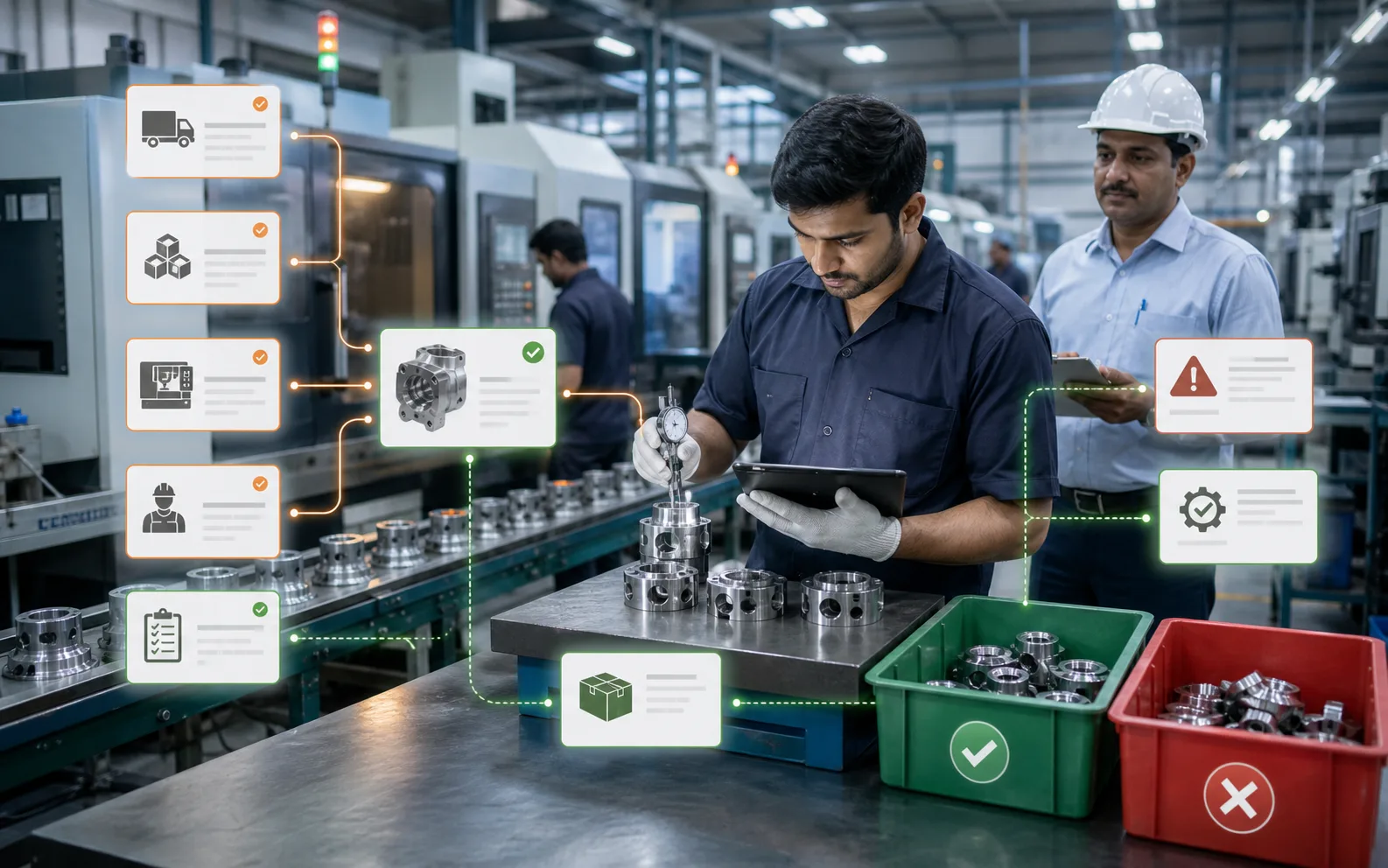
You track quality issues in real time by capturing defects, rejections, inspection results, and quality holds at the point where they happen, then connecting that information with production, inventory, and dispatch. The key is speed. If quality problems are discovered late, the factory may continue producing bad output, consume more material, delay dispatch, and create avoidable rework.
In many factories, quality data is still recorded after the fact. Inspectors write notes, supervisors update registers, rejection numbers are added at the end of the shift, and management hears about the issue only when dispatch is already affected. By then, the cost of correction is higher.
Real-time quality tracking gives manufacturers an earlier signal. It helps teams answer: What defect occurred? Which batch is affected? Which machine or operator was involved? How much quantity is on hold? Can production continue safely? Does dispatch need to be warned?
This is where factory floor visibility becomes directly connected to quality control.
Why Quality Issues Must Be Captured Early
A small quality issue can become expensive if it moves unnoticed through the process. A wrong setting, poor raw material lot, tool wear, incorrect assembly, surface defect, measurement variation, or missed inspection point can affect many units before anyone reacts.
Early capture helps manufacturers:
- Stop repeated defects
- Isolate affected batches
- Reduce rework
- Prevent bad material from moving forward
- Protect customer commitments
- Understand root causes faster
- Improve operator and machine performance
- Reduce disputes between production and quality
The purpose is not to slow production unnecessarily. The purpose is to prevent the factory from producing faster in the wrong direction.
What Real-Time Quality Tracking Should Include
Real-time quality tracking should be practical and structured. It should not depend only on long remarks or delayed inspection sheets.
A good quality tracking process should capture:
- Work order or batch number
- Product or item code
- Production line or machine
- Inspection stage
- Inspector or supervisor
- Checked quantity
- Accepted quantity
- Rejected quantity
- Rework quantity
- Defect type
- Defect severity
- Quality hold status
- Root cause, once known
- Corrective action
- Release or rejection decision
When this data is connected to production, the team can see whether the issue is isolated or spreading.
Standard Defect Categories Matter
If every inspector writes defects differently, analysis becomes difficult. One person may write “scratch,” another may write “surface mark,” another may write “finish issue.” All three may describe a similar problem, but the system cannot easily group them.
Standard defect categories help create clean data. Examples may include:
- Dimensional variation
- Surface defect
- Wrong material
- Assembly error
- Printing or labeling error
- Packaging damage
- Color variation
- Contamination
- Missing component
- Process parameter issue
- Customer-specific nonconformance
These categories should be specific enough to support action but not so complex that inspectors avoid using them.
Quality Holds Should Be Visible to Production and Dispatch
One of the biggest gaps in many factories is that production believes an order is complete while quality has not cleared it. Dispatch may plan shipment, sales may commit to the customer, and stores may move goods, only for the batch to be held later.
A real-time quality system should make hold status visible across departments.
The system should show:
- Which batch is on hold
- Why it is on hold
- How much quantity is affected
- Who raised the hold
- What action is pending
- Whether rework is possible
- Whether replacement production is needed
- Whether dispatch is at risk
This prevents confusion and improves customer communication.
In-Process Quality Checks Are More Useful Than Final Inspection Alone
Final inspection is important, but it is often too late to prevent waste. In-process quality checks help detect problems while production is still running.
Examples of in-process checks include:
- First-piece approval
- Periodic dimension checks
- Process parameter checks
- Line clearance checks
- Visual defect checks
- Weight or quantity verification
- Assembly fit checks
- Packaging checks
When these checks are recorded during production, the system can alert teams if rejection rises or a parameter moves outside tolerance. This helps prevent large batches of defective output.
Link Quality Issues to Machines, Operators, and Material Lots
Quality data becomes more powerful when it is linked to operational context. A defect is not just a defect. It happened on a specific machine, during a specific shift, with specific material, under specific process conditions.
Useful links include:
- Machine or line
- Operator or team
- Shift
- Material lot
- Supplier batch
- Tooling
- Work order
- Process stage
This helps identify patterns. If defects repeat on one machine, maintenance or calibration may be needed. If defects appear only with one material lot, supplier quality may be the issue. If rejections rise in one shift, training or supervision may need review.
Real-Time Alerts Should Be Meaningful
Quality alerts are useful only when they are designed carefully. Too many alerts will be ignored. Too few alerts will miss important problems.
Useful alert triggers may include:
- Rejection rate above threshold
- Defect repeated beyond a defined count
- Critical defect recorded
- Batch placed on hold
- First-piece approval failed
- Quality inspection delayed
- Rework quantity increasing
- Customer-critical product flagged
- Same defect repeated across shifts
Alerts should go to the right person. A machine parameter issue may go to production and maintenance. A batch hold may go to production, quality, stores, and dispatch. A supplier-related issue may go to purchase and incoming quality.
Quality Data Should Feed Improvement Meetings
Real-time quality tracking helps the current shift, but historical quality data helps long-term improvement.
Teams should review:
- Top defect types
- Rejection by product
- Rejection by machine
- Rejection by supplier lot
- Rework by process
- Quality holds by reason
- Repeat issues
- Cost of poor quality
This helps move quality discussions from opinion to evidence. Instead of saying “quality is bad this week,” the team can identify which defect, process, machine, or material caused the problem.
Where AICAN Optiwise Fits
AICAN Optiwise helps manufacturers connect quality tracking with production, inventory, purchase, dispatch, and reporting. This matters because quality issues affect more than inspection. They affect material usage, delivery commitments, rework planning, costing, and customer trust.
With Optiwise, manufacturers can create clearer visibility around work orders, quality status, rejection, rework, batch holds, and operational reports. This helps teams respond earlier and reduce confusion between departments.
AICAN builds practical ERP systems for manufacturing businesses that need stronger daily control. You can learn more about the company on the About AICAN page.
FAQ
What is real-time quality tracking?
Real-time quality tracking means recording defects, inspection results, rejection, rework, and quality holds as they happen during production, instead of waiting until the end of the shift or final inspection.
Why is real-time quality monitoring important?
It helps manufacturers catch defects earlier, stop repeated errors, reduce rework, isolate affected batches, and protect dispatch commitments.
What quality data should be captured?
Capture product, work order, batch, machine, operator, inspected quantity, accepted quantity, rejected quantity, defect type, quality hold status, and corrective action.
Can ERP help track quality issues?
Yes. ERP can connect quality data with production, inventory, purchase, and dispatch so teams can see the operational impact of quality problems.
Should quality alerts stop production automatically?
Not always. Some critical defects may require immediate stoppage, while minor issues may need review. Alert rules should match the risk level and factory process.
How do I reduce repeated quality issues?
Track defects by machine, process, material lot, operator, and shift. Review patterns regularly and take corrective action on the root cause, not only the rejected quantity.
Founder’s Note
Quality problems become harder to solve when they are discovered late. By then, people argue about what happened, when it happened, and who knew about it. Real-time quality visibility changes that conversation.
At AICAN, we believe quality should be part of the operating flow, not a separate island. Production, quality, stores, and dispatch should all know when a batch is on hold and why. That clarity protects the customer and the factory.
Final Thought
Real-time quality tracking is not about adding more inspection paperwork. It is about making quality issues visible early enough to act. When defects, holds, rework, and inspection results are connected with production data, manufacturers can reduce waste, protect delivery, and improve process discipline.
The sooner a factory sees the quality truth, the sooner it can fix the real problem.

Related Posts
How Sensors Help With Quality Control in Manufacturing
Explain quality-control sensors through measured property, tolerance, calibration evidence, sampling, false alerts and human disposition.
11 Jun 2026Read more →
Track Quality Issues in ERP: Inspection to Disposition
Follow an inspection issue through stock hold, approved rework or scrap, quantity reconciliation and corrective-action checks, with a 50-part example.
28 May 2026Read more →How Can IoT Improve My Quality Control Process?
Learn how IoT improves quality control by connecting inspection data, batch traceability, machine conditions, process parameters, and corrective action.
13 May 2026Read more →
Predictive Maintenance Software: A Growing Manufacturing Tech Career
Learn why predictive maintenance software is creating manufacturing tech careers in IoT, analytics, AI, machine data, and ERP-connected operations.
3 May 2026Read more →