
Use IoT to Protect Production Deadlines: An Exception Workflow
Use IoT to Protect Production Deadlines. Use a worked manufacturing test, explicit inputs and exception checks before rollout.

Use IoT to Protect Production Deadlines: An Exception Workflow helps you connect machine events to delivery risk before the due date is missed. Test one real order and one exception before expanding scope.
Machine 4 stops during a 500-piece order. The signal is mapped to the operation and current quantity so planning can estimate the shortfall, assign maintenance and decide whether to reroute work.
Start with the decision the system must support
Translate a stop, slow cycle or energy anomaly into affected work, remaining quantity and a named response.
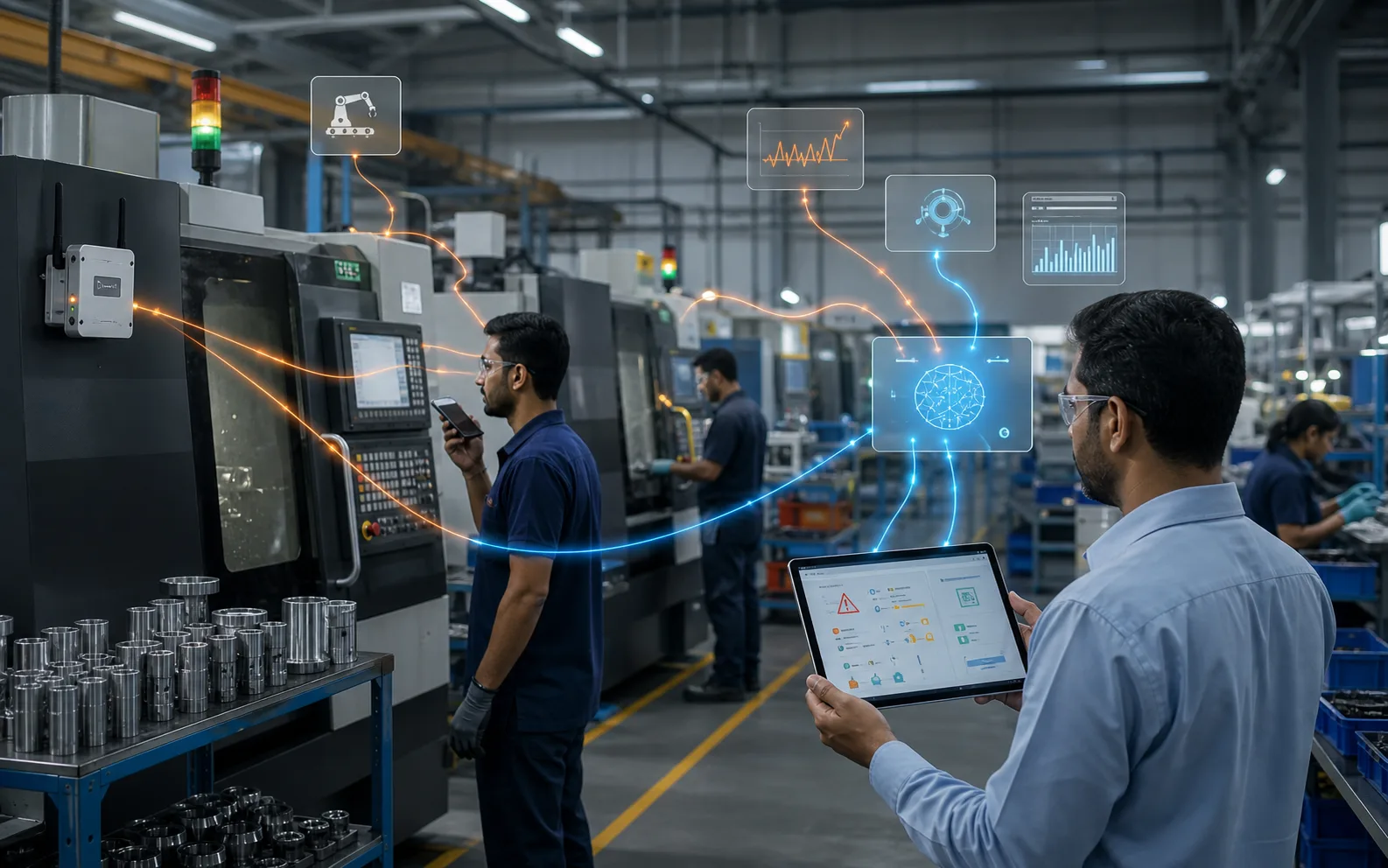
OptiEdge captures and buffers machine data; Optiwise links runtime, downtime, cycles, OEE and alerts to production context and role-specific operational views.
Use ISA-95 enterprise and control-system model as an external reference for the relevant process or control model. It does not prove an Optiwise feature or business result; our product statements come from the current feature record.
| # | Input to prepare | Evidence to retain |
|---|---|---|
| 1 | Order, operation and remaining quantity | Owner and last update |
| 2 | Machine signal and timestamp | Definition and source |
| 3 | Expected cycle and available capacity | Acceptance rule |
| 4 | Escalation and recovery action | Exception owner |
Run one controlled workflow
- 1. Order, operation and remaining quantity. Name the owner and authoritative record.
- 2. Machine signal and timestamp. Use the current value from the test order.
- 3. Expected cycle and available capacity. Write the pass condition before the demo.
- 4. Escalation and recovery action. Assign the person who resolves a mismatch.
Keep the first test small enough to reconcile by hand. When the result differs from the source documents, identify whether the problem is master data, timing, transaction ownership or configuration.
Test exceptions with the normal flow
- Signal arrives late
- Job context is missing
- Alternate machine needs approval
For every exception, record the expected status, permitted action, approver and audit trail. The workflow should expose a problem without allowing an unapproved shortcut to rewrite history.
Verify the connected Optiwise workflow
Review workflow details, product capability, supporting guide, implementation context, connected process, book a demo. In the demo, ask us to run the scenario with your roles and sample records. Confirm the source transaction, resulting status, action, correction method and report.
Questions to ask before rollout
What should we test first?
Choose one current order with a known complication. Prepare the four inputs above, run the sequence and reconcile the result with the source documents.
What result should we accept?
Accept the workflow only when the normal path and named exceptions leave a complete, role-appropriate record. Keep feature validation separate from a promised outcome.
IoT helps manufacturers meet production deadlines by showing problems early: machines behind schedule, downtime affecting output, material waiting, quality holds, maintenance risk, energy or utility issues, and order progress gaps.
A missed deadline rarely appears suddenly. It builds through small delays. A machine starts late. Material reaches the line late. A quality check holds a batch. A changeover takes longer than expected. Maintenance response is delayed. The issue becomes visible to management only when dispatch is already at risk.
IoT helps bring that risk forward in time.
Deadline Control Starts With Live Production Progress
A production deadline cannot be managed if progress is visible only at the end of the shift.
IoT can show:
- order started or not started
- target vs actual output
- hourly production trend
- machine running or stopped status
- current operation stage
- expected completion risk
- shift-wise progress
This helps supervisors and planners act before the day is lost.
Downtime Alerts Protect the Schedule
Downtime is one of the biggest threats to deadlines. IoT can detect machine stoppages and send alerts when downtime crosses a threshold.
More importantly, it can capture the reason:
- machine breakdown
- tool change
- material shortage
- quality hold
- setup delay
- no manpower
- utility issue
- waiting for instruction
When the reason is clear, the right team can respond faster.
Material Readiness Matters
A machine may be available, but production still stops if material is not ready. IoT and connected workflows can make material waiting visible.
When production status connects with inventory and purchase, teams can see whether delays come from:
- raw material shortage
- wrong material issued
- late internal movement
- vendor delay
- packaging shortage
- quality inspection hold
This helps planning address supply constraints earlier.
Quality Holds Need Early Visibility
A batch held for quality can delay dispatch as much as machine downtime. IoT and digital quality workflows can show which batches are cleared, on hold, rejected, or under rework.
This helps production and sales teams understand whether a deadline is realistic.
Quality visibility also helps prevent repeated delays by connecting defects with machine, material, shift, and process context.
Maintenance Risk Should Be Part of Planning
If a critical asset is showing abnormal behavior, production deadlines may be at risk even before breakdown happens.
IoT condition monitoring can show warning signs such as vibration increase, temperature rise, current variation, repeated micro-stoppages, or unusual energy consumption.
Planning teams can use this information to:
- schedule maintenance before urgent jobs
- shift production to another machine
- arrange spares
- adjust commitments
- reduce emergency downtime
This makes production planning more realistic.
Order Risk Dashboards Help Management Focus
A useful dashboard should not show only machine data. It should show order risk.
For example:
- which orders are on track?
- which are behind?
- which machine is causing risk?
- is material available?
- is quality cleared?
- is maintenance risk present?
- can dispatch still happen on time?
This helps management focus on exceptions instead of chasing every update.
Review Routines Turn Data Into Delivery Performance
Data alone does not meet deadlines. Teams need review routines.
A daily production review should cover:
- orders due soon
- target vs actual progress
- downtime reasons
- material waiting
- quality holds
- maintenance risk
- action owners
- dispatch impact
This keeps the factory aligned around delivery commitments.
How Optiwise Supports the Workflow
AICAN Optiwise helps manufacturers connect production, inventory, purchase, sales, finance, and reporting so deadline risk is visible across departments. Production deadlines are not only a shop-floor issue; they depend on material, machines, quality, planning, and dispatch coordination.
Optiwise supports connected manufacturing control so teams can move from last-minute firefighting to earlier action. You can explore AICAN and learn more on About AICAN.
FAQ
Can IoT guarantee deadlines?
No. IoT cannot guarantee deadlines, but it can reveal risks earlier so teams can respond before delays become unavoidable.
What data helps most with deadlines?
Order progress, machine status, downtime reason, material readiness, quality hold, maintenance risk, and dispatch date are highly useful.
Should sales teams see production status?
They may need controlled visibility into order progress and dispatch risk so customer communication is more accurate.
Can IoT help with urgent orders?
Yes. Real-time visibility helps planners understand whether urgent orders can be inserted without damaging other commitments.
Does deadline tracking require ERP integration?
It becomes much stronger with ERP or production-order integration because machine data can be connected with customer commitments.
Founder’s Note
At AICAN, we believe delivery reliability is built before dispatch day. It starts with seeing risk early enough to act.
A connected factory should help teams protect commitments instead of explaining misses after they happen.
Final Thought
IoT helps meet production deadlines by making delay visible early.
When machine status, material readiness, quality, maintenance, and order progress come together, the factory gets more time to make better decisions.

Related Posts
Is AI Worth the Investment for My Factory?
Learn how to decide if AI is worth the investment for your factory by evaluating use cases, data readiness, costs, risks, ROI, and operational impact.
13 Jun 2026Read more →Manufacturing AI Mistakes to Avoid Before You Start
List manufacturing AI mistakes and controls for unclear use case, messy data, unsafe automation, no owner, weak security and unreviewed recommendations.
13 Jun 2026Read more →What's the Difference Between AI and Regular Automation?
Understand the difference between AI and regular automation in manufacturing, with practical examples for workflows, decisions, alerts, and predictive operations.
13 Jun 2026Read more →What Are the Risks of Using AI in Manufacturing?
Understand the risks of AI in manufacturing, including bad data, wrong recommendations, safety issues, security, job fear, over-automation, and implementation failure.
13 Jun 2026Read more →