
What Is IoT in Metal Fabrication?
Understand IoT in metal fabrication, including machine monitoring, welding visibility, material tracking, downtime alerts, quality data, ERP integration, and practical rollout steps.

What Is IoT in Metal Fabrication?
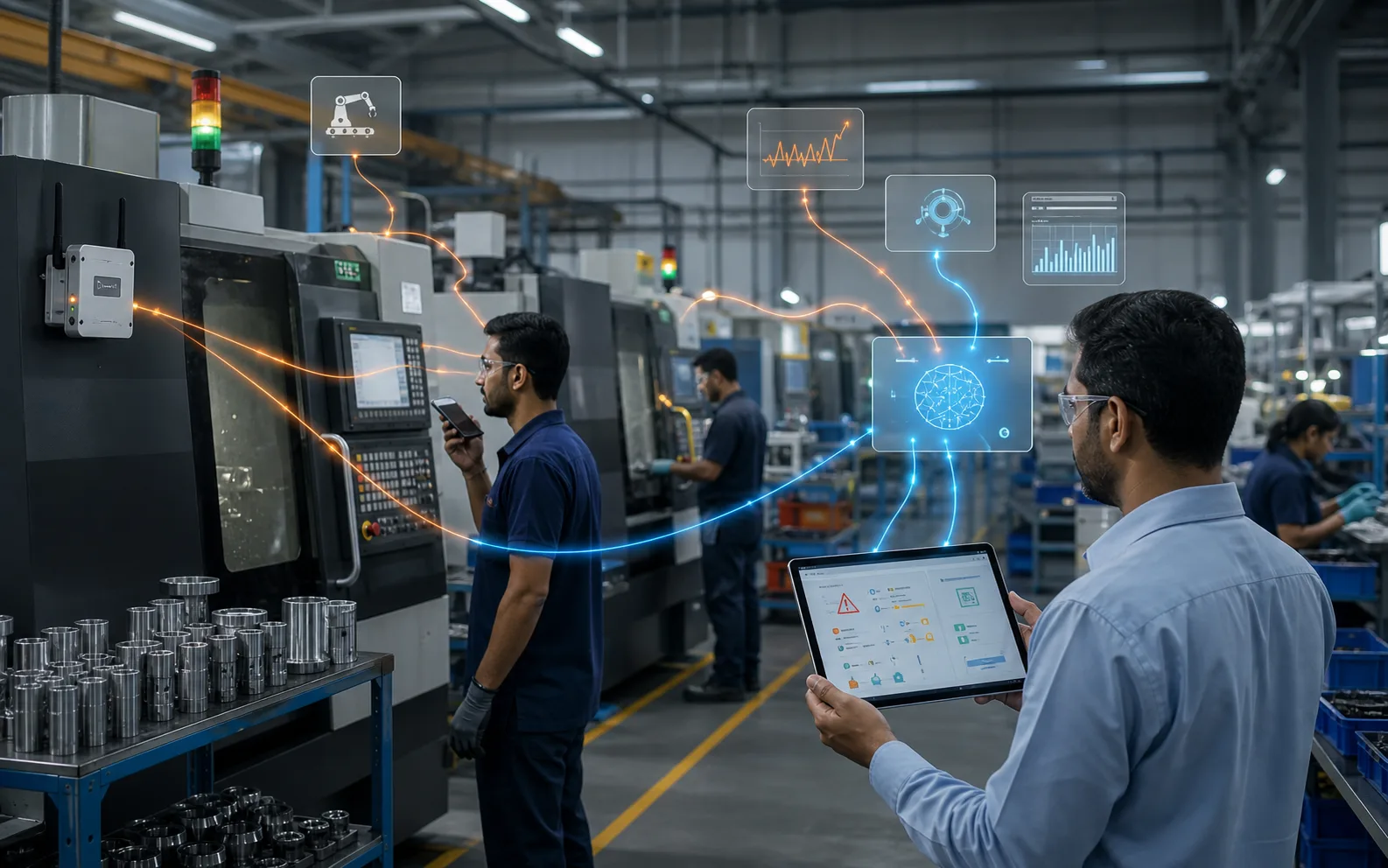
IoT in metal fabrication means connecting machines, equipment, sensors, operators, and production systems so the factory can see what is happening in near real time. It can track machine status, downtime, job progress, material movement, welding conditions, quality checks, energy usage, and maintenance signals.
The value of IoT is not the device itself. The value is visibility. A fabrication shop can use IoT to know which machine is running, which job is delayed, why a welding bay is idle, whether a cutting machine has stopped, or whether a critical piece of equipment needs attention.
For metal fabrication companies, IoT becomes most useful when connected to ERP. Machine data alone is helpful, but when it links to job cards, material, quality, maintenance, dispatch, and costing, it becomes part of factory control. AICAN Optiwise is built to support that connected approach.
What IoT Can Monitor In Fabrication
IoT can support many parts of a fabrication business, depending on the equipment and process maturity.
Common areas include:
- Cutting machine status
- Welding bay utilization
- CNC or VMC runtime
- Compressor or utility performance
- Crane or material handling activity
- Shot blasting or painting line status
- Machine downtime and alarms
- Temperature, vibration, power, or current signals
- Job progress and operator updates
- Maintenance alerts
The right starting point depends on the factory’s biggest pain. A shop struggling with late jobs may start with job and machine status. A plant struggling with breakdowns may start with downtime and maintenance signals.
IoT Is Not Only For Large Plants
Many small and mid-sized fabrication companies assume IoT is only for large factories. That is not true. IoT can be introduced in a focused way.
A practical starting point may be:
- Monitor 3 important machines
- Capture running and idle status
- Track downtime reasons
- Link machine status to job cards
- Review delays daily
The first goal should be better visibility, not full automation.
How IoT Data Is Collected
IoT data can be collected through machine controllers, PLCs, sensors, electrical signals, edge devices, gateways, or manual operator inputs.
In real fabrication shops, a mixed model is common. Some machines can provide direct data. Others need sensors. Some processes still need supervisor updates.
The system should be practical enough to work with the machines already on the floor.
Why ERP Integration Matters
If IoT only shows machine data, the team still has to ask: which job is affected?
ERP integration connects IoT data to production context. For example:
- Machine stopped while running Job 458
- Welding bay idle because fit-up is pending
- Cutting machine delayed due to material shortage
- Inspection hold blocking dispatch
- Machine downtime affecting a customer delivery
This context turns IoT data into action.
IoT For Downtime Reduction
IoT can help reduce downtime by making stoppages visible quickly and by capturing repeat patterns.
Useful downtime tracking includes:
- When the machine stopped
- How long it remained stopped
- Why it stopped
- Who acknowledged it
- What job was affected
- Whether maintenance was involved
- Whether the stoppage repeated
This helps maintenance and production teams focus on repeat causes rather than isolated complaints.
IoT For Quality And Traceability
In some fabrication environments, IoT can support quality by connecting process data with inspection records. For example, machine settings, welding conditions, or runtime data may help explain quality issues.
Not every shop needs advanced quality IoT from day one. But even basic traceability can help when rework, rejection, or customer complaints occur.
Implementation Roadmap
A practical IoT rollout should be phased:
- Identify the biggest production visibility problem.
- Select a small group of important machines or processes.
- Capture simple, reliable signals first.
- Link data to job cards and production stages.
- Train supervisors and operators on reason capture.
- Review dashboards daily.
- Expand only after data is trusted.
This prevents the project from becoming a technology experiment disconnected from operations.
Common Mistakes
The first mistake is collecting too much data with no decision process. The second is ignoring operators. The third is not validating machine signals. The fourth is keeping IoT separate from ERP.
The best IoT implementation is not the most complex. It is the one the factory actually uses to improve delivery, utilization, maintenance, and quality.
Where AICAN Optiwise Fits
AICAN Optiwise helps manufacturers connect IoT visibility with ERP workflows. For metal fabrication, this means machine status, job progress, material readiness, quality, maintenance, and dispatch can be viewed together.
This connected view helps teams act on problems earlier and manage the factory with less guesswork.
Founder’s Note
At AICAN, we believe IoT should not feel like a science project. It should answer simple but important factory questions: what is running, what is waiting, what is delayed, and what needs attention.
AICAN Optiwise is built to bring IoT and ERP closer to the daily rhythm of manufacturing. Learn more on About AICAN.
FAQs
What does IoT mean in metal fabrication?
It means connecting machines, sensors, equipment, and production systems to collect useful data about machine status, downtime, job progress, quality, and maintenance.
Do fabrication shops need IoT?
They may need IoT if they struggle with poor visibility, machine downtime, delayed jobs, manual reporting, or weak production tracking.
Is IoT useful without ERP?
It can provide machine visibility, but ERP integration makes it more useful by connecting machine data to jobs, material, quality, dispatch, and costing.
Can IoT monitor welding operations?
Yes, depending on the setup. It can help track welding bay utilization, equipment status, downtime, and sometimes process-related signals.
How should a small fabrication shop start with IoT?
Start with a few important machines, simple status monitoring, downtime reasons, and job-card linkage before expanding.
How can AICAN Optiwise help?
AICAN Optiwise helps connect IoT data with ERP workflows so metal fabrication teams can monitor machines, jobs, quality, and dispatch in one connected system.

Related Posts
Is AI Worth the Investment for My Factory?
Learn how to decide if AI is worth the investment for your factory by evaluating use cases, data readiness, costs, risks, ROI, and operational impact.
13 Jun 2026Read more →Manufacturing AI Mistakes to Avoid Before You Start
List manufacturing AI mistakes and controls for unclear use case, messy data, unsafe automation, no owner, weak security and unreviewed recommendations.
13 Jun 2026Read more →What's the Difference Between AI and Regular Automation?
Understand the difference between AI and regular automation in manufacturing, with practical examples for workflows, decisions, alerts, and predictive operations.
13 Jun 2026Read more →What Are the Risks of Using AI in Manufacturing?
Understand the risks of AI in manufacturing, including bad data, wrong recommendations, safety issues, security, job fear, over-automation, and implementation failure.
13 Jun 2026Read more →