
Total Quality Management | Optiwise
Learn Total Quality Management for manufacturing SMEs, including principles, benefits, examples, implementation steps, common mistakes, and how ERP supports quality visibility.
Total Quality Management: A Practical Guide for Manufacturing SMEs
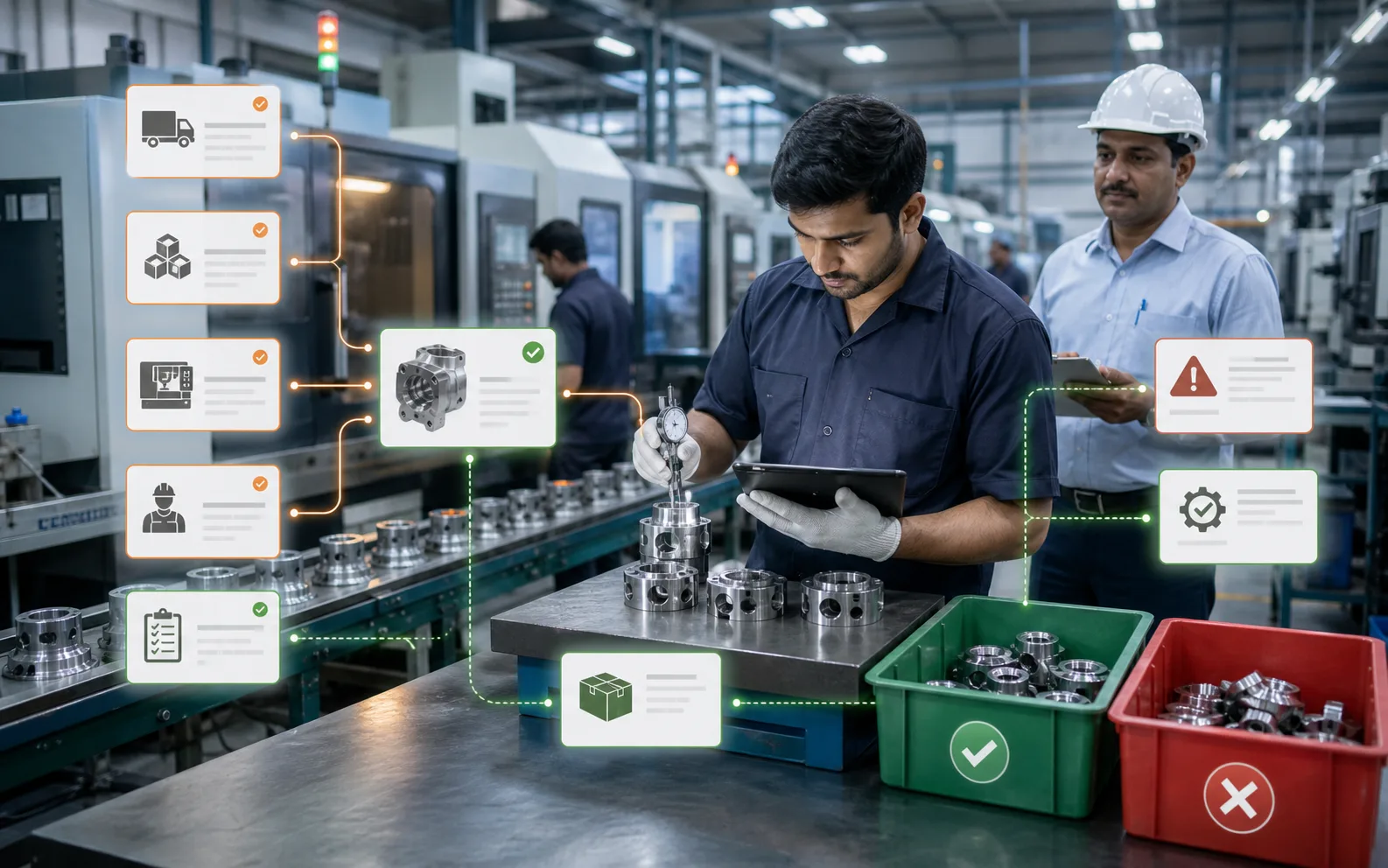
Quality should not depend only on final inspection. By the time a defect reaches final inspection, material, labour, machine time, and delivery time have already been consumed.
Total Quality Management, or TQM, is a management approach where quality becomes everyone's responsibility. It is not limited to the quality department. Sales must understand customer requirements clearly. Purchase must select reliable suppliers. Stores must preserve material properly. Production must follow process standards. Supervisors must track deviations. Management must review data and remove recurring causes.
For manufacturing SMEs, TQM is powerful because quality problems often appear as hidden costs: rework, rejection, delayed dispatch, customer complaints, warranty claims, and loss of trust. A practical TQM approach helps reduce these losses by improving processes, not only by increasing inspection.
This guide explains Total Quality Management, its principles, benefits, implementation steps, examples, and how AICAN Optiwise helps SMEs connect quality with production, inventory, purchase, and reporting.
Note: This article is for general operational and quality improvement understanding only. Industry-specific quality, safety, certification, and regulatory requirements should be reviewed with qualified professionals.
What Is Total Quality Management?
Total Quality Management is a continuous improvement approach focused on delivering quality through every process and every team.
It aims to improve:
- customer satisfaction
- process consistency
- defect prevention
- supplier quality
- employee involvement
- data-based decision-making
- continuous improvement
- cost of quality
The word “total” matters because quality is built across the whole organization.
Why TQM Matters for Manufacturing SMEs
TQM helps SMEs:
- reduce rejection and rework
- improve customer trust
- improve delivery reliability
- reduce wastage
- improve supplier performance
- build process discipline
- reduce firefighting
- improve team accountability
- strengthen long-term competitiveness
For SMEs, quality improvement often has a direct effect on margin because less rejection means less wasted material and labour.
Core Principles of TQM
Customer Focus
Quality starts with understanding what the customer actually needs. Wrong specifications, unclear drawings, or misunderstood tolerances create defects before production begins.
Process Approach
TQM focuses on improving the process so good output becomes repeatable.
Employee Involvement
Operators, supervisors, stores teams, purchase teams, and quality teams all influence quality.
Continuous Improvement
TQM is not a one-time project. It is a habit of reviewing defects, causes, and improvements.
Data-Based Decisions
Quality decisions should use evidence: rejection data, inspection results, customer complaints, supplier performance, and rework trends.
Supplier Quality
Poor input material creates poor output. Suppliers must be part of the quality system.
Example of TQM in Manufacturing
A fabrication company faces repeated rejection after powder coating. Instead of blaming only the coating vendor, the team studies the whole process.
They find issues in surface cleaning, storage before coating, handling scratches, and vendor process variation. The improvement plan includes better pre-coating inspection, handling standards, vendor checklist, and rejection reason tracking.
This is TQM thinking: quality is improved across the flow, not only at the final stage.
TQM vs Quality Control
Quality control focuses on checking whether output meets requirements.
TQM focuses on designing and improving processes so output meets requirements consistently.
Quality control detects defects. TQM tries to prevent them.
Steps to Implement TQM
1. Define Quality Goals
Start with practical goals such as reducing rejection, improving first-pass yield, reducing customer complaints, or improving supplier quality.
2. Capture Defect Data
Record defect type, product, process, machine, operator, supplier, and root cause where possible.
3. Identify Major Problems
Use Pareto analysis to identify defects that cause the biggest loss.
4. Find Root Causes
Use 5 Whys, cause-and-effect diagrams, process review, and team input.
5. Standardize Improvements
Document improved methods, inspection points, and responsibilities.
6. Train Teams
Operators and supervisors must understand the new standard.
7. Review Results
Track whether rejection, rework, and complaints actually reduce.
Common TQM Mistakes
Treating Quality as Only Inspection
Inspection catches problems late. Process improvement prevents them earlier.
No Defect Reason Tracking
Without reason data, improvement becomes guesswork.
Blaming People Instead of Fixing Process
People matter, but recurring defects usually need process correction.
No Management Review
Quality improvement needs leadership attention.
Ignoring Suppliers
Supplier quality affects final product quality.
How ERP Supports TQM
ERP supports TQM by making quality data visible.
A connected ERP can help track:
- incoming inspection
- in-process inspection
- final inspection
- rejection quantity
- defect reasons
- rework
- supplier performance
- production order quality
- customer complaints
- corrective actions
Optiwise by AICAN helps SMEs connect quality with production, inventory, purchase, and reporting so improvement becomes measurable.
TQM KPIs for SMEs
Track:
- rejection rate
- rework quantity
- first-pass yield
- customer complaints
- supplier rejection
- cost of poor quality
- corrective action closure
- repeat defect frequency
- inspection pass rate
Founder’s Note
At AICAN, we believe quality control becomes stronger when factory data becomes visible. Many SMEs already know where problems are happening, but they need a system that captures those signals consistently.
AICAN Optiwise helps manufacturers connect production, quality, purchase, and reporting so quality improvement can move from discussion to daily discipline.
FAQs
What is Total Quality Management?
Total Quality Management is a continuous improvement approach where quality is built into every process and every department.
Is TQM useful for SMEs?
Yes. SMEs can use TQM to reduce rejection, rework, wastage, customer complaints, and delivery issues.
How is TQM different from quality control?
Quality control detects defects. TQM improves processes to prevent defects.
What data is needed for TQM?
Defect reasons, rejection quantity, process stage, supplier performance, inspection results, and customer complaints are useful.
How does Optiwise support TQM?
Optiwise by AICAN connects production, quality, purchase, inventory, and reporting data so SMEs can improve quality with visibility.

Related Posts
How Sensors Help With Quality Control in Manufacturing
Explain quality-control sensors through measured property, tolerance, calibration evidence, sampling, false alerts and human disposition.
11 Jun 2026Read more →
Track Quality Issues in ERP: Inspection to Disposition
Follow an inspection issue through stock hold, approved rework or scrap, quantity reconciliation and corrective-action checks, with a 50-part example.
28 May 2026Read more →How Can IoT Improve My Quality Control Process?
Learn how IoT improves quality control by connecting inspection data, batch traceability, machine conditions, process parameters, and corrective action.
13 May 2026Read more →
Predictive Maintenance Software: A Growing Manufacturing Tech Career
Learn why predictive maintenance software is creating manufacturing tech careers in IoT, analytics, AI, machine data, and ERP-connected operations.
3 May 2026Read more →