
What Happens to My Data When I Use IoT Platforms?
Understand how manufacturing IoT data is collected, transmitted, stored, processed, accessed, integrated, secured, and used for factory decisions.
What Happens to My Data When I Use IoT Platforms?
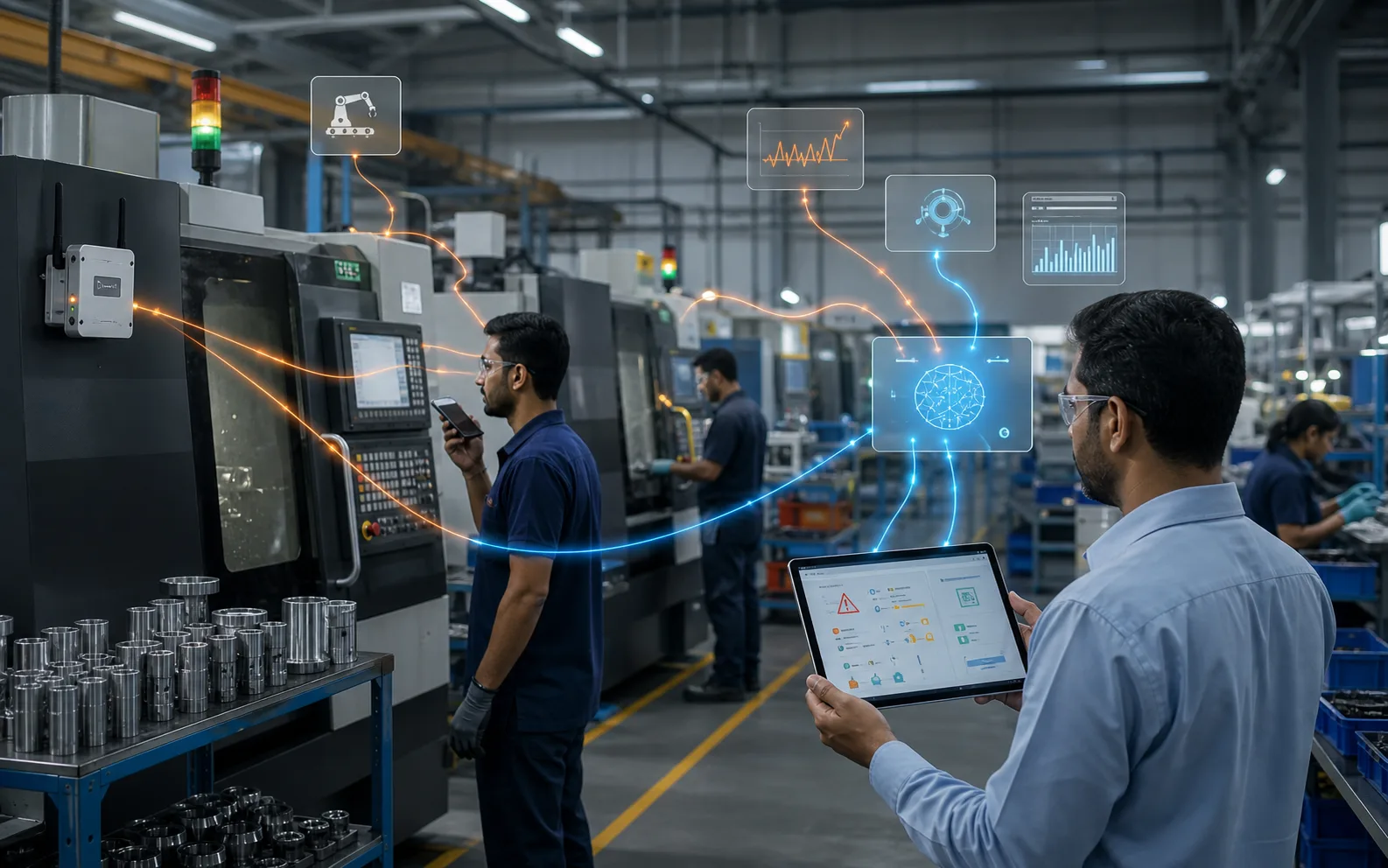
When you use an IoT platform, factory data usually moves through a chain: machines and sensors collect signals, gateways transmit them, software processes them, dashboards display them, and business systems may use them for production, maintenance, quality, energy, and management decisions.
That sounds technical, but manufacturers should understand it clearly. Your data is not just numbers. It may describe production output, machine performance, energy use, quality results, maintenance conditions, dispatch risk, and operational habits.
Good IoT data management should answer four questions: what is collected, where it goes, who can access it, and how it is protected.
Step 1: Data Is Collected From the Factory Floor
Data may come from:
- machines
- PLCs
- sensors
- energy meters
- gateways
- operator screens
- barcode or QR scans
- quality inspection stations
- maintenance inputs
- ERP or production systems
The type of data depends on the use case. A downtime project may collect machine status and reason codes. An energy project may collect consumption and output. A quality project may collect process conditions and inspection results.
The important principle is data minimization: collect what supports the decision, not everything possible.
Step 2: Data Is Transmitted Through a Network
After collection, data must move from the factory floor to the platform. This may happen through wired networks, Wi-Fi, industrial gateways, local servers, cellular networks, cloud connections, or hybrid architectures.
A good setup should handle factory realities such as network interruption, electrical noise, device disconnects, and local processing needs.
Manufacturers should ask:
- what happens if the internet goes down?
- is data stored locally and synced later?
- how is data encrypted in transit?
- which devices can send data?
- how are gateways secured?
Step 3: Data Is Processed Into Useful Information
Raw data is not always directly useful. A sensor signal may need to become machine status. A current reading may need to become running or idle time. A stoppage must be linked with a reason. Energy readings may need to be converted into energy per unit.
Processing may include:
- filtering noisy signals
- calculating downtime
- mapping machine states
- generating alerts
- combining sensor data with production orders
- calculating trends
- preparing reports
This is where an IoT platform turns raw readings into operating visibility.
Step 4: Data Is Stored
Data may be stored locally, in the cloud, or in a hybrid model. Storage decisions depend on system design, compliance needs, security requirements, reporting history, and performance needs.
Manufacturers should understand:
- where the data is stored
- who owns the data
- how long it is retained
- how backups work
- how deleted users are handled
- how exports are managed
- whether data can be retrieved if the vendor changes
These questions are business questions, not only IT questions.
Step 5: Data Is Displayed to Users
Dashboards, reports, and alerts present the data to different roles.
Operators may see current machine status. Supervisors may see target vs actual output. Maintenance may see abnormal asset behavior. Quality may see batch traceability. Owners may see exceptions, cost, and dispatch risk.
Access should be role-based. Not every user needs every report or setting.
Step 6: Data May Integrate With ERP or Other Systems
IoT data becomes more valuable when it connects with business systems.
Examples include:
- production orders
- inventory movement
- maintenance tickets
- quality records
- purchase planning
- sales commitments
- finance and costing
- dispatch tracking
Integration helps avoid duplicate work and connects factory reality with business decisions.
Security and Privacy Questions to Ask
Manufacturers should ask every IoT provider practical questions:
- who owns the data?
- where is it stored?
- how is it encrypted?
- who can access it?
- how is vendor access controlled?
- are logs available?
- how are devices authenticated?
- how are backups handled?
- what happens if the service is discontinued?
- can data be exported?
NIST’s Cybersecurity Framework and CISA’s cybersecurity performance goals are useful references for thinking about governance, protection, detection, response, and recovery in connected environments.
Official references: NIST Cybersecurity Framework and CISA Cybersecurity Performance Goals.
Where AICAN Optiwise Fits
AICAN Optiwise helps manufacturers connect operational data with production, inventory, purchase, sales, finance, and reporting workflows. Data should not sit unused in separate systems. It should help teams make clearer decisions.
Optiwise is designed around connected manufacturing control. You can explore AICAN and learn more on About AICAN.
FAQ
Who owns the IoT data?
This depends on the provider agreement. Manufacturers should clarify ownership, access, export rights, retention, and deletion before implementation.
Is factory data stored in the cloud?
It may be cloud, local, or hybrid. The right model depends on connectivity, security, reporting, and operational needs.
Can IoT data be integrated with ERP?
Yes. Integration is often one of the most valuable uses because it connects machine reality with orders, inventory, quality, maintenance, and costing.
What happens if the internet goes down?
A well-designed system may buffer data locally and sync later, but this must be confirmed during architecture planning.
Should every employee see IoT data?
No. Access should be role-based. Users should see the data needed for their work.
Founder’s Note
At AICAN, we believe manufacturing data should be treated with respect. It tells the story of how the factory runs, where it struggles, and where it can improve.
That data should be useful, protected, and connected to real workflows. Otherwise it becomes another pile of information without operational value.
Final Thought
IoT data should not disappear into a black box. Manufacturers should know what is collected, where it goes, who can access it, and how it supports decisions.
The more clearly you understand the data journey, the more confidently you can use IoT.

Related Posts
Is AI Worth the Investment for My Factory?
Learn how to decide if AI is worth the investment for your factory by evaluating use cases, data readiness, costs, risks, ROI, and operational impact.
13 Jun 2026Read more →Manufacturing AI Mistakes to Avoid Before You Start
List manufacturing AI mistakes and controls for unclear use case, messy data, unsafe automation, no owner, weak security and unreviewed recommendations.
13 Jun 2026Read more →What's the Difference Between AI and Regular Automation?
Understand the difference between AI and regular automation in manufacturing, with practical examples for workflows, decisions, alerts, and predictive operations.
13 Jun 2026Read more →What Are the Risks of Using AI in Manufacturing?
Understand the risks of AI in manufacturing, including bad data, wrong recommendations, safety issues, security, job fear, over-automation, and implementation failure.
13 Jun 2026Read more →