
An ERPNext Alternative Built for Your Factory: Optiwise
Choose Optiwise as your manufacturing ERPNext alternative. Connect factory operations with AI actions, no-code modules and complete order workflows.
Bring your factory onto Optiwise: one connected system for sales, production, purchasing, inventory, subcontracting and quality. Extend it with no-code modules and AI agents that work on your business records. Manufacturing ERP, shop-floor execution, industrial IoT, actionable AI and no-code customization work together in Optiwise.
Looking for an ERPNext alternative for manufacturing? Optiwise combines the core factory workflow with tools to adapt it: related records, custom forms, SOPs, approvals and event-based automations.
Book an Optiwise demo · Explore Optiwise production
Optiwise and ERPNext at a glance
| Your workflow | Optiwise | ERPNext |
|---|---|---|
| Manufacturing foundation | Model the real product: BOMs up to five levels, subassemblies, variants, scrap, byproducts and costs, with separate process routing, drawings and in-house or outsourced operations. | BOMs, work orders and production planning. |
| Shop-floor records | Run each operation with machine and worker allocation, cycle-time-aware planning, drawings and SOPs. Capture time, output and quality through operators, supervisors or IoT, then manage rework and finished-goods receipt. | Job cards and production-step tracking. |
| Management reporting | Give each role an action queue for approvals, shortages and open work. Track customer orders across production, purchasing and stores, and use live IoT dashboards to drill from plant performance into machine alarms. | Manufacturing performance and cost reports. |
Product references: ERPNext Manufacturing. Updated 10 September 2026.
ERP + MES + industrial IoT + AI. One Optiwise platform.
AI that moves factory work forward
Ask about delayed orders, retrieve vendor history or create a stock entry in natural language. Optiwise routes the request to a specialized production, purchase, inventory, sales or task agent and executes within your role permissions. Your team can work in its own language.
Industrial IoT, from the device to the decision
Connect OptiEdge gateways, power monitors, machine-status signals and vibration sensors. Track OEE, runtime, downtime and energy. Our machine intelligence highlights abnormal signals, while the command center takes you from a multi-plant view to the machine that needs attention.
Your process, built into your ERP
Create relational modules, parent/child records, conditional forms, formulas and rollups without code. Add approvals, event-driven automations, webhooks and versioned SOPs so the system follows the way your factory operates.
Explore Optiwise AI agents · Explore industrial IoT · Explore no-code customization
Why choose Optiwise for your factory
Choose one connected operating workflow
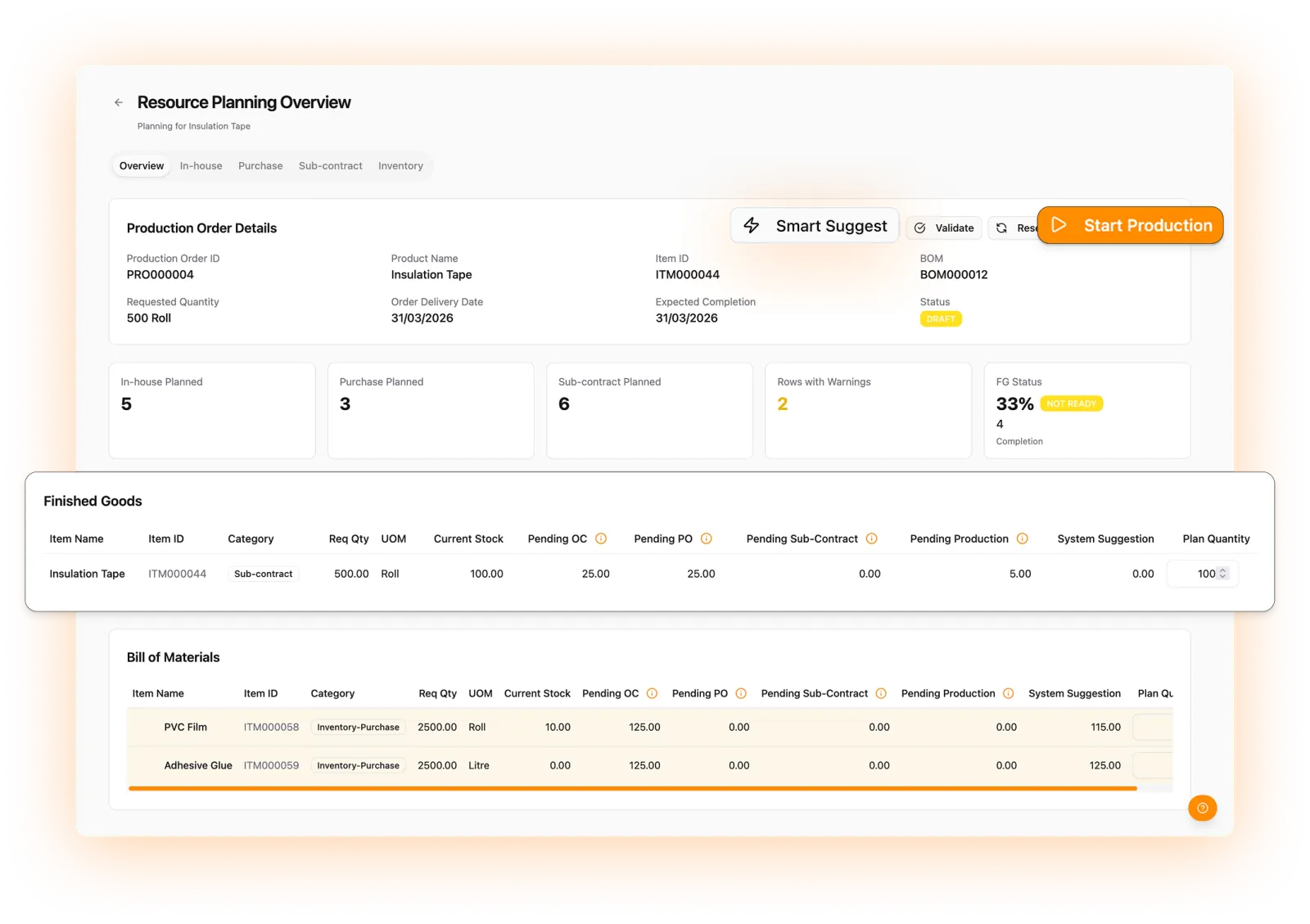
Start with inquiries and quotations, confirm the sales order and create the production work. Plan material, buy shortages, send outside operations to subcontractors, inspect receipts and receive finished goods. Optiwise carries the order context across the departments that deliver it.
Make your factory process part of Optiwise
Build a relational module for a process that needs its own records. Add formulas, rollups, parent/child relationships and the right table, board, calendar or dashboard view. Configure forms, approvals and event-based actions, and link SOPs to the machines or operations that use them.
Let the team ask and act in natural language
Our specialized AI agents work with sales, purchasing, inventory, production and task records. Ask for order status or vendor history, then initiate actions within the user’s role permissions. Multilingual interaction helps teams work with the system in familiar language.
See your factory workflow in Optiwise
Bring your product, process and team requirements. We’ll walk you through the connected order-to-production workflow and map it to your factory.
Book your Optiwise demo · Meet your AI agents · Explore no-code workflows
Questions about ERPNext and Optiwise
Is Optiwise an ERPNext alternative for manufacturing?
Yes. Optiwise covers connected factory operations including sales, BOMs, work orders, purchasing, inventory, subcontracting and quality, with AI agents and no-code customization.
Can we customize Optiwise for our processes?
Yes. Create related modules, forms, views, formulas and automations, and configure role access and SOP steps around your operating requirements.
Does Optiwise include industrial IoT and AI?
Yes. Optiwise combines manufacturing ERP and shop-floor execution with industrial IoT and specialized AI agents. Connect machines through gateways and sensors, track OEE, downtime and energy, and use natural-language queries and actions across production, purchasing, inventory, sales and tasks. No-code modules and automations let you extend the workflow.
Related Posts

A Manufacturing Alternative to SAP: Optiwise
Run your factory in Optiwise, a manufacturing alternative to SAP Business One with connected operations, AI agents and no-code workflows.
14 Jun 2026Read more →How Do I Know If My Manufacturing Business Really Needs an ERP?
A practical guide for manufacturers to identify when spreadsheets, manual follow-ups, and disconnected systems are no longer enough — and when ERP becomes an operational necessity.
14 Jun 2026Read more →Production Management System Optimized | Optiwise
Learn best practices for optimizing a production management system across planning, scheduling, material readiness, quality, and reporting.
12 Jun 2026Read more →
What Is the Best ERP for Pharmaceutical Manufacturing?
Learn how to choose the best ERP for pharmaceutical manufacturing, with guidance on batch control, quality workflows, traceability, inventory, documentation, and GMP discipline.
10 Jun 2026Read more →