
Optiwise vs Oracle Fusion Cloud for Manufacturing SMEs
Compare Optiwise with Oracle Fusion Cloud Manufacturing. See production, scheduling, subcontracting and quality workflows for your factory.
Bring manufacturing execution, materials and business decisions into Optiwise. Our connected system gives your factory production planning, purchasing, inventory, quality, AI actions and no-code workflows. Manufacturing ERP, shop-floor execution, industrial IoT, actionable AI and no-code customization work together in Optiwise.
Oracle Fusion Cloud Manufacturing supports global manufacturing operations across production modes. Here, we compare that product with the concrete factory workflows in Optiwise; NetSuite is covered separately.
Book an Optiwise demo · Explore Optiwise production
Optiwise and Oracle Fusion Cloud Manufacturing at a glance
| Your workflow | Optiwise | Oracle Fusion Cloud Manufacturing |
|---|---|---|
| Production execution | Run each operation with machine and worker allocation, cycle-time-aware planning, drawings and SOPs. Capture time, output and quality through operators, supervisors or IoT, then manage rework and finished-goods receipt. | Mixed-mode production and work-order execution. |
| Scheduling | Allocate work using machine-process compatibility, worker skills, shifts, leave and cycle times. Follow bottlenecks and resource availability alongside production jobs, rather than maintaining a separate capacity plan. | Schedules using material, capacity and calendar constraints. |
| Quality | Control acceptance at receipt and during production. Configure inspection parameters and forms, route pass/fail/rework decisions and release accepted quantities into stock with the order and inspection history attached. | Closed-loop quality and product genealogy. |
| Contract work | Control outsourced work end to end: service orders, BOM-derived material challans, vendor-held stock, partial returns, inspections, rejected goods and processing costs. Keep outside work connected to the production requirement. | Contract manufacturing and supplier collaboration. |
| Connected operations | Connect machines with OptiEdge gateways, power monitoring, status signals and vibration sensing. Track OEE, runtime, downtime and energy, with AI anomaly alerts and a command center across plants. | Smart Operations with operator and supervisor workbenches. |
Product references: Oracle Fusion Cloud Manufacturing. Updated 10 September 2026.
ERP + MES + industrial IoT + AI. One Optiwise platform.
AI that moves factory work forward
Ask about delayed orders, retrieve vendor history or create a stock entry in natural language. Optiwise routes the request to a specialized production, purchase, inventory, sales or task agent and executes within your role permissions. Your team can work in its own language.
Industrial IoT, from the device to the decision
Connect OptiEdge gateways, power monitors, machine-status signals and vibration sensors. Track OEE, runtime, downtime and energy. Our machine intelligence highlights abnormal signals, while the command center takes you from a multi-plant view to the machine that needs attention.
Your process, built into your ERP
Create relational modules, parent/child records, conditional forms, formulas and rollups without code. Add approvals, event-driven automations, webhooks and versioned SOPs so the system follows the way your factory operates.
Explore Optiwise AI agents · Explore industrial IoT · Explore no-code customization
Why choose Optiwise for your factory
Keep the customer order at the center
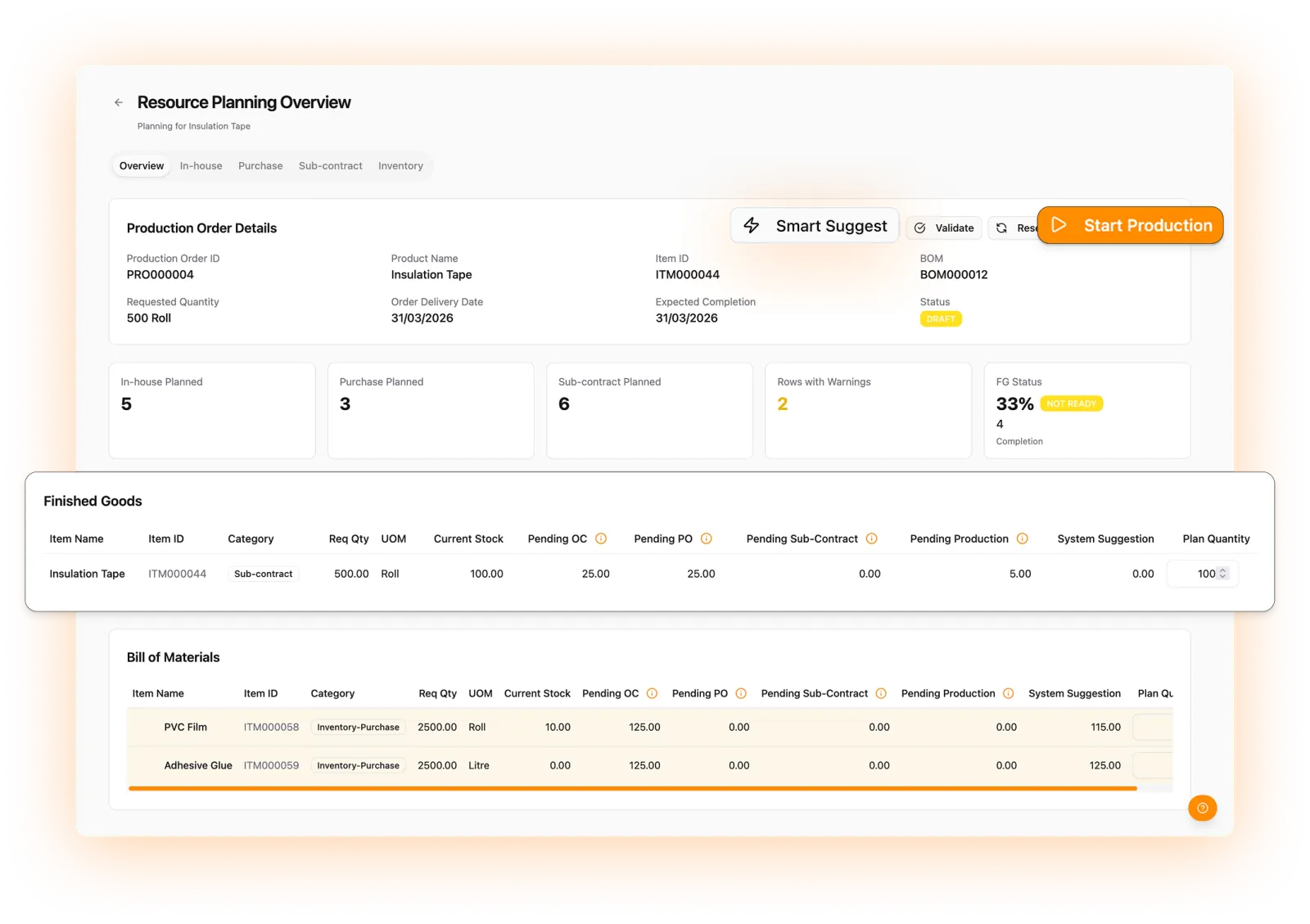
Create work orders from confirmed sales and plan the in-house, purchase and subcontract quantities. Smart Suggest checks stock, open purchases and existing production against BOM demand. Teams can move from the requirement to the action without rebuilding the order in a separate planning file.
Run the factory with its actual process detail
Use nested BOMs, process routing, drawings and SOPs. Allocate machines and workers, capture time and output, and inspect the result. Track material outside the factory through service orders and challans, with partial returns and quality outcomes attached.
Make changes to your workflow without starting over
Build custom relational modules, add forms and choose the views each team needs. Configure event-based automations and role access. Our AI agents help users ask questions and carry out permitted actions across production, purchasing, sales and inventory.
See your factory workflow in Optiwise
Bring your product, process and team requirements. We’ll walk you through the connected order-to-production workflow and map it to your factory.
Book your Optiwise demo · Meet your AI agents · Explore no-code workflows
Questions about Oracle Fusion Cloud Manufacturing and Optiwise
Is this comparison about Oracle NetSuite?
No. This page compares Optiwise with Oracle Fusion Cloud Manufacturing. NetSuite is a separate Oracle product and has its own comparison on our website.
What makes Optiwise relevant to manufacturing SMEs?
Optiwise connects order-to-production work, materials, purchasing, subcontracting and quality with AI agents and no-code tools that let teams configure their own operating workflows.
Does Optiwise include industrial IoT and AI?
Yes. Optiwise combines manufacturing ERP and shop-floor execution with industrial IoT and specialized AI agents. Connect machines through gateways and sensors, track OEE, downtime and energy, and use natural-language queries and actions across production, purchasing, inventory, sales and tasks. No-code modules and automations let you extend the workflow.
Related Posts

Kanban System | Optiwise
Learn how a Kanban system works in manufacturing, where it helps, where it fails, and how Optiwise connects Kanban signals with inventory, purchase, and production planning.
12 Jun 2026Read more →Erp In Operations Management | Optiwise
Learn how ERP improves operations management by connecting planning, inventory, purchase, production, quality, dispatch, finance, and reporting.
12 Jun 2026Read more →ERP for FMCG Companies in India
A practical guide to ERP for FMCG companies in India, covering distributor orders, batch tracking, expiry, inventory, production, schemes, costing, and reporting.
11 Jun 2026Read more →
Optiwise, Odoo, Acumatica and Business Central for Manufacturing
Compare manufacturing workflows in Optiwise, Odoo, Acumatica and Dynamics 365 Business Central. See what your factory can run in Optiwise.
11 Jun 2026Read more →