
AI Native ERP vs Traditional ERP
Compare AI native ERP and traditional ERP for manufacturing, including workflow intelligence, alerts, forecasts, production visibility, implementation, and decision support.
AI Native ERP vs Traditional ERP
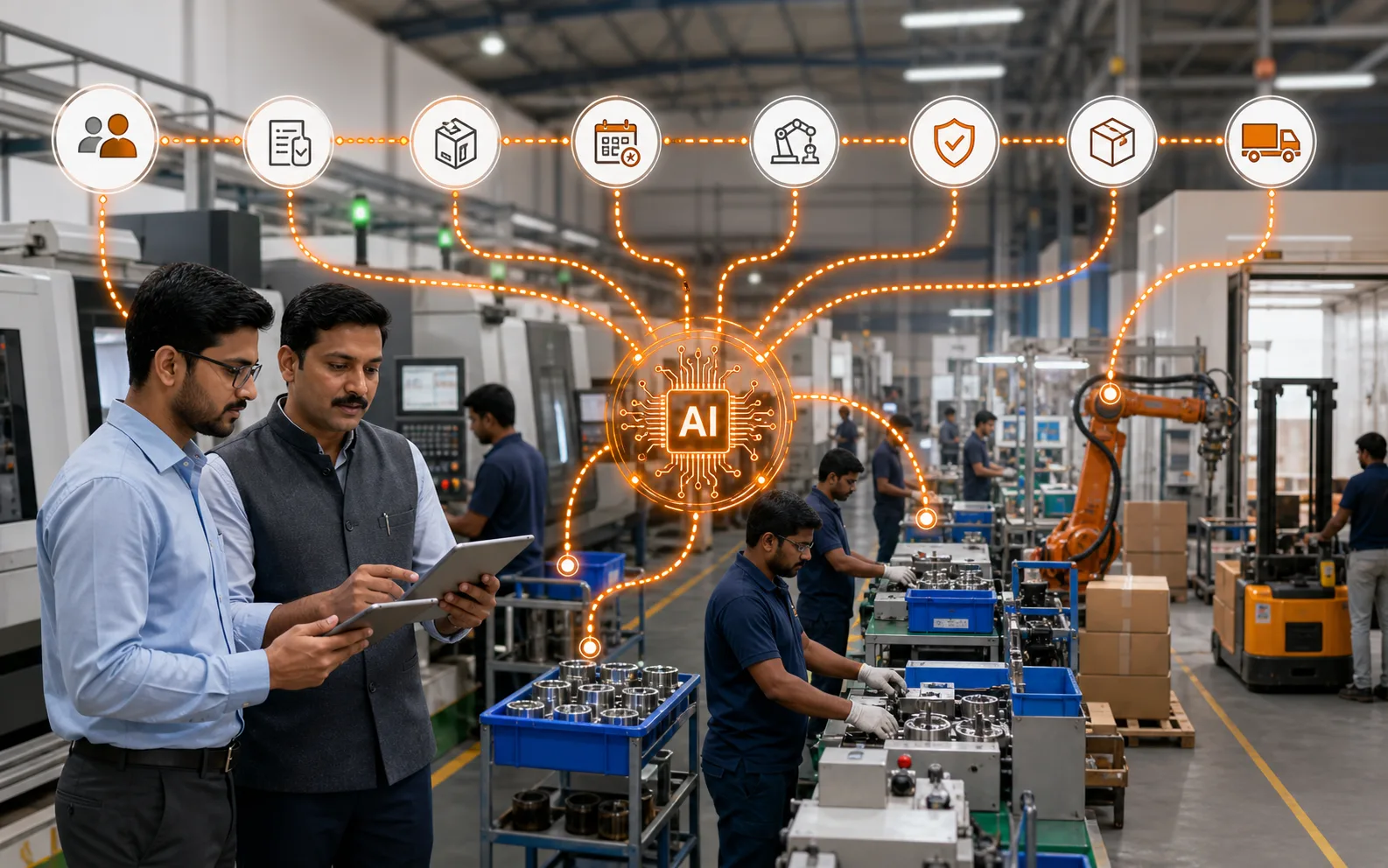
AI native ERP is designed to use data for intelligence from the beginning. Traditional ERP is usually designed first to record transactions and connect business functions. Both can be useful, but manufacturers increasingly need systems that help them act earlier, not only record what happened.
AI native ERP should help summarize exceptions, detect risk, forecast needs, recommend actions, and support decisions across production, inventory, purchase, sales, finance, and reporting.
The difference is not just technology. It is how the system helps people work.
Traditional ERP: System of Record
Traditional ERP is valuable because it creates structure. It records purchase orders, stock movement, production entries, invoices, payments, and reports.
This foundation is necessary for control.
But traditional ERP often depends on users to manually search for insights.
AI Native ERP: System of Action
AI native ERP should help users know what needs attention. It can flag delayed production, inventory risks, purchase delays, machine downtime patterns, quality trends, and customer order issues.
This shifts ERP from passive record-keeping to active decision support.
Manufacturing Use Cases
AI native ERP can support production summaries, material shortage alerts, predictive maintenance signals, slow-moving stock analysis, quality trend detection, and management exception reports.
These use cases help manufacturers respond earlier.
Data Quality Still Matters
AI native does not mean data quality becomes irrelevant. In fact, it becomes more important.
AI needs reliable item masters, BOMs, inventory entries, production records, purchase data, and finance data.
Implementation Fit
Manufacturers should ask whether the ERP is easy to adopt, supports real workflows, and provides useful AI features without overwhelming users.
AI should simplify decisions, not create noise.
Where AICAN Optiwise Fits
AICAN Optiwise is built around connected, AI-ready manufacturing workflows across production, inventory, purchase, sales, finance, and reporting.
AICAN helps manufacturers move toward systems that support action, not only record-keeping. Learn more at About AICAN.
Founder’s Note
The future of ERP is not just more screens. It is better signals.
AI native ERP should help factory teams know what matters, why it matters, and what action is needed.
FAQ
What is AI native ERP?
AI native ERP is ERP designed with AI-driven alerts, summaries, forecasts, and decision support as a core capability.
Is AI native ERP better than traditional ERP?
It can be more useful when the business has reliable data and wants proactive decision support.
Does AI native ERP replace traditional ERP functions?
No. It still needs strong core ERP workflows.
What should manufacturers check?
Check production fit, data quality, usability, AI relevance, support, and measurable outcomes.
Final Thought
AI native ERP is valuable when it helps manufacturers move from recording work to improving work. The system should make action clearer.

Related Posts
Is AI Worth the Investment for My Factory?
Learn how to decide if AI is worth the investment for your factory by evaluating use cases, data readiness, costs, risks, ROI, and operational impact.
13 Jun 2026Read more →Manufacturing AI Mistakes to Avoid Before You Start
List manufacturing AI mistakes and controls for unclear use case, messy data, unsafe automation, no owner, weak security and unreviewed recommendations.
13 Jun 2026Read more →What's the Difference Between AI and Regular Automation?
Understand the difference between AI and regular automation in manufacturing, with practical examples for workflows, decisions, alerts, and predictive operations.
13 Jun 2026Read more →What Are the Risks of Using AI in Manufacturing?
Understand the risks of AI in manufacturing, including bad data, wrong recommendations, safety issues, security, job fear, over-automation, and implementation failure.
13 Jun 2026Read more →