
How Can AI Help Me Plan Production Better?
Learn how AI improves production planning through material visibility, capacity analysis, scheduling support, bottleneck detection, and delivery risk alerts.
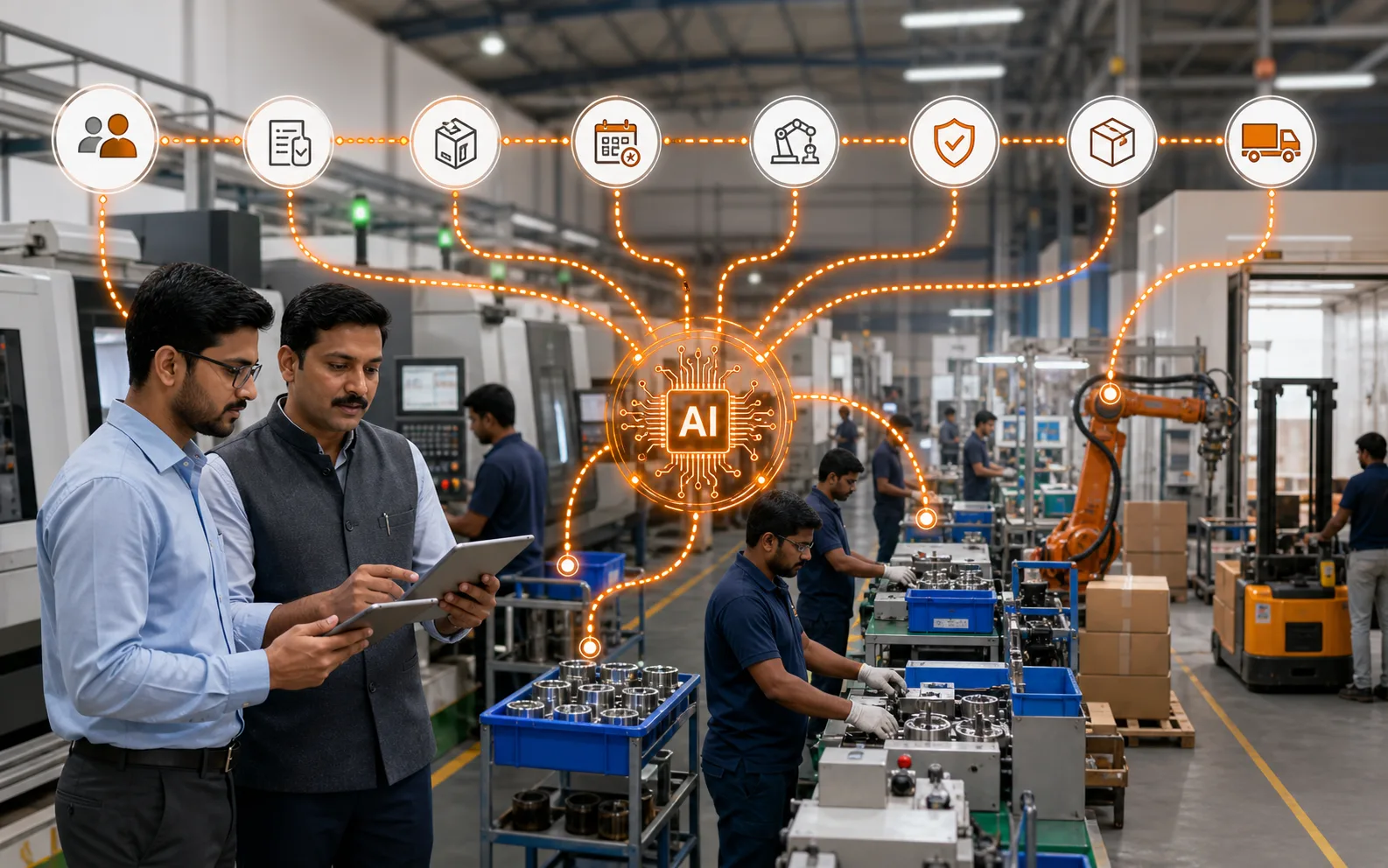
How Can AI Help Me Plan Production Better?
AI helps you plan production better by bringing more information into the planning decision at the right time. A planner must consider customer due dates, order priority, material availability, machine capacity, manpower, quality status, changeovers, and dispatch commitments. Manually balancing all of this is difficult, especially when conditions change daily.
AI for production planning can highlight risks, suggest sequencing, identify bottlenecks, and show which orders are likely to be delayed. It helps planners move from reactive scheduling to more controlled planning.
The best result is not a perfect plan. It is a more realistic plan.
Material-Linked Planning
Production plans often fail because material is not ready. AI can compare planned orders with current stock, open purchase orders, expected receipts, and consumption patterns.
This helps planners avoid scheduling work that cannot start and helps purchase teams understand what is truly urgent.
Capacity and Bottleneck Visibility
AI can analyse machine load, routing, cycle times, downtime history, and work-in-progress to identify capacity risks. This helps planners see where bottlenecks may appear before they affect delivery.
Planning becomes stronger when constraints are visible.
Better Order Prioritization
Not every order should be treated the same. AI can help prioritize based on due date, customer importance, material readiness, production complexity, and dispatch impact.
This reduces the risk of working on the wrong job first.
Faster Rescheduling
Plans change. Material gets delayed, machines stop, urgent orders arrive, and quality holds appear. AI can help planners understand the impact of changes and suggest practical alternatives.
This reduces panic planning.
Better Communication
When planning data is connected, production, purchase, sales, quality, and dispatch teams can work from the same view. This reduces conflicting updates and improves coordination.
Where AICAN Optiwise Fits
AICAN Optiwise supports AI for production planning by connecting production, inventory, purchase, sales, finance, reporting, IoT readiness, and AI workflows. Planners can see order demand, material readiness, production progress, and dispatch commitments in a connected system.
Learn more at AICAN Optiwise and About AICAN.
Founder’s Note
AICAN’s founder-led belief is that production planning should be based on factory reality, not guesswork. AI should help planners see constraints earlier and make commitments with more confidence.
Better planning starts with connected information.
FAQ
What does AI improve in production planning?
AI improves material visibility, capacity analysis, bottleneck detection, order prioritization, rescheduling, and delivery risk identification.
Does AI replace planners?
No. It supports planners with better information and recommendations while humans make final trade-offs.
What data is needed?
Sales orders, production orders, BOMs, stock, purchase orders, routing, machine capacity, quality status, and dispatch dates.
Can AI help with urgent orders?
Yes. AI can show the impact of urgent orders on material, capacity, and existing commitments.
Final Thought
AI helps production planners by making constraints visible before they become delays. A better plan is one that the shopfloor can actually execute.
Next step: Visit AICAN Optiwise to explore AI-supported production planning for your factory.

Related Posts
Is AI Worth the Investment for My Factory?
Learn how to decide if AI is worth the investment for your factory by evaluating use cases, data readiness, costs, risks, ROI, and operational impact.
13 Jun 2026Read more →Manufacturing AI Mistakes to Avoid Before You Start
List manufacturing AI mistakes and controls for unclear use case, messy data, unsafe automation, no owner, weak security and unreviewed recommendations.
13 Jun 2026Read more →What's the Difference Between AI and Regular Automation?
Understand the difference between AI and regular automation in manufacturing, with practical examples for workflows, decisions, alerts, and predictive operations.
13 Jun 2026Read more →What Are the Risks of Using AI in Manufacturing?
Understand the risks of AI in manufacturing, including bad data, wrong recommendations, safety issues, security, job fear, over-automation, and implementation failure.
13 Jun 2026Read more →