
How Does AI Manufacturing Actually Work in Practice?
Learn how AI manufacturing works in practice, from data capture and ERP integration to AI analysis, alerts, human review, and workflow action.
How Does AI Manufacturing Actually Work in Practice?
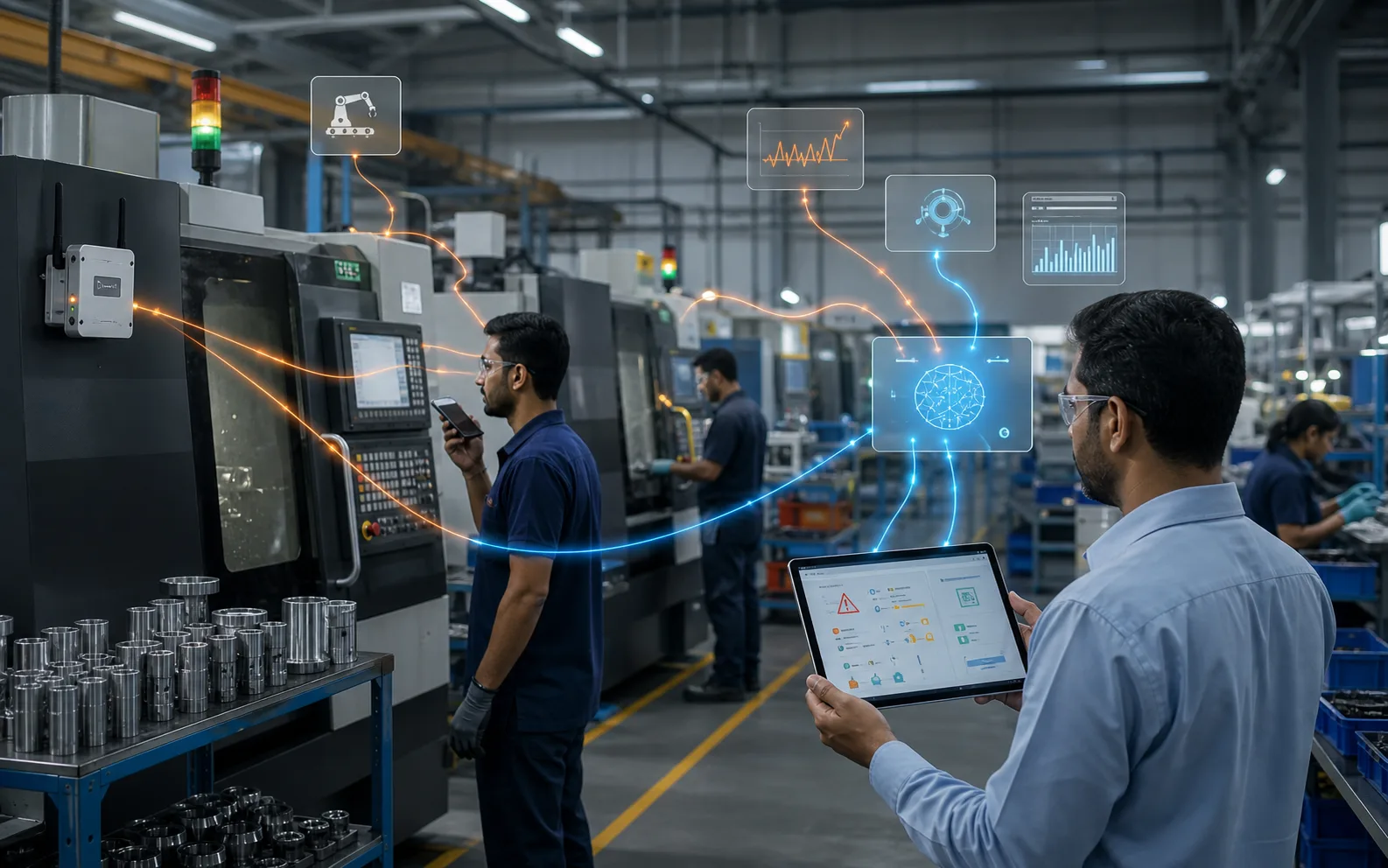
AI manufacturing works in practice by collecting factory data, analyzing it for patterns, presenting useful insights, and helping people take action. It is not magic, and it is not always robots. Most practical AI starts with data from ERP, machines, quality records, inventory, production, maintenance, and reports.
The process is simple to understand: capture data, analyze it, review the insight, act on it.
Step 1: Capture Data
AI needs input. Data may come from:
- ERP systems
- Production entries
- Inventory movement
- Purchase orders
- Quality inspections
- Maintenance logs
- Machine sensors
- Barcode scans
- Dispatch records
- Customer orders
- Finance reports
If the data is not captured, AI cannot analyze it.
Step 2: Clean and Structure Data
Factory data is often messy. Item names may be inconsistent. Downtime reasons may be vague. Rejection notes may be unstructured.
Before AI can work well, data must be reasonably structured.
This does not mean perfect data. It means usable data.
Step 3: Analyze Patterns
AI analyzes the data to identify patterns, risks, and exceptions.
Examples:
- Material likely to run short
- Quality defects increasing
- Machine downtime repeating
- Supplier delivery delays
- Production jobs likely to miss deadlines
- Slow-moving stock
- Abnormal consumption
Step 4: Present Insights
Insights may appear as dashboards, alerts, summaries, recommendations, or natural language answers.
A good AI system should not overwhelm users. It should show what needs attention.
Step 5: Human Review
People review AI output. A planner checks schedule recommendations. A quality engineer reviews defect analysis. A maintenance head verifies machine alerts.
Human review keeps the system responsible.
Step 6: Workflow Action
The insight must lead to action:
- Raise a purchase order
- Inspect a machine
- Adjust a schedule
- Hold dispatch
- Update an SOP
- Investigate a defect
- Review a supplier
- Correct inventory
AI creates value only when insights become action.
Step 7: Feedback and Improvement
Teams should record whether the AI insight was useful. Over time, this improves rules, workflows, and trust.
Practical Example
Suppose production is delayed. AI reviews material readiness, WIP, machine downtime, and quality holds. It finds that one raw material is delayed from a vendor. It alerts planning and purchase. The team follows up with the vendor and adjusts the schedule.
That is AI manufacturing in practice: connected data, useful insight, human action.
Where AICAN Optiwise Fits
AICAN Optiwise is built around this practical workflow. It connects ERP, workflows, reports, IoT readiness, and AI agents across sales, purchase, inventory, production, shopfloor, quality, dispatch, and finance visibility.
This gives AI the operational context needed to support real decisions, not just generic answers.
Learn more at AICAN Optiwise and About AICAN.
Founder’s Note
AICAN’s view is that AI in manufacturing should be understandable. If teams cannot see how AI connects to their work, they will not trust it.
Optiwise is built to make AI practical: data from real workflows, insights in context, and actions that teams can review and execute.
FAQ
Does AI manufacturing always involve robots?
No. Many AI use cases involve data, reports, planning, quality, inventory, and maintenance.
What data does AI manufacturing need?
ERP, production, inventory, quality, maintenance, purchase, dispatch, and machine data are useful.
Who reviews AI insights?
The relevant team: production, quality, maintenance, purchase, stores, or management.
Can AI act automatically?
It can, but manufacturers should begin with human-reviewed recommendations.
What makes AI practical?
Connected data, clear workflows, user training, and measurable outcomes.
Final Thought
AI manufacturing works when data turns into insight and insight turns into action. The practical value comes from connecting AI with real factory workflows.
Next step: Explore AICAN Optiwise if your factory wants AI that works inside everyday manufacturing operations.

Related Posts
Is AI Worth the Investment for My Factory?
Learn how to decide if AI is worth the investment for your factory by evaluating use cases, data readiness, costs, risks, ROI, and operational impact.
13 Jun 2026Read more →Manufacturing AI Mistakes to Avoid Before You Start
List manufacturing AI mistakes and controls for unclear use case, messy data, unsafe automation, no owner, weak security and unreviewed recommendations.
13 Jun 2026Read more →What's the Difference Between AI and Regular Automation?
Understand the difference between AI and regular automation in manufacturing, with practical examples for workflows, decisions, alerts, and predictive operations.
13 Jun 2026Read more →What Are the Risks of Using AI in Manufacturing?
Understand the risks of AI in manufacturing, including bad data, wrong recommendations, safety issues, security, job fear, over-automation, and implementation failure.
13 Jun 2026Read more →