
How Much Data Do I Need to Train AI Systems?
Learn how much data manufacturers need for AI systems, from simple AI tools to predictive maintenance, quality analytics, computer vision, and ERP-connected AI.
How Much Data Do I Need to Train AI Systems?
The amount of data you need for AI depends on the use case. Some AI tools do not need you to train a model at all. Others need months or years of reliable manufacturing data.
This is why manufacturers should not begin with the question, “How much data do we need?” They should begin with, “What problem are we trying to solve?”
Simple AI Use Cases Need Less Data
If you are using AI for SOPs, training guides, report summaries, customer emails, or documentation, you may not need large datasets.
You need useful inputs such as:
- Process notes
- Existing SOPs
- Report exports
- Work instructions
- Quality notes
- Training material
- Meeting notes
The AI is not being trained from scratch. It is helping organize and generate content from the information you provide.
ERP-Connected AI Needs Structured Data
If AI is answering questions about operations, it needs structured ERP data.
Useful data includes:
- Sales orders
- Purchase orders
- Inventory movement
- BOMs
- Production orders
- Quality records
- Dispatch records
- Vendor data
- Customer data
- Finance visibility
The amount of data matters, but structure and accuracy matter more.
Predictive Maintenance Needs Historical Patterns
Predictive maintenance requires enough data to understand normal behavior and failure patterns.
Useful data includes:
- Downtime history
- Maintenance records
- Machine runtime
- Alarm history
- Vibration readings
- Temperature readings
- Spare usage
- Failure events
If failures are rare, the system may need more time to learn. If downtime logs are vague, predictions will be weak.
Quality AI Needs Defect Data
Quality AI can work with inspection records, rejection reasons, complaint notes, batch data, and supplier history.
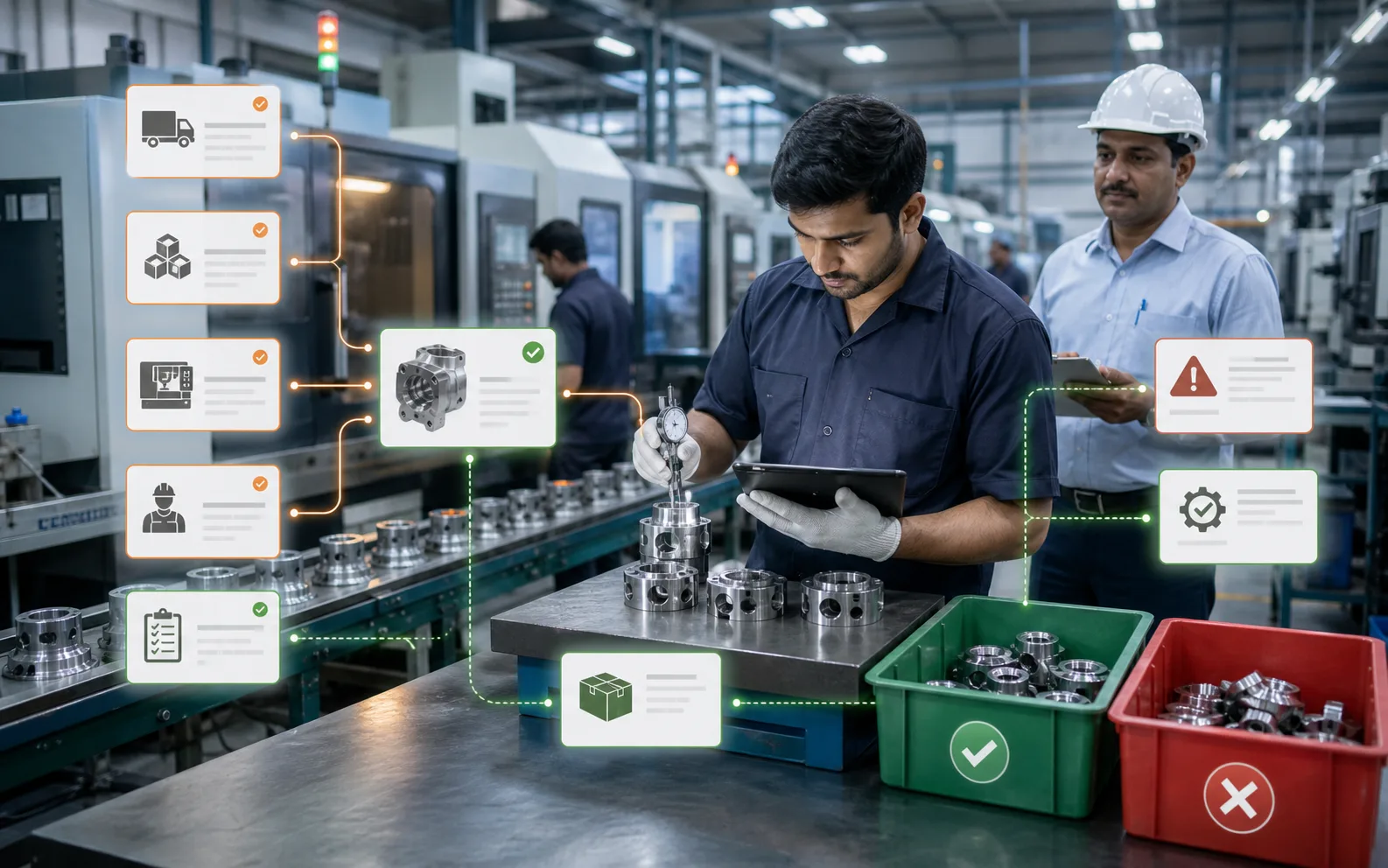
For computer vision, data needs are higher. You need enough images of good and defective products under consistent conditions.
You also need labeled examples: what is acceptable, what is defective, and what type of defect is present.
More Data Is Not Always Better
Bad data at large volume is still bad data. AI needs relevant, clean, consistent data.
A smaller but reliable dataset can be more useful than years of messy records.
Important data qualities:
- Accurate
- Timely
- Consistent
- Labeled where needed
- Connected to the right workflow
- Reviewed by domain experts
Can Small Manufacturers Use AI with Limited Data?
Yes. Small manufacturers can start with use cases that do not require large datasets:
- SOPs
- Report summaries
- Inventory ageing
- Quality note grouping
- Purchase delay summaries
- Production delay review
As digital workflows improve, more advanced AI becomes possible.
Do You Need to Train Your Own AI Model?
Not always. Many manufacturers can use existing AI capabilities inside software platforms. Custom model training is needed only for specific advanced cases, such as computer vision, predictive maintenance models, or unique process optimization.
Most factories should not start by training a model. They should start by organizing data and choosing a practical use case.
Where AICAN Optiwise Fits
AICAN Optiwise helps manufacturers create the structured data foundation AI needs. It connects ERP, workflows, reports, IoT readiness, and AI agents across sales, purchase, inventory, production, shopfloor, quality, dispatch, and finance visibility.
For MSME manufacturers, this is critical. Before training advanced AI systems, factories need connected operational data.
Learn more at AICAN Optiwise and About AICAN.
Founder’s Note
AICAN’s belief is that AI readiness begins with operational discipline. Manufacturers do not need to wait until they have perfect data, but they do need to start capturing the right data consistently.
Optiwise is built to help factories create that foundation, so AI can become more useful over time.
FAQ
Do I need thousands of records to use AI?
Not for simple use cases. Documentation, summaries, and basic analysis can start with limited data.
When do I need large datasets?
Predictive maintenance, computer vision, forecasting, and custom AI models usually need more data.
Is clean data more important than large data?
Yes. Clean, relevant data is more useful than large amounts of messy data.
Can AI work with spreadsheets?
Yes, for basic analysis, but ERP-connected data is better for ongoing operational AI.
Should I train my own AI model first?
Usually no. Start with existing AI tools or AI-enabled platforms before custom model training.
Final Thought
The data needed for AI depends on the problem. Start with one use case, organize the relevant data, and build toward more advanced AI as your factory matures.
Next step: Explore AICAN Optiwise if you want to build the connected manufacturing data foundation AI needs.

Related Posts

Is AI Worth the Investment for My Factory?
Learn how to decide if AI is worth the investment for your factory by evaluating use cases, data readiness, costs, risks, ROI, and operational impact.
13 Jun 2026Read more →Manufacturing AI Mistakes to Avoid Before You Start
List manufacturing AI mistakes and controls for unclear use case, messy data, unsafe automation, no owner, weak security and unreviewed recommendations.
13 Jun 2026Read more →What's the Difference Between AI and Regular Automation?
Understand the difference between AI and regular automation in manufacturing, with practical examples for workflows, decisions, alerts, and predictive operations.
13 Jun 2026Read more →What Are the Risks of Using AI in Manufacturing?
Understand the risks of AI in manufacturing, including bad data, wrong recommendations, safety issues, security, job fear, over-automation, and implementation failure.
13 Jun 2026Read more →