
What Industries Are Using AI in Manufacturing?
Explore which manufacturing industries use AI, including automotive, electronics, food, pharma, chemicals, packaging, textiles, metal fabrication, and MSME manufacturing.
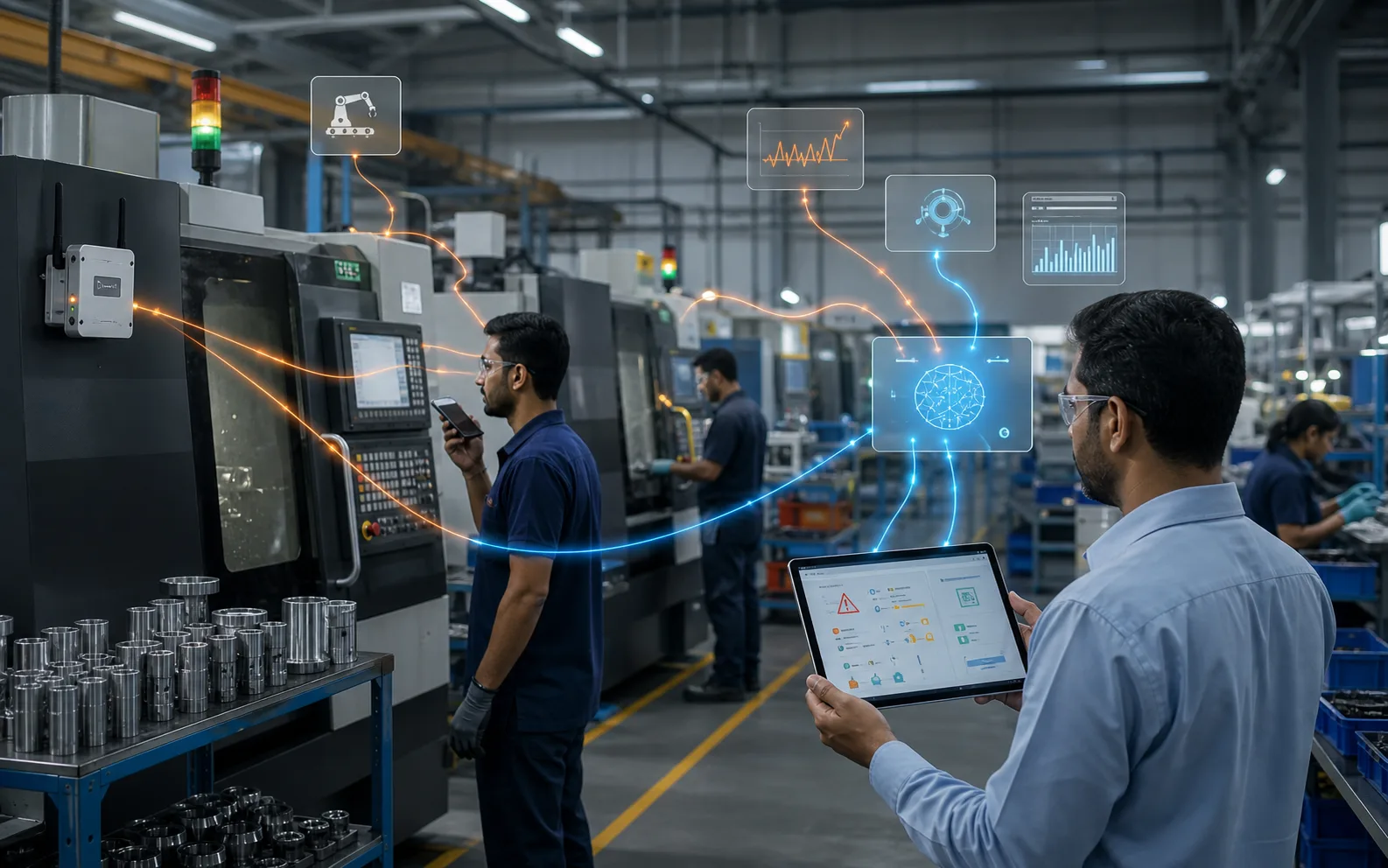
What Industries Are Using AI in Manufacturing?
Many manufacturing industries are using AI, but not always in the same way. An automotive plant may use AI for quality inspection and predictive maintenance. A food manufacturer may use AI for batch consistency and compliance documentation. A packaging manufacturer may use AI for planning, defects, and inventory.
The right AI use case depends on the industry’s process, risks, and data.
Automotive and Auto Components
Automotive and component manufacturers use AI for quality inspection, production planning, predictive maintenance, supplier analysis, and traceability.
Because quality standards are strict and production volumes are high, even small improvements can create large value.
Common AI use cases:
- Visual defect detection
- Machine downtime prediction
- Supplier quality analysis
- Production scheduling
- Traceability and compliance
Electronics Manufacturing
Electronics manufacturing often involves complex assemblies, high precision, and strict quality checks.
AI can help with:
- Defect detection
- Process parameter monitoring
- Test result analysis
- Component traceability
- Inventory planning
- Yield improvement
Because components can be small and high-volume, AI vision and analytics can be valuable.
Food and Beverage Manufacturing
Food manufacturers use AI for quality, shelf-life planning, batch consistency, compliance records, demand forecasting, and wastage reduction.
Useful AI applications include:
- Batch record review
- Quality parameter analysis
- Inventory and expiry tracking
- Demand planning
- Cleaning schedule support
- Compliance documentation
Pharmaceutical and Healthcare Manufacturing
Pharma and healthcare manufacturing require strong compliance, traceability, and documentation.
AI can help with:
- Quality documentation
- Batch record review
- Deviation summaries
- Predictive maintenance
- Compliance preparation
- Production planning
Human validation remains essential because regulatory requirements are strict.
Chemicals and Process Manufacturing
Chemical manufacturers use AI to monitor process parameters, improve safety, reduce wastage, and predict equipment issues.
AI can support:
- Temperature and pressure monitoring
- Batch consistency
- Yield analysis
- Safety risk detection
- Maintenance prediction
- Inventory planning
Packaging Manufacturing
Packaging manufacturers often deal with high volumes, tight delivery timelines, material variation, and quality checks.
AI can help with:
- Production scheduling
- Material consumption analysis
- Defect trends
- Machine downtime
- Inventory control
- Dispatch planning
Textile and Apparel Manufacturing
Textile and apparel manufacturers can use AI for demand planning, quality inspection, production tracking, fabric defect detection, inventory management, and workflow planning.
AI can help reduce rework and improve delivery visibility.
Metal Fabrication and Engineering Units
Fabrication and engineering manufacturers often handle custom jobs, drawings, material planning, machine scheduling, and job costing.
AI can support:
- Quotation analysis
- Material planning
- Job tracking
- Production delay summaries
- Quality issue analysis
- Machine utilization review
MSME Manufacturing
MSME manufacturers can benefit from AI even without large budgets. Their strongest starting points are often:
- SOP creation
- Report summaries
- Inventory ageing
- Quality trend analysis
- Purchase follow-up
- Production delay review
- Owner dashboards
AI does not need to start with robotics. It can start with visibility.
What These Industries Have in Common
Across industries, AI works best when it solves a specific operational pain:
- Downtime
- Defects
- Inventory risk
- Compliance burden
- Planning delay
- Supplier risk
- Manual reporting
- Training gaps
Different industries use different data, but the principle is the same.
Where AICAN Optiwise Fits
AICAN Optiwise is built for Indian manufacturers, especially MSMEs that need connected ERP, workflows, reports, IoT readiness, and AI agents. It supports the operational backbone that many industries need: sales, purchase, inventory, production, shopfloor, quality, dispatch, and finance visibility.
Because different industries have different workflows, AI needs a manufacturing-first operating layer. Optiwise is designed around that need.
Learn more at AICAN Optiwise and About AICAN.
Founder’s Note
AICAN’s view is that AI should not be limited to large factories or one industry. Indian MSME manufacturers across sectors need practical systems that understand how factories run.
Optiwise is built to give manufacturers a connected foundation so AI can support real workflows, whether the factory makes components, packaging, chemicals, food products, textiles, or engineered goods.
FAQ
Which manufacturing industry uses AI the most?
Automotive, electronics, pharma, and large process industries have strong AI adoption, but MSMEs are increasingly adopting practical AI too.
Can small industry units use AI?
Yes. They can start with reporting, inventory, quality, documentation, and planning support.
Is AI useful in process manufacturing?
Yes. AI can help monitor parameters, improve batch consistency, and reduce downtime.
Is AI useful in custom manufacturing?
Yes. It can help with planning, material readiness, job tracking, and costing visibility.
Do all industries need the same AI tools?
No. AI tools should match the industry’s workflow and data.
Final Thought
AI is not limited to one manufacturing industry. It becomes useful wherever factories need better visibility, fewer delays, stronger quality, and faster decisions.
Next step: Explore AICAN Optiwise if your manufacturing business needs AI built around real industry workflows.

Related Posts
Is AI Worth the Investment for My Factory?
Learn how to decide if AI is worth the investment for your factory by evaluating use cases, data readiness, costs, risks, ROI, and operational impact.
13 Jun 2026Read more →Manufacturing AI Mistakes to Avoid Before You Start
List manufacturing AI mistakes and controls for unclear use case, messy data, unsafe automation, no owner, weak security and unreviewed recommendations.
13 Jun 2026Read more →What's the Difference Between AI and Regular Automation?
Understand the difference between AI and regular automation in manufacturing, with practical examples for workflows, decisions, alerts, and predictive operations.
13 Jun 2026Read more →What Are the Risks of Using AI in Manufacturing?
Understand the risks of AI in manufacturing, including bad data, wrong recommendations, safety issues, security, job fear, over-automation, and implementation failure.
13 Jun 2026Read more →